

Israel's 26th Knesset is scheduled to be sworn in on November 10, and political tensions are mounting ahead of the new parliament's first session. Yashar! party chairman Gadi Eisenkot and leaders of the bloc seeking to replace Prime Minister Benjamin Netanyahu are coordinating efforts to remove Knesset Speaker Amir Ohana, a move intended to give them control of the parliamentary agenda even before a new government is formed.
The bloc hopes to use that control to advance legislation establishing a state commission of inquiry, repealing laws associated with the judicial overhaul and introducing mandatory national service. But Likud is working to prevent the opposition from securing the parliamentary majority needed to replace Ohana. Its efforts are proceeding along two main tracks: challenging the public legitimacy of parliamentary votes that rely on the support or abstention of Arab parties, and identifying lawmakers who could be persuaded to withhold their votes from the planned move.
Gallery
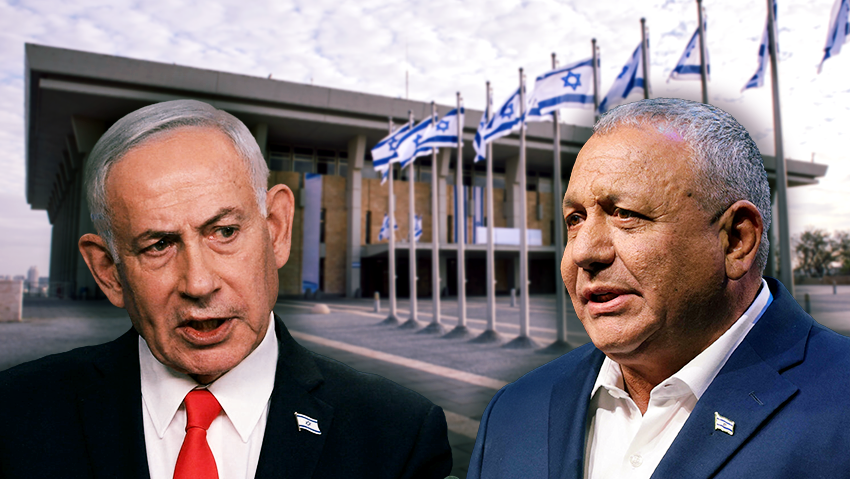
Benjamin Netanyahu and Gadi Eisenkot
(Photo: shutterstock, REUTERS/Ronen Zvulun, AP Photo/Ariel Schalit)
On Saturday evening, Eisenkot's Yashar! party accused Likud figures of contacting its members in an apparent effort to undermine the emerging parliamentary majority. "In recent hours, there has been outright panic within Likud, including phone calls to Yashar! members from ministers and incoming Knesset members, among them Almog Cohen, Yoav Kisch, Yaakov Bardugo and others," the party said. "The entire public can see how rattled you are by your defeat. We are committed to carrying out the voters' decision and establishing a Zionist government that will serve all Israelis."
Likud denied the allegations. "Gadi and Manelis are under pressure because we are disrupting their plans to cooperate with parties that support terrorism," the party said. Cohen and Bardugo also denied the claims. Yashar! responded with another sharply worded statement, accusing Netanyahu and his associates of repeatedly denying politically sensitive contacts and actions.
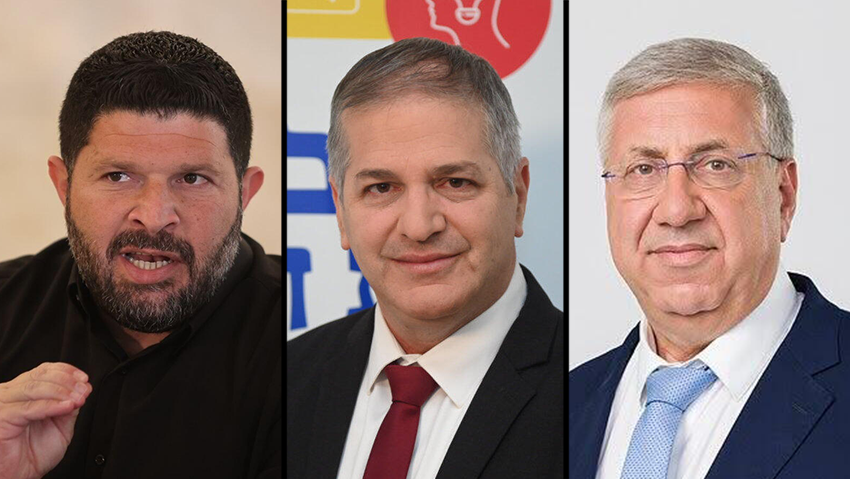
Almog Cohen, Yoav Kisch, Yaakov Bardugo
(Photo: Thomas Studio, Yair Sagi, Alex Kolomoisky)
"The man who sent Shlomi Fogel to negotiate with Hamas and denied it, who sent Miki Zohar to negotiate with Mansour Abbas and denied it, who insists on employing a Qatari agent in his office and denies it, who lost on October 27 and denies it, is sending emissaries to Yashar! and denying it," the party said. These allegations were made by Yashar! and have not been independently established.
"You know exactly how this works. By the way, since Yashar!'s last statement to the media, Orit Strock has also called. A reminder to drink cold water even on an autumn evening. Have a good week," the statement continued.
Strock responded on X, acknowledging that she had made a call but rejecting the suggestion that it had any political purpose. "I plead guilty! I called my good friend Tal Ohana this evening to congratulate her on entering the Knesset," Strock wrote. "Tal and I work together on rehabilitating the northern border communities. Just last Sunday, we were exchanging messages about the new group forming to strengthen Even Menachem. I love and appreciate Tal very much, and I wanted to share in her happiness."
"Tal didn't answer, but I'm sure she'll call me back. I'm certain nothing straight or crooked will destroy the strong friendship between us," she added, making a play on the name Yashar!, which means "straight" in Hebrew.
Eisenkot seeks ultra-Orthodox support for new government
Meanwhile, efforts to assemble the next government are continuing, with Eisenkot seeking to bring the ultra-Orthodox parties into a coalition that could secure a parliamentary majority. A source close to Eisenkot said in a private conversation that the Yashar! leader was focusing considerable effort on persuading both Shas and United Torah Judaism to join a government under his leadership.
"Eisenkot is going all out to convince the ultra-Orthodox parties, both Shas and United Torah Judaism, to enter the government," the source said. "It won't be with the Arabs. We believe it's possible." According to the source, the main obstacle is Yisrael Beytenu chairman Avigdor Liberman, who pledged before the election that he would not join a government with ultra-Orthodox parties.
The source said Liberman was facing intense pressure from potential coalition partners not to oppose the inclusion of those parties in the next government. A Yashar! official suggested Liberman might expect a far-reaching offer, such as an agreement to rotate the premiership, but said the objective remained to persuade him to support the arrangement.
If Eisenkot receives the first mandate to form a government, as political sources expect, a lawmaker from his camp would also chair the Knesset's Arrangements Committee, which oversees parliamentary procedures during the transition to a new government. That would give the bloc opposing Netanyahu an additional measure of influence over the Knesset while coalition negotiations continue.
However, some figures within the bloc believe Netanyahu should be given the first opportunity to form a government. They argue that allowing him to exhaust his mandate could reduce his ability to pressure lawmakers in the opposing camp immediately before a possible dissolution of the Knesset and another election.
Likud officials acknowledge that, at this stage, their efforts are not primarily aimed at dismantling rival parties or securing actual defections, largely because of the compressed political timetable. Instead, the party is focusing on persuading individual lawmakers not to support replacing the Knesset speaker if the move depends on votes from Arab parties.
The strategy reflects the narrow parliamentary arithmetic following the October 27 election, which left neither of the main political blocs with a straightforward path to forming a government. Even without persuading lawmakers to formally switch parties, Likud could potentially prevent the opposition from achieving its immediate objective if enough members decline to participate in the vote or refuse to support a candidate backed by Arab parties.
On Friday, Likud launched a coordinated social media campaign, with nearly all its ministers publishing posts, statements or messages challenging the legitimacy of parliamentary moves supported by Arab lawmakers. At the same time, the party continued drawing public attention to an investigation into suspicions that Qatar interfered in the election. The issue has become part of Likud's broader messaging, which portrays the Arab parties as having "stolen the election," an allegation advanced by the party rather than an established finding.
Likud is preparing to intensify the campaign with videos, strongly worded political messages, demonstrations and pressure on incoming lawmakers from the opposing bloc. Particular attention is being directed toward newly elected lawmakers with right-wing political backgrounds, whom Likud considers potential targets for its efforts to disrupt the opposition's parliamentary strategy.
Two and a half weeks before the election, Yedioth Ahronoth and ynet reported that Likud had established a special team tasked with weakening Eisenkot's Yashar! party by encouraging several of its lawmakers to leave. The team included Likud lawmakers and strategic advisers whose work focused specifically on potential movements between political blocs after the election.
The battle to replace Knesset Speaker Amir Ohana
Replacing the Knesset speaker is widely regarded as one of the most consequential steps the bloc opposing Netanyahu could take before forming a government. The office carries substantial authority over parliamentary proceedings and the legislative agenda. Once a speaker has been elected, removing that person is exceptionally difficult, requiring the support of 90 Knesset members. That makes the appointment particularly important in a fragmented parliament, where control of the legislative process could have lasting consequences even if coalition negotiations fail.
But while there is broad agreement among members of the bloc opposing Netanyahu about the need to replace Ohana, there is no consensus over who should succeed him. The disagreement is compounded by suspicions that one of the parties could eventually enter a unity government with Netanyahu, potentially leaving the others politically exposed.
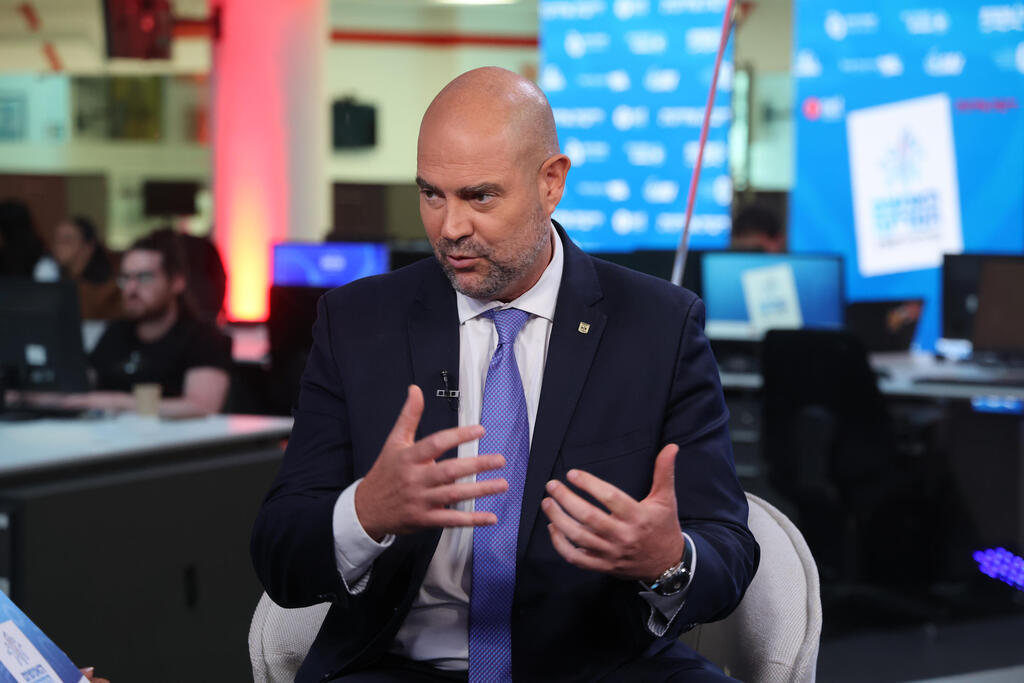
Knesset Speaker Amir Ohana
(Photo: Yariv Katz)
Eisenkot wants to nominate Orit Farkash-Hacohen, a lawmaker from his party, while Liberman favors Oded Forer, a close political ally from Yisrael Beytenu. Representatives of Naftali Bennett's Beyachad party, however, believe the position should be held by a more senior political figure rather than an ordinary lawmaker.
They have raised the possibility of appointing Yesh Atid chairman Yair Lapid. Some figures in Beyachad believe Lapid could be acceptable both to Liberman and to Ra'am chairman Mansour Abbas, whose party's support could be crucial in the vote.
Under Israeli law, the sitting Knesset speaker may remain in office during the transition period, and elections for a new speaker must take place no later than the formation of the next government. In practical terms, that process could take as long as two months.
However, a 2020 High Court of Justice ruling involving then-Knesset Speaker Yuli Edelstein established an important precedent. Edelstein had sought to prevent the Knesset from convening to vote on replacing him. The court ruled that when 61 Knesset members demand a vote on electing a new speaker, the vote must be held without delay, even before a new government is formed.
The bloc opposing Netanyahu therefore intends to coordinate a written demand supported by at least 61 lawmakers, which could be submitted immediately after the new Knesset is sworn in.
Arab party votes could determine the outcome
The strategy would require coordination with the Arab parties, including Ra'am and the Joint List. Joint List lawmaker Ahmad Tibi has already declared that he would support replacing Ohana with a candidate from the bloc opposing Netanyahu, with the stated objective of changing control of the Knesset.
Senior figures in Eisenkot's camp argue that relying on Arab party votes for a parliamentary procedure is fundamentally different from forming a government dependent on Arab support or abstention. They believe that, unlike a coalition agreement involving Arab parties, electing a new speaker with their backing would be considered legitimate and acceptable by nearly all members of the opposing bloc.
According to those officials, there is broad agreement over the need to proceed with the initiative, and most of the parties involved regard it as essential. The distinction is important because several opposition leaders have made commitments against forming a government with Arab parties, while others have expressed reservations about relying on their support.
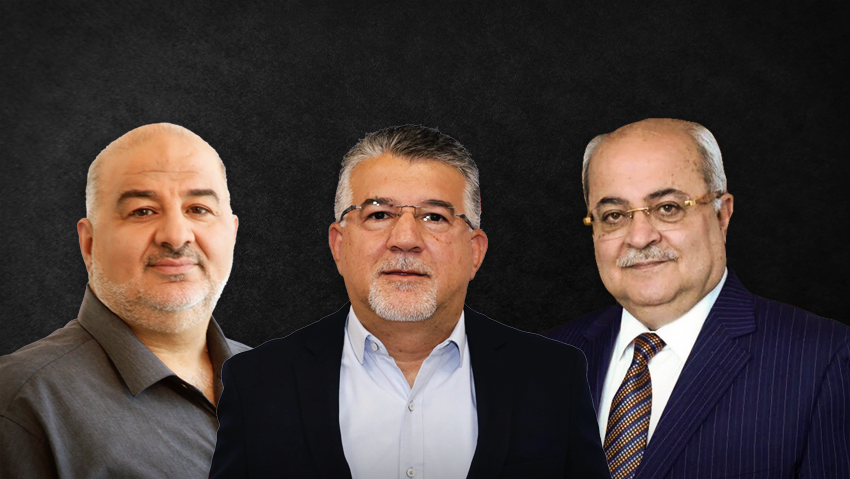
Mansour Abbas, Yousef Jabareen and Ahmad Tibi
(Photo: Ryan Preuss, Yariv Katz)
By treating the replacement of the speaker as a parliamentary matter rather than a coalition arrangement, Eisenkot's camp hopes to assemble a majority that would otherwise be politically difficult to achieve. Nevertheless, even if the effort succeeds, advancing the proposed legislation would present a separate challenge.
A majority willing to replace the speaker would not necessarily support controversial legislation, including the repeal of judicial overhaul laws or changes to military conscription requirements. Some lawmakers could regard those measures as too politically consequential to advance during a transitional period, particularly before a new government has secured the Knesset's confidence.
As a result, replacing Ohana would provide greater influence over the legislative agenda but would not, by itself, guarantee the votes needed to pass Eisenkot's proposed laws.
Eisenkot outlines plans for parliamentary majority
Earlier Saturday evening, following a meeting with opposition leader Yair Lapid, Eisenkot published a lengthy statement detailing what he intends to do with what he called the "clear parliamentary majority" opposed to Netanyahu and his allies.
"I will work to establish a state commission of inquiry, advance mandatory service for all, take immediate steps to increase and strengthen the number of people serving in the IDF, provide appropriate compensation and recognition for those who serve, repeal the laws of the judicial overhaul and more," Eisenkot wrote.
He emphasized that the Knesset, rather than the outgoing government, would determine the country's political direction. "Don't let anyone mislead you: In Israel, it is the Knesset that gives the government its vote of confidence, not the other way around," he said.
Eisenkot also reiterated four principles he had established before the election as conditions for participation in a future government. "I consistently presented four principles that would strengthen Israel and apply to any partnership: recognition of Israel as a Jewish, democratic, liberal and egalitarian state; commitment to the values of the Declaration of Independence; mandatory military, national or civilian service for all Israeli citizens; and recognition of Hamas as a terrorist organization whose military and governing capabilities in Gaza must be destroyed," he wrote.
Eisenkot said those principles would form the basis for his efforts to create a broad coalition. "On the basis of these principles, I intend to establish a broad Zionist government committed to the national interest," he wrote. "To achieve this, I will coordinate with my partners and work to expand our cooperation in order to fulfill the voters' wishes and immediately improve Israel's domestic and international standing."
He added that membership in the proposed coalition would not be restricted to the parties currently working with him. "Any Knesset member willing to sign on to these principles is a potential partner in establishing a new government that will be good for Israel. The door to the government we establish will be open to any elected official who accepts these principles and is prepared to rise to the occasion."
Eisenkot also made clear that he intended to do everything possible to prevent another election. "Clearly, the high voter turnout, together with the challenges facing us, demands an extraordinary effort to avoid another election and another prolonged political crisis by every possible means," he said.
"On October 27, the public had its say, and the decision on the composition of Israel's next government belongs solely to Israeli citizens, without outside interference or manipulation. That is how it should be," he added. "Now the responsibility rests with us, the elected representatives, to do everything possible to translate the will of the people into reality."