

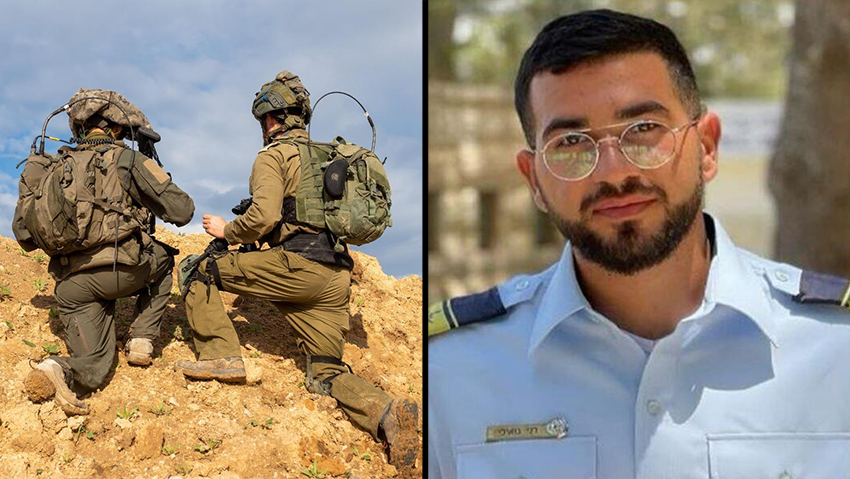
During the October 7 massacre, Border Police officer Sgt. First Class Ran Gvili went out to fight the terrorists who overran communities in Israel’s western Negev, despite suffering from a shoulder injury. He was killed in battles at Kibbutz Alumim and then abducted to Gaza. Now, after 842 agonizing days for his family and friends, and nearly four months after the agreement ending the war that led to the return of all other hostages held by Hamas and other Palestinian terror groups, Israel is voicing cautious optimism that the man known for his bravery as “Rani, defender of Alumim” will finally be brought home for burial in Israel.
Israeli officials said Sunday evening, alongside a meeting of the security cabinet on the question of reopening the Rafah crossing and shortly after the IDF revealed that searches for Gvili have been underway since the weekend at a cemetery in Gaza City, that there is “cautious optimism” the last fallen hostage can be located and the chapter finally closed.
According to the officials, the entire move has been coordinated with the United States, both at the political level and the military level, including through the U.S. coordination headquarters in Kiryat Gat. The Americans coordinated the search operation with the mediators and with Egypt, which updated Hamas in order to prevent misunderstandings. The officials added that the intelligence that led to the searches is reliable and supports the optimistic assessment that this time the effort will succeed — allowing Israel to finally complete what it has defined as the central goal of the war: the return of all 251 civilians and soldiers abducted in the October 7 attack.
The outcome of the searches also carries major political significance. Israel set Gvili’s return as a precondition for moving to Phase 2 of President Trump’s peace plan for Gaza — the phase meant to focus on rebuilding the Strip, on the condition that Hamas agrees to disarm, an issue surrounded by major question marks. Ahead of that phase, the Trump administration has been pressing to reopen the Rafah crossing in both directions, in part to bolster the standing of the new Palestinian technocratic government meant to replace Hamas’ rule. Israel has opposed reopening the crossing as long as Gvili has not been returned.
The emerging decision ministers are expected to approve at the cabinet meeting is to authorize Prime Minister Benjamin Netanyahu and Defense Minister Israel Katz to decide on reopening the Rafah crossing in the coming days, subject to developments in the searches. At the same time, Nikolay Mladenov, the “special envoy for Gaza,” tasked with mediating between the peace council established by Trump and the new Palestinian technocratic government, is expected to arrive in Israel on Monday for final coordination ahead of reopening the crossing. Israeli officials say preparations are underway for an immediate reopening if Gvili is located in the near future.
Israeli sources described the searches as a “rare operational opportunity,” estimating that the cemetery in Gaza City, between the Daraj Tuffah and Shijaiyah neighborhoods, is the area where Gvili is buried. At the same time, they stressed there is an understanding that the searches may not yield the hoped-for result. Hamas has claimed it exhausted its own capabilities, but the intelligence behind the operation did not come solely from the terror group. It was preceded by extensive intelligence-gathering over the past two years aimed at tracing Gvili’s fate.
Hamas passed on information suggesting Gvili was buried in a mass grave and claimed it believes he was buried alongside terrorists who were killed. With all other options exhausted, both sides concluded that the most reasonable possibility is that he is indeed buried there. Additional intelligence “closed in” on the area and the cemetery where IDF forces have been conducting searches since the weekend, in an operation dubbed “Brave Heart.” Hamas operatives also searched the area to some extent but apparently lacked sufficient tools. “Hamas wants to end this episode and understands that Gvili must be returned,” an Israeli official said Sunday.
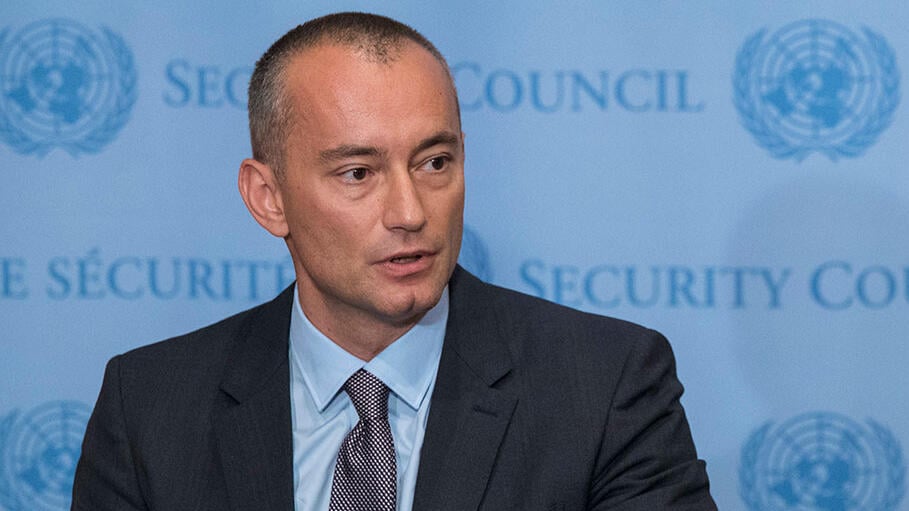
Mladenov to arrive in Israel tomorrow
(Photo: AP)
The searches, it should be noted, began after a significant delay. Information indicating Gvili might be buried in that cemetery reached Israel several months ago. Although the cemetery lies east of the Yellow Line, in an area under Israeli control, political leaders did not give the green light to search there and instead relied on Hamas to carry out the searches, preferring that the terror group conduct them. The IDF used that time to gather additional intelligence to justify sending soldiers to search the site, as was done over the weekend.
The operation is being led by the commander of the Alexandroni Brigade, with Battalion 75 and engineering forces, along with doctors, including a dentist, and military rabbinate personnel tasked with assisting in identification if and when remains are found, since dental identification is the fastest method. The dentist is operating with a portable X-ray unit in the field. Part of the security force is deployed slightly beyond the Yellow Line.
The cemetery contains hundreds of bodies. The IDF prepared a full mental health support plan for soldiers searching among the remains. In the first phase of the searches alone, 170 bodies are being examined, each individually.