

The latest round of talks in Geneva ended Tuesday, and despite optimistic signals from Tehran and comments by a U.S. official that Iran would return within two weeks with proposals, Washington continues to move forces into the Middle East. In Israel, officials are pessimistic about the chances of success.
U.S. Vice President JD Vance said Tuesday night that while discussions with Iran had progressed in certain respects, Tehran was still unwilling at this stage to accept some of President Donald Trump’s red lines. At the same time, war rhetoric has intensified in Iran, with threats from Supreme Leader Ayatollah Ali Khamenei and ongoing military drills.
Gallery
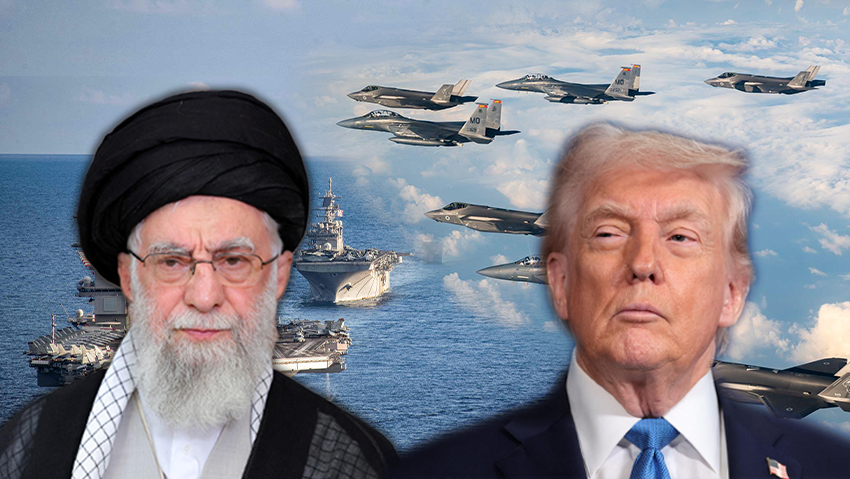
(Photo: REUTERS/Jonathan Ernst, Office of the Iranian Supreme Leader/WANA (West Asia News Agency)/Handout via REUTERS))
Footage from Iran’s military exercise in the Strait of Hormuz


Earlier, parts of the Strait of Hormuz were closed for several hours for what Iran described as “security measures.” Iranian officials said the closure was meant to safeguard maritime traffic as the country launched a military exercise aimed at preparing forces for threats. Shortly after the announcement, Khamenei posted in Hebrew on X, threatening to sink U.S. Navy ships.
“We continue to hear that the U.S. is sending destroyers to Iran. The American destroyers are undoubtedly dangerous, but the weapons that can sink them are more dangerous,” he wrote. He also warned President Donald Trump against an attack, saying the U.S. military “could suffer a blow so severe it would not recover from it,” adding that “even the strongest army in the world can sometimes suffer a devastating strike.”
Soon afterward, another senior Iranian official told Al-Jazeera that carrying out Khamenei’s threats against the United States was “practically ready and within reach.” He said Iran was actively training for various scenarios, including responding to any American attack.
‘Trump’s large armada’
At the same time, the United States is preparing for a potential strike. Over the past 24 hours, the U.S. has sent about 50 fighter jets of various models to the Middle East. The aircraft carrier USS Gerald R. Ford, which the administration decided to deploy to the region due to tensions with Iran, has set sail for the Atlantic Ocean accompanied by six destroyers.
Those forces will join substantial U.S. assets already in the region, including the guided missile destroyer USS Delbert D. Black, the aircraft carrier USS Abraham Lincoln and its strike group, including the destroyers USS Michael Murphy, USS Frank E. Petersen Jr. and USS Spruance. Also operating in the area are the destroyers USS McFaul, USS Mitscher, USS Roosevelt and USS Bulkeley.
U.S. air defense batteries have also been deployed in the region. According to reports, three squadrons of F-15E fighter jets have been stationed in Jordan. In addition, six F-35 fighter jets from the Vermont Air National Guard were seen landing in the Azores, a Portuguese archipelago in the Atlantic, after being moved from the Caribbean to a position closer to the Middle East. Several U.S. Navy EA-18G Growler electronic warfare aircraft have in recent weeks left Puerto Rico and landed in Spain.
Optimism in Iran, waiting in Washington
Shortly before 3 p.m. Israel time Tuesday, the Geneva talks concluded, after which Iranian officials expressed optimism. Iranian Foreign Minister Abbas Araghchi said the second round of nuclear talks with the United States was “very serious,” and that the sides “reached understandings on several key issues that will form the basis for a possible agreement. This does not mean we will reach a deal soon, but the path has begun.”
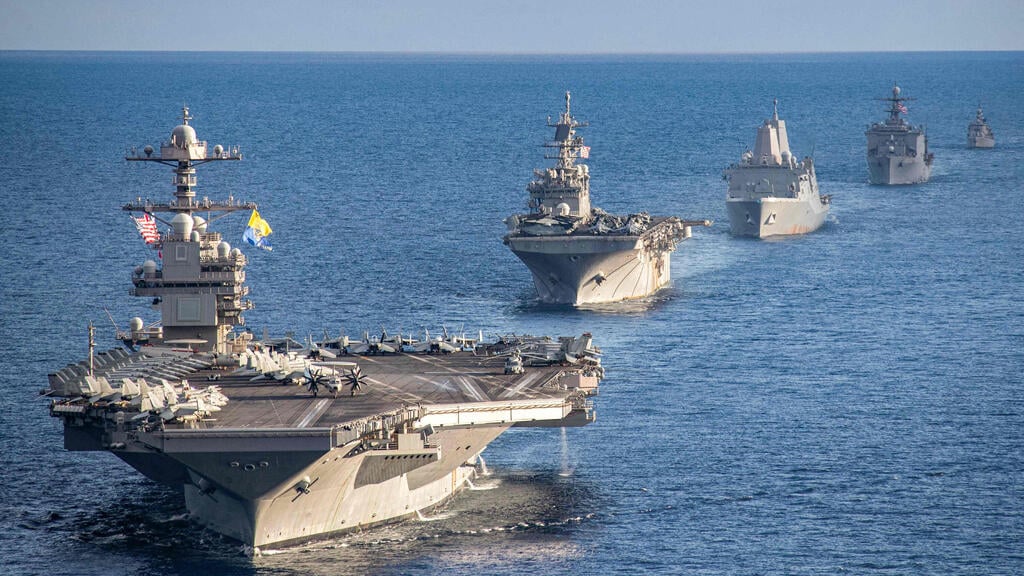
The aircraft carrier Gerald R. Ford is also en route to the region
(Photo: Maxwell Orlosky / US DEPARTMENT OF DEFENSE / AFP)
Araghchi, who led the Iranian delegation, said “good progress” had been made and that the direction was positive. No date was set for the next round, and both sides agreed to work on draft language before scheduling a third round. “We have a clearer picture of what needs to be done. There are still issues both sides need to work on,” he said, adding that the sides would review two copies of a potential agreement and continue discussions after consulting their respective governments.
Oman’s foreign minister, Sayyid Badr Hamad Al Busaidi, who is mediating between the sides, also voiced optimism. “Today’s indirect negotiations between the Islamic Republic of Iran and the United States of America in Geneva concluded with good progress towards identifying common goals and relevant technical issues. The spirit of our meetings was constructive. Together we made serious efforts to define a number of guiding principles for a final deal. The contribution of the IAEA Director General Rafael Grossi was much appreciated. Much work is yet to be done, and the parties left with clear next steps before the next meeting,” he wrote on X.
A U.S. official said there had been progress but many details remain unresolved. According to the official, the Iranians said they would return within two weeks with detailed proposals to address some of the remaining gaps. However, the last time a similar statement was made by a U.S. official, during talks in June last year, the United States ultimately carried out strikes in Iran.
Vance said the United States has multiple options at its disposal, including a strong military and what he described as an exceptional diplomatic team. After speaking with U.S. envoys, he stressed that Washington is determined to prevent Iran from acquiring a nuclear weapon, calling such an outcome a disaster for Americans. He emphasized that Washington “very much wants to resolve this through talks,” but added that “the president has all options on the table.” He made clear that President Donald Trump can choose to end diplomatic efforts if he concludes they have run their course, a decision that ultimately rests with him.
Iran’s new proposal
The Wall Street Journal reported that in an effort to advance negotiations, senior Iranian officials have floated the possibility of suspending uranium enrichment, transferring part of Iran’s enriched uranium stockpile outside the country and pursuing economic agreements with the United States. According to the report, Iran has avoided committing to a complete halt in enrichment, and the proposal may not meet the bar set by Trump.
The newspaper reported that, according to diplomats from the United States, Iran and other Middle Eastern countries, some enriched uranium would be transferred to a third country “such as Russia,” and Iran would suspend enrichment activities for up to three years. However, the report noted that much of Iran’s enriched uranium stockpile is believed to be buried at nuclear sites bombed by the United States in June, which Trump has said were completely destroyed, meaning enrichment may already have been halted.
The Journal also reported that “some local diplomats are thinking bigger” and are seeking to entice Trump with an ambitious plan that would include business agreements, similar to proposals his advisers presented before the ceasefire in the Gaza Strip.
Pessimism in Israel, Knesset debate
Against the backdrop of the U.S.-Iran talks, Israel’s Security Cabinet is expected to convene Thursday evening. On Wednesday, Home Front Command chief Maj. Gen. Shay Kleper is scheduled to deliver a classified security briefing to members of the Knesset Foreign Affairs and Defense Committee, focusing on preparations for potential missile and drone attacks against Israel.
Despite the optimistic statements from Tehran, Israeli officials believe the talks were not encouraging. While there has been some progress on the nuclear issue, Iran’s leadership is refusing to discuss ballistic missiles and support for proxy groups, and U.S. officials are said to be far from optimistic.
At a defense-tech conference hosted by ynet and Yedioth Ahronoth in cooperation with Israel’s engineers and architects association, former Home Front Command chief Maj. Gen. (res.) Eyal Eisenberg addressed the ongoing tensions. “It is no secret, every citizen of the country understands that Israel is covered by missile threats from Dan to Eilat,” he said, referring to the country’s northernmost and southernmost points.
Brig. Gen. (res.) Itzik Bar, head of the National Emergency Authority, added: “This is a new reality. I don’t know how many countries live in a situation like this, where they are either in routine or at war, and we are in a state of readiness. At the moment, the readiness is for another campaign against Iran. We won’t elaborate, but many things need to be derived from that.”