

After the decision to move talks between the United States and Iran to Oman, Middle Eastern officials involved in efforts to ease tensions between the US and the Islamic Republic are lowering expectations. The Wall Street Journal reported on Wednesday that those officials assess the talks scheduled for Friday in Oman are unlikely to produce a breakthrough, instead serving as a forum for exchanging ideas. Some believe that, in practice, a military confrontation between the sides has already become inevitable.
In the United States, Secretary of State Marco Rubio said on Wednesday evening that if Iran wants the talks to lead to something meaningful, they must include, among other issues, Iran’s ballistic missile program, which Tehran insists is off-limits, as well as funding for terrorist organizations in the region and the “treatment” of the Iranian people. “If Iran wants to meet on Friday, we’re ready. Ultimately, the United States is prepared to talk and has always been prepared to talk with Iran,” Rubio said. He did not confirm that the talks would take place in Oman, but added that it appears the Iranians “changed their minds” after ruling out talks in Turkey.
Trump on Iran: 'We are negotiating now'
(Video: The White House)


Iran unexpectedly demanded on Tuesday that the talks be moved to Muscat, the capital of Oman, and that invitations sent to Arab and Muslim countries to participate be canceled. But the central question remains what Iran is willing to discuss: the nuclear issue — and only that. Tehran is refusing to discuss its ballistic missile program, its proxy organizations and other issues, insisting these are defensive capabilities not subject to negotiation. A similar signal came again Wednesday evening, when a senior Iranian official told Reuters: “The talks with the United States in Oman will be about the nuclear issue only — the missile program is not on the table.”
Regional officials told The Wall Street Journal that it was indeed agreed to meet in Oman rather than Turkey, but said it remains unclear whether the talks will focus solely on the nuclear issue and whether additional countries will join, or whether only U.S. and Iranian representatives will participate, possibly along with Oman as mediator. In Iran, claims were published Wednesday afternoon that the talks would deal only with the nuclear issue and sanctions relief. Reuters quoted a Gulf source as saying that for now it appears the talks will begin with the nuclear issue and only afterward address other matters, step by step.
Gallery
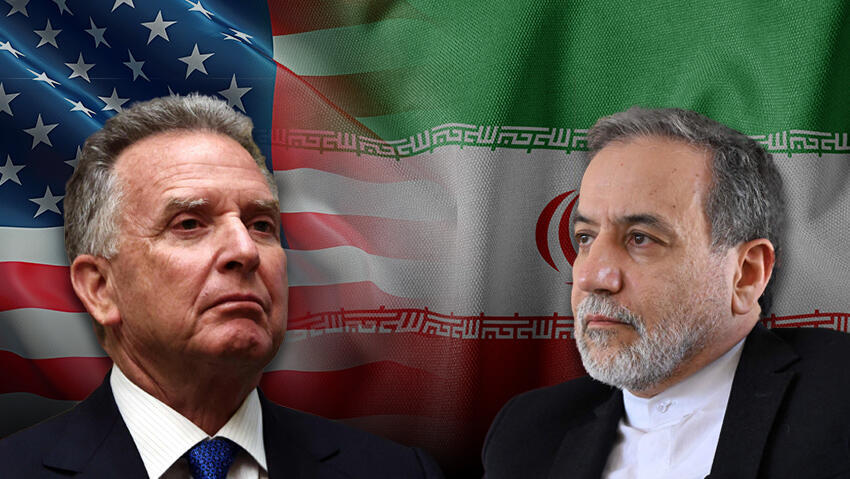
U.S. envoy Steve Witkoff and Iranian Foreign Minister Abbas Araghchi met in European cities
(Photo: Evelyn Hockstein/Pool/Reuters, Amer Hilabi/AFP, CameraObscura82/Shutterstock, Smolkov Vladislav/Shutterstock)
According to the Middle Eastern officials cited by The Wall Street Journal, the main goal of the talks at this stage is a general declaration by both sides stating that they are committed to diplomacy and agreeing to reduce tensions and halt hostile actions, in their words.
Moving the talks to Oman is a “small tactical victory,” as described by The Wall Street Journal, because Oman is a far more discreet venue than Turkey. This would allow Omani officials to operate under less pressure from regional powers such as Turkey and, of course, with far less media attention than would have been the case in Istanbul. In several rounds of talks prior to Operation Rising Lion, U.S. envoy Steve Witkoff and Iranian Foreign Minister Abbas Araghchi met in European cities such as Vienna and Rome, where numerous journalists awaited them. They later also met in Oman.
Trump considered withdrawing from the talks
The negotiations are also expected to be overshadowed by two unusual incidents on Tuesday in the Persian Gulf. The first was an attempted hijacking of a tanker flying the U.S. flag in the Strait of Hormuz. The second was the downing of an Iranian drone that approached the aircraft carrier Abraham Lincoln, which was sailing about 800 kilometers from Iran. The Wall Street Journal reported on Wednesday that Trump considered withdrawing from the talks with Iran following the two incidents, but ultimately decided against it.
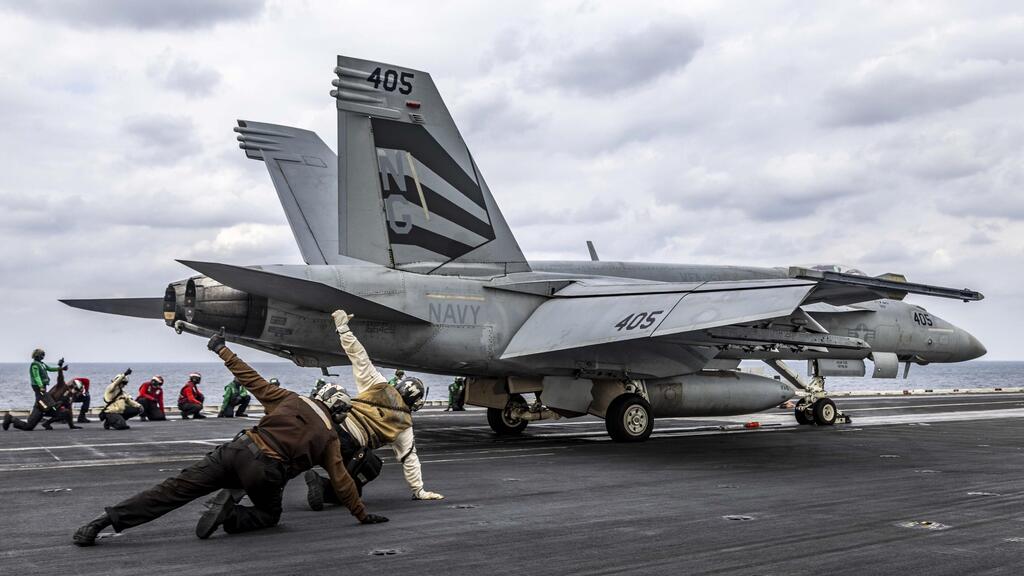
A US military F/A-18 Super Hornet fighter jet aboard the aircraft carrier Abraham Lincoln amid tensions with Iran
(Photo: CENTCOM)
Assuming the U.S.-Iran talks do take place and do not collapse at the first meeting, it is likely that several rounds of negotiations will follow, lasting at least several weeks, if not months. The clear implication is that Trump will not order a strike in the coming weeks. The question, however, is what the Americans will do with the massive “armada” sent to the Middle East, whose deployment costs tens of billions of dollars. One option is that Trump will seek an opportunity for de-escalation and order the withdrawal of the aircraft carrier Abraham Lincoln, for example, or perhaps change its course.
At a meeting held Tuesday between Prime Minister Benjamin Netanyahu, senior defense officials and President Trump’s envoy Steve Witkoff, Netanyahu presented Israel’s red lines for a good agreement with Iran: zero uranium enrichment, removal from Iran of its stockpile of 450 kilograms of enriched uranium, a halt to the missile program and an end to support for its proxies in the Middle East. In addition to IDF Chief of Staff Eyal Zamir and Mossad Director David Barnea, a number of major generals from the General Staff also attended the meeting, from which no photos or video were released.
Witkoff was presented with updated intelligence assessments on Iran’s nuclear program and ballistic missile program, as well as information on the killing of Iranian civilians. For his part, Witkoff made clear that the United States is not naive and will insist on its conditions in dealing with Tehran.
An Israeli official claimed Tuesday night that the likelihood of a U.S. strike on Iran has increased. According to the official, Tehran understands that the American noose is tightening and has likely concluded that the die has been cast — and therefore is not deterred from provocations, such as those carried out in the Strait of Hormuz and the Arabian Sea, in order to gain domestically.