


Prime Minister Benjamin Netanyahu told the Knesset on Monday that no state commission of inquiry will be established to investigate the failures surrounding Hamas’ Oct. 7 massacre, drawing sharp condemnation from opposition lawmakers and bereaved families who called the move a “red line.”
The announcement came during a “40 signatures” debate initiated by opposition factions demanding the formation of a state inquiry into the government and security establishment’s conduct before and during the attack that killed about 1,200 people and saw some 250 others taken hostage to Gaza.

Netanyahu, opening his speech to the plenum, said, “There are days, like today, when I look back at the mission that has guided me throughout my public life — to fight those who seek to destroy us and to ensure our existence in our land.” He linked his remarks to the 50th anniversary of a 1975 United Nations resolution declaring that “Zionism is a form of racism,” saying the attack on Zionism was “an attack on our state, which embodies the realization of Zionism.”
Discussing the ongoing war, Netanyahu said, “The current war, the war of rebirth, is a just war against those who rose against us on seven fronts. On Oct. 7 we suffered a terrible blow — but one from which we immediately rose.”
He said Israel had resisted international pressure, including advice not to enter Gaza City, and credited “military pressure in Gaza and diplomatic pressure by the United States” with helping to secure the return of hostages. “The campaign is not over,” Netanyahu said. “Hamas will be disarmed, and Gaza will be demilitarized — either the easy way or the hard way.”
In a veiled criticism of the IDF, Netanyahu referred to the arrest of outgoing Military Advocate General Yifat Tomer-Yerushalmi, suspected of leaking a video showing reservists allegedly abusing a Palestinian detainee at the Sde Teiman base. He said the incident “caused immeasurable damage” to Israel and the military, and accused those involved of “distorting the truth and supplying propaganda ammunition to our worst enemies.”
Turning back to the inquiry issue, Netanyahu said the key question was “not only who is being investigated, but who investigates the truth.” He argued that an inquiry supported only by half the public would lack legitimacy. “We want to establish a commission that will have the broadest possible public support,” he said. “Not one that half the nation rejects or believes is rigged in advance.”
Members of the coalition applauded, while families of the “October Council” — a group representing bereaved families of Oct. 7 victims — turned their backs to him in protest.
Opposition leader Yair Lapid of Yesh Atid accused Netanyahu of evading responsibility and compared the Likud-led government to the old Mapai party, which dominated Israeli politics in the state’s early years. “Each scandal replaces the last — all to make us forget Oct. 7,” Lapid said.
Israel Beytenu leader Avigdor Lieberman said Netanyahu was “personally responsible for the Oct. 7 massacre,” citing his decision to allow Qatari funds to flow to Hamas and his “policy of containment.” He vowed that a future government would establish “a true state commission of inquiry that will investigate everyone and issue personal recommendations.”
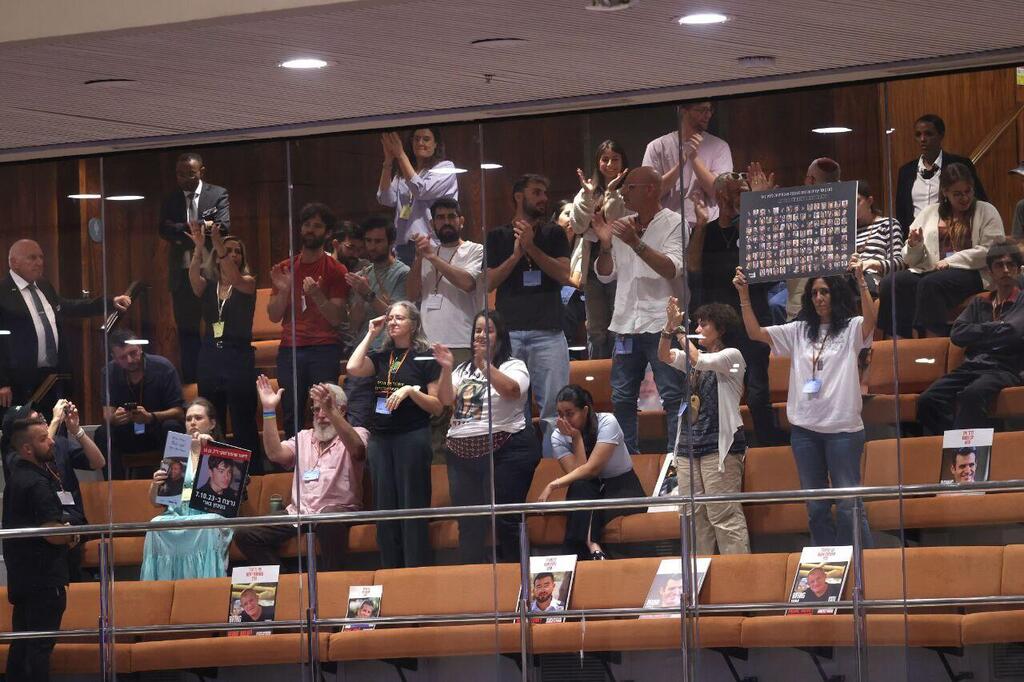
Bereaved families in the Knesset plenum
(Photo: Alex Kolomoisky)
MK Naama Lazimi of The Democrats told Netanyahu, “You will not defeat the bereaved families — they are our moral compass. The disaster will forever remain a stain on your forehead and your government’s.”
This was the second “40 signatures” debate requiring the prime minister’s attendance on the issue. In the previous session in March, Netanyahu spoke for only a minute about a state inquiry and devoted most of his remarks to attacking the opposition.
Ahead of Monday’s session, the October Council held a press conference announcing a mass rally for Saturday night at Tel Aviv’s Habima Square to demand the creation of a state commission.
Following Netanyahu’s remarks, the group released a statement saying the prime minister had “crossed a red line.”
Last month, ynet reported that Netanyahu was exploring legal options to amend the State Commission of Inquiry Law, potentially removing the clause that allows such commissions to issue personal recommendations against public officials.
Netanyahu is reportedly considering three options: amending the existing law; promoting a private bill drafted by Likud MK Ariel Kallner, which has been shelved; or forming a governmental inquiry committee with similar powers, appointed directly by the government rather than under the law.
The Supreme Court has ordered the government to update it by mid-November on the establishment of an inquiry into the Oct. 7 failures.
The October Council urged Israelis to join Saturday’s protest in Tel Aviv, declaring, “The days of political spin instead of answers are over. We will fight for the truth as our loved ones fought for their lives.”