

Nearly three weeks have passed since that morning when gunfire thundered in the heart of the Gulf of Eilat. To be precise, it was heavy machine guns firing bursts. A jet ski speeding from the Jordanian shore bounced over the ripples of the Red Sea and appeared to have no intention of stopping within the territorial waters of the Hashemite Kingdom.
An Israeli Navy Dvora patrol boat, responsible for the northern sector of the Gulf of Eilat, began closing the distance to the speeding vessel, but it stood little chance. A jet ski can easily reach 45 knots, or 83 kilometers per hour. The Dvora is not a vessel to dismiss, but even at full throttle it reaches 30 knots, or 55 kilometers per hour. What chance did it have?
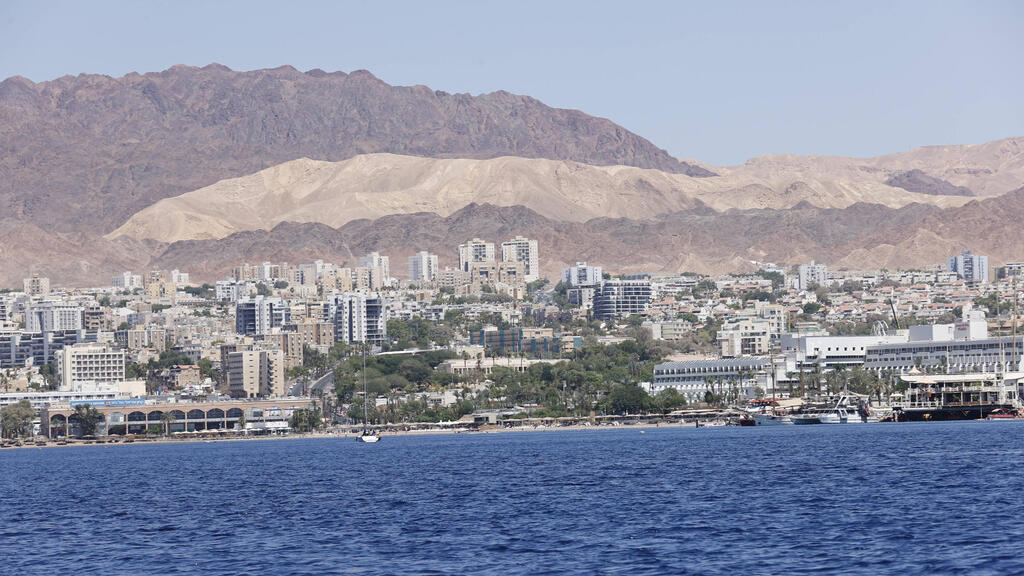
At the time, Yossi Kisos was standing on the pier at the beach below the veteran Red Rock Hotel, not far from the site where the Ink Flag was raised in 1949. He operates a sailing center there, offering cruises and marine attractions, with 20 boats that tow banana boats, inflatable tubes and parasails. His business sits right next to the city’s naval base.
“Suddenly I heard an alarm from inside the base, and I saw the Tzra’a [a light patrol boat] shoot out to sea like crazy,” he recalls. “In the Gulf of Eilat there is always a presence of two Dvora boats, one in the north, on the border with Jordan, and one in the south, on the border with Egypt, across from Taba. The Tzra’a boats are launched when a fast vessel is needed, but usually they go out on patrol calmly. That morning, after the alarm, the Tzra’a shot out of the harbor at full speed, raising huge wakes you could surf on.”
Now we are in the heart of the gulf, about three kilometers from shore, on one of Kisos’ boats. He points to the route the jet ski took toward Eilat, cutting diagonally toward the EAPC beach as the southern Dvora closed in and the soldiers aboard began firing at it with machine guns. A Border Police force was rushed to the beach and deployed there in preparation for the terrorist’s arrival. Civilians who had gone out for a morning walk along the beach watched the drama unfold and grew tense. Meanwhile, the Tzra’a skimmed across the water and forced the jet ski rider to turn south and move parallel to the shore.
The Tzra’a has four engines, each producing 350 horsepower. Together, they generate a speed of 100 kilometers per hour with ease. A female soldier aboard the Tzra’a operated the front machine gun, forcing the jet ski rider to make a sharp turn back home. He was already two kilometers inside Israel’s territorial waters when he began racing back toward Jordan, where he was arrested by a police boat that had left the Port of Aqaba.
A shower on the Jordanian beach
People often say Eilat is a small city where everyone knows everyone. That has not been true for a long time. According to the Central Bureau of Statistics, about 58,000 residents live there, while municipal figures put the number at about 65,000. They are joined during most months of the year by an average of 30,000 to 40,000 tourists a day, a figure that doubles in the summer months.
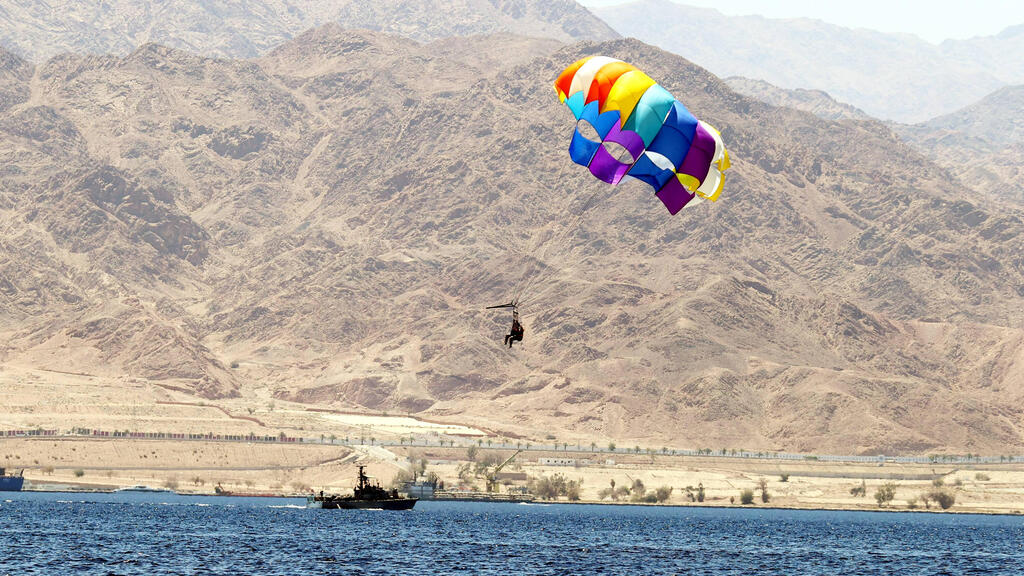
A Dvora patrol boat off the coast of Aqaba
(Photo: Gadi Kabalo)
“That means the rumor about what happened at sea spread here like a rocket, by word of mouth,” says Shay Tovli, a city resident. “Within an hour or two, everyone in Eilat had heard about the incident. Because the military did not issue an orderly statement, all kinds of rumors began to spread. The navy initially said it was not an infiltration and that the shooting was a routine weapons test. Later it emerged that there really had been an infiltration by a vessel from Jordan. Someone said the Shin Bet claimed it was merely a reconnaissance patrol by a hostile element that wanted to test our navy’s deployment. I don’t buy it. If you stand on the beach in Eilat with binoculars, you can see people under the shower, washing off on the Jordanian beach. It works the other way too. They don’t need to send a vessel for forward observation. They can simply stand on the Jordanian beach and see that there are two Dvora boats in the water and another missile boat tied to the dock at the port.”
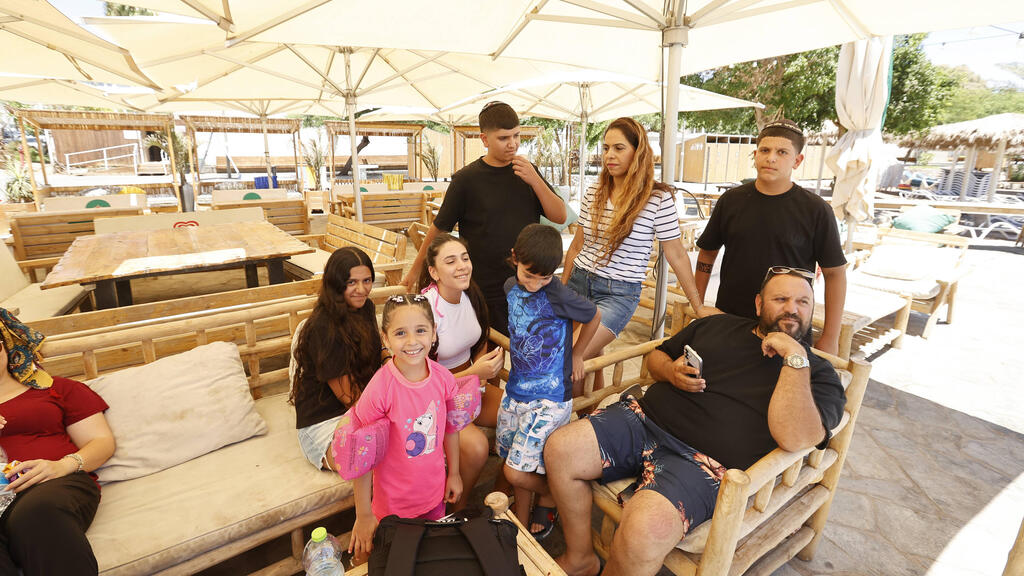
The Mizrahi family
(Photo: Gadi Kabalo)
As Eilat residents were trying to understand the meaning of the incident that unfolded before their eyes in the middle of the gulf, a report was published at the beginning of the week saying Shin Bet chief David Zini had warned in closed-door discussions that the next October 7 would be in Eilat. The following day, the agency quickly issued a clarification saying there was no concrete intelligence about an intention to attack or raid the city. But the psychological damage had already been done.
October 7 is not just another date on the Israeli-Jewish calendar. That day has been forever linked to the greatest disaster to strike this place since 1948, a disaster seared into the soul through countless testimonies, images and horrific videos. There is no need to elaborate. Every one of us understands what it means when people speak of “the next October 7.”
“Of course it put residents under pressure,” says Eilat Mayor Eli Lankri. “Wouldn’t you be stressed if they said that was what would happen in your city? It is a recipe for hysteria and panic. I am glad the Shin Bet issued a calming statement that put things in perspective. Once it was published, residents called me in a panic. ‘Tell me, is this serious?’ ‘Tell me, is this real?’ ‘How do we stop the invasion?’ It was not as though there was general hysteria, but it certainly created some unease.”
In July and August, an average of about 140,000 people stay in Eilat each day. There are several thousand young people from across the country working on the beaches, in hotels, restaurants and cafés. Next year, a medical school is expected to open there, bringing researchers and specialist doctors to the city. Talk of the next October 7 happening there is not only gut-wrenching. The concern is that it will make some people lose their desire to come.
Seven drones have struck the city during the October 7 war, along with an Iranian missile with a cluster warhead. “And still,” Mayor Lankri says, “we put it in perspective. Missiles and rockets have hit all over the country. Even during the war, Israeli tourists came here to breathe a little. I am glad the Shin Bet chief is devoting intelligence and operational attention to Eilat and that the city is on the security agenda. The IDF has reinforced forces around it along the border, and there is an increased police presence in the streets and on the beaches. After the massacre, no threat can be taken lightly.”

Eilat Mayor Eli Lankri; 'Wouldn’t you be stressed?'
(Photo: Gadi Kabalo)
If that is the situation, one must take a deep breath and try to calm down. On Kisos’ beach, we met the Mizrahi family from Rehovot: father Yitzhak, mother Rotem and their four children. On the way to their vacation in the city, their 13-year-old son Ariel read on Instagram what the Shin Bet chief had said about Eilat. Eyebrows were raised in the car.
“My husband recently returned from four months of reserve duty in the north, and we really needed this vacation,” Rotem says. “During the war with Iran, a missile that did not explode fell behind our house. Another missile fell on a building near the mall and completely destroyed it. So what, should we lock ourselves at home in fear?”
Yitzhak adds: “Anyone who lives in fear needs to let go. We talked about the Eilat scenario, but we did not get worked up. As you can see, it did not ruin our plans.”
It did not ruin only the Mizrahi family’s plans, but the feeling is that this was the last thing Eilat needed after nearly three years of war. The city has about 12,000 hotel rooms and another 4,000 daily rental units. Most are booked several months ahead, until after the Tishrei holidays. That is why, when speaking with Itamar Elitzur, CEO of the Eilat Hotel Association, one can almost hear him knocking on wood for good measure, against the evil eye.
“You see here Israelis’ need to rest, to air out, to breathe a little vacation air, to be by the pool, by the sea, to spend quality time with family,” he says. “It is such a strong need, so essential, that people, families with children, fill the city’s hotels even in the middle of the week, during the school year. You ask whether talk of one threat or another has an effect, and my answer is simple: We are almost fully booked for the entire summer. Every hotel has a security department. It is like not being worried about missiles falling in Tel Aviv while you are spending time there. We live in a given environment. Eilat is no more dangerous than anywhere else in the country.”
Traffic jams against terrorists
If Nukhba terrorists managed to infiltrate in a pickup truck from the Jordanian border, they would get stuck here in the traffic that clogs the city’s many roundabouts. And the peak of summer is still ahead. An infiltration from the sea is supposed to run into naval vessels, as happened three weeks ago. As for the sea, Kisos warns against complacency. The water is full of sensors that alert to any vessel approaching Israeli waters and to divers who might try to arrive covertly. Still, he remembers a rather unusual infiltration in 1992.
“King Hussein’s horse ran away from the stable at his villa in Aqaba, ran into the water and swam to Eilat,” he recalls. “It came ashore, was caught and was returned with honor to the king.”
Everyone we spoke with said the land border is closed off by a good border fence stretching from Eilat to Ramon Airport, 20 kilometers north of the city. From there onward, it is a free-for-all. We called Hanan Ginat, head of the Hevel Eilot Regional Council. His council includes 12 communities, nine of them along the Arava Road, not far from the Jordanian border. Two are right next to the fence. Kibbutz Lotan sits directly on the border, and Kibbutz Grofit is only about a kilometer away.
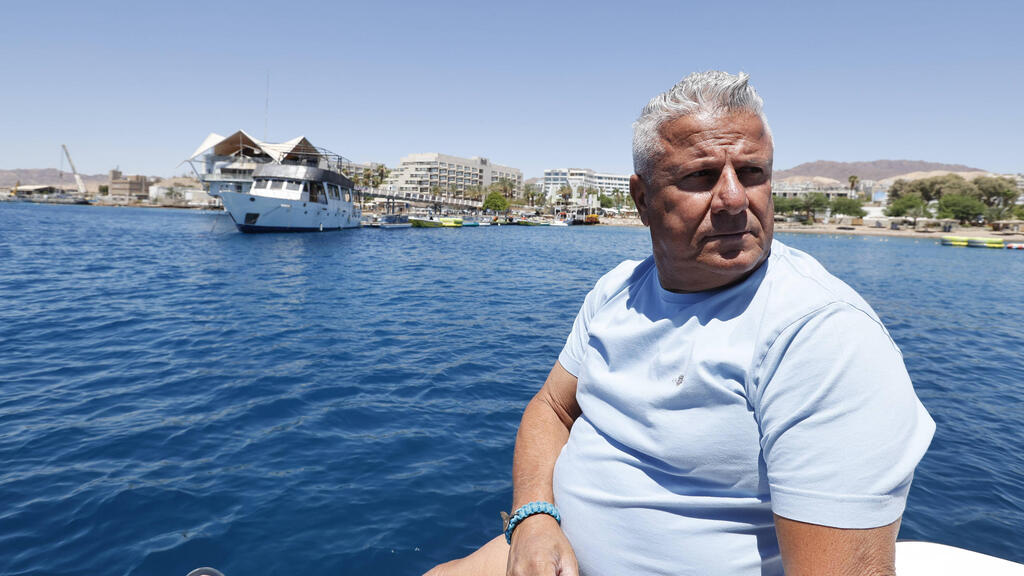
Yossi Kisos; 'Suddenly, an alarm at the base'
(Photo: Gadi Kabalo)
“We have 100 kilometers of border in the council, and only about half of it has a fence,” he says. “That is very troubling, certainly after the reports about the Shin Bet chief’s warning. Recently there has been a huge increase in drone flights from the Jordanian side into our territory. I am talking about an average of one drone a day crossing from one side to the other. Right now these are smuggling drugs and weapons, but who knows what comes next. There is great concern here that one day these drones will be used to harm us. These are aircraft capable of carrying 80 kilograms. Imagine that instead of rifles, they carry bombs and drop them on us. And again, before the drones, there is no fence here.
“And I have to mention the IDF. The army tripled or quadrupled its forces along the Jordanian border as soon as the latest war with Iran began. Those forces did not leave. They are still here because the army understands the potential danger. There are communities here that had only a local standby squad made up of residents, and now an entire company is stationed there.”
From what you know, is this just a general assessment, or is there some intelligence thread driving this kind of deployment?
“I don’t know what they have, but it is very simple. If someone decides to carry out another October 7, they will come here. On the Egyptian border, there is a six-meter-high fence. At sea, a jet ski came and the navy chased it and made it flee. We may not have a sea here, but we also do not have a fence.”
And suppose there were a fence. The Gaza border had a fence, and it did not prevent the disaster.
“True, you need much more than a fence. But at least there should be a fence. That is the minimum.”