

Three days before Iran and the United States are expected to sign a memorandum of understanding in Switzerland, many of the agreement’s full details remain unknown, even after U.S. President Donald Trump said it had already been signed “electronically” and publicly declared it a “fair” and “good” deal.
Speaking alongside Qatar’s Emir Sheikh Tamim bin Hamad al Thani on the sidelines of the G7 summit in France, Trump framed the emerging arrangement as a decisive barrier against an Iranian nuclear weapon, while also issuing unusually blunt criticism of Israel’s military conduct in Lebanon.
Gallery
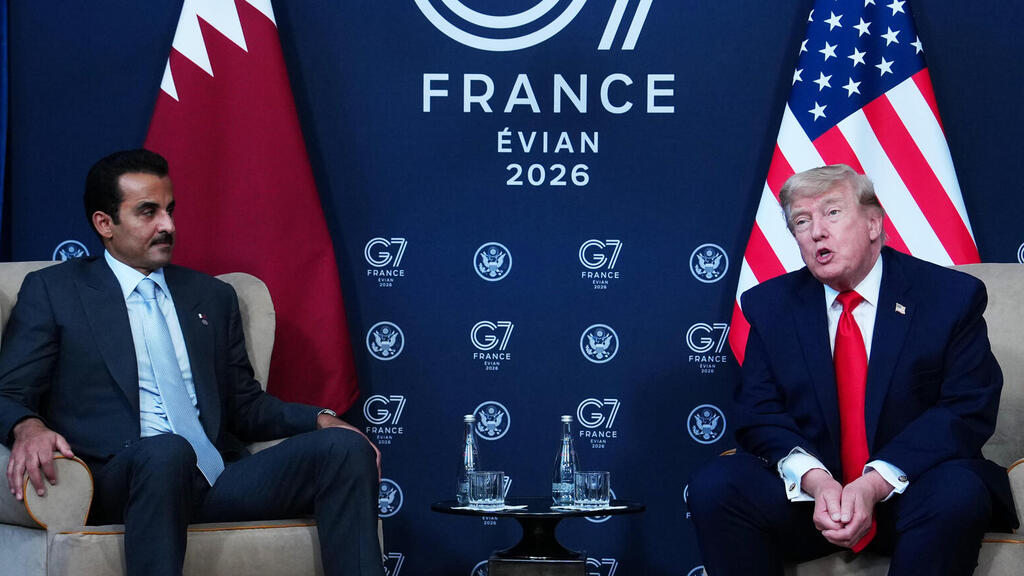
Evian, France. US President Donald Trump meets with Qatar’s Emir Sheikh Tamim bin Hamad Al Thani
(Photo: AP/ Julia Demaree Nikhinson)
“We think it’s a fair deal, it’s a good deal,” Trump told reporters, adding that it was now moving into a second stage, which he said would be “actually easier.”
“The only thing that really matters to me is Iran will never have a nuclear weapon,” Trump said. “They’re not going to develop it. They’re not gonna buy it. They’re not going to do anything with it. And if they do, they suffer unbelievable consequences.”
He added that the wording of the agreement had been changed at his insistence.
“That’s the reason I got in and that’s the reason I agreed to sign,” Trump said. “In the beginning, when Marco was with me, they worded it that Iran ‘will not develop a nuclear weapon.’ I said: ‘No, no. You don’t only not develop a nuclear weapon, you also don’t acquire it.’ So we added that, and it took another few days of negotiation. It sounds ridiculous, but that’s the way it was.”
Trump said the agreement now states that Iran will not develop, purchase or otherwise acquire a nuclear weapon.
“They’re not going to develop it. They’re not gonna buy it. They’re not going to do anything with it,” he said. “And if they do, all hell will rain down on them. And they won’t do it. We appreciate the relationship that we’ve had with Iran in this short period of time.”
Trump also rejected reports that the deal would require the United States to invest money in Iran, calling the claim “ridiculous.”
“We are not investing any money, we have no obligation to invest any money in Iran,” he said. “We have the right to it if we want but we’re not investing any money.”
Iranian media have reported that the framework to end the war included a clause requiring the United States to present reconstruction plans for Iran worth $300 billion.
Asked about Iran’s stockpile of highly enriched uranium, which Vice President JD Vance said the United States would help Tehran remove under the agreement, Trump said Washington intended to retrieve it.
“We’re going to go get it,” Trump said. “But to go get it, it’s a big deal because they say only China and us have the equipment where you can even get it. The whole mountain is collapsed on top. We have cameras on it.”
“You could make the case: why are you even bothering? Because it’s not really valuable,” he added. “It’s not very valuable. But I think psychologically, we want to get it.”
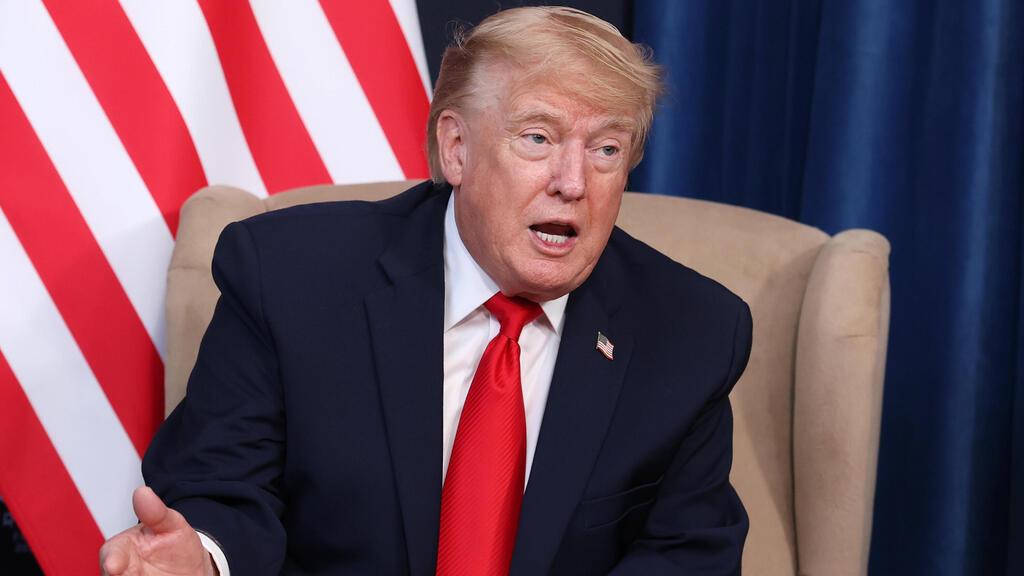
US President Donald Trump
(Photo: Anna Moneymaker/Getty Images)
Trump also revisited his decision during his first term to withdraw from the 2015 nuclear agreement reached under President Barack Obama.
“They would have done tremendous damage had we not cancelled the Obama nuclear deal,” Trump said. “That was a road to a nuclear weapon. It was the dumbest deal I’ve ever seen other than NAFTA.”
Trump denied that his objective in the war was regime change in Iran, although he said the killing of several Iranian leaders meant such change had effectively taken place.
“I don’t believe in regime change,” he said. “I’ve watched regime changes for years, they never work.”
But Trump’s comments on Israel and Lebanon were no less striking. Asked whether Israel’s refusal to withdraw from Lebanon could endanger the success of his framework to end the war, Trump said the agreement could survive, but criticized Israel’s handling of Hezbollah.
“I see that as the minor war, the Iran war is a big one,” Trump said. “But we have the same little problem that keeps popping up over and over again, and that’s Hezbollah.”
“Israel’s fighting Hezbollah too long and too many people are being killed,” he said.
Trump then appeared to criticize Israeli strikes in Lebanon that have hit residential buildings.
“You don’t have to knock down an apartment house every time you’re looking for somebody, because there are a lot of people in those apartment houses, and they’re not all Hezbollah, that I can tell you,” he said.
“And I suggest that to Israel: to let Syria take care of Hezbollah is, to be honest with you, I think they do a better job of doing it.”
Trump also criticized Israel for attacking Lebanon shortly before the agreement was expected to be signed.
He said Israel had attacked Lebanon “two hours before we’re signing the agreement.”
A reporter then asked whether Trump was frustrated with Prime Minister Benjamin Netanyahu, following reports of heated exchanges between the U.S. president and the Israeli leader.
“No,” Trump replied. “We had a great relationship. We’re talking about some end details.”
“We’ve had a very effective relationship. Without us, without the United States, there would be no Israel,” he said. “Without me, there would be no Israel, because no other president was willing to do what I did.”
“I’ve had a great relationship with Bibi,” Trump added, “but now Bibi has to be more responsible with respect to Lebanon.”
Meanwhile, Iranian officials continue to insist that the agreement also includes a ceasefire in Lebanon, which Iranian Foreign Minister Abbas Araghchi said would begin Friday.
“Yesterday, the immediate and final end of the war on all fronts, including Lebanon, was announced, and the official implementation of the memorandum of understanding will begin Friday,” Araghchi said.
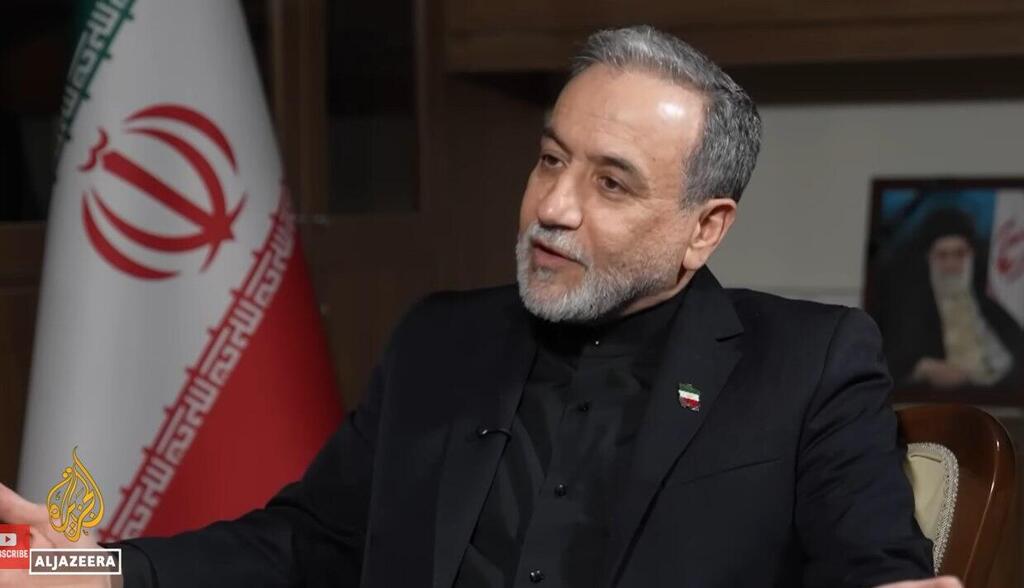
Iranian Foreign Minister Abbas Araghchi
He warned that “any Israeli military attack against Lebanon from now on will constitute a violation of the memorandum of understanding with the United States.”
“Iran viewed ending the war in Lebanon as an obligation,” he said. “Just as the ceasefire included Lebanon, the declaration of the end of the war also includes the Lebanese front.”
According to Araghchi, the negotiations were divided into two stages because of difficulties in reaching understandings.
“The first stage discussed ending the war, the Strait of Hormuz, the release of frozen Iranian funds and reconstruction,” he said. “After that, negotiations will continue for 60 days, until a final agreement is reached, which will address the nuclear issue and the removal of sanctions.”
“The most important achievement of the first stage is the declaration of an immediate and permanent end to the war on all fronts, which entered into force Monday morning, although official implementation will begin Friday,” he added.
In Israel, there is concern that during the next two months, when the sides are expected to discuss the nuclear issue, Iran could try to break out toward a bomb. But another central issue, ballistic missiles, does not appear to be included in the memorandum of understanding, as far as is currently known.
Iran has traditionally refused to discuss its missile program, which it defines as a matter of self-defense.
Iran possesses long-range missiles capable of reaching Europe, making the issue a major concern for European governments. A senior European diplomat said the agreement was flawed and constituted a strategic threat to Europe, questioning why the United States had not insisted on including missiles in the framework. In the past, there had been discussion of limiting missile ranges, but there is serious doubt that Iran would agree.
Netanyahu said at a press conference Monday night that Iran had planned to develop 20,000 ballistic missiles, calling it an existential threat to Israel. The concern, according to Israeli officials, is that if Iran were to launch large numbers of missiles at once, the damage could be comparable to that of a small nuclear weapon.
That is why Israel insisted during the war on striking Iran’s ballistic capabilities, including missile production facilities, in an effort to prevent Tehran from building more missiles in the future. Whether those strikes achieved their objective remains unclear, especially as Iran has shown an ability to find alternatives, and Israeli officials believe China is likely to assist it.
During the war, Iran launched thousands of ballistic missiles at Israel and Gulf states. Some missiles also reached Europe, including a strike on a British base in Cyprus, a member of the European Union. That is likely one reason French President Emmanuel Macron and European Commission President Ursula von der Leyen both demanded Monday that the missile issue be included in any final agreement.
Macron said the agreement should urgently and unconditionally allow the reopening of the Strait of Hormuz, and said it created an opportunity for broader negotiations aimed at advancing peace and security across the Middle East. Such talks, he said, should address concerns over Iran’s nuclear program, what he described as Tehran’s destabilizing regional activity and its ballistic missile program.
Von der Leyen expressed hope that the agreement would open the door to broader talks and “lead to the end of Iran’s nuclear and ballistic missile programs.”
Their remarks are significant, though not surprising, given that Europe is taking a tougher line on the issues that directly affect its own security.
Whether missiles are included in a final agreement, if one is reached, will depend largely on the United States and how determined Washington is to press the issue. In Israel, the assessment is that there may ultimately be no final agreement, meaning not only missiles, but also the nuclear issue and Iran’s proxies could remain unresolved.
The framework also does not appear to address drones, another significant threat, though one that affects Iran’s Gulf neighbors more than Israel.
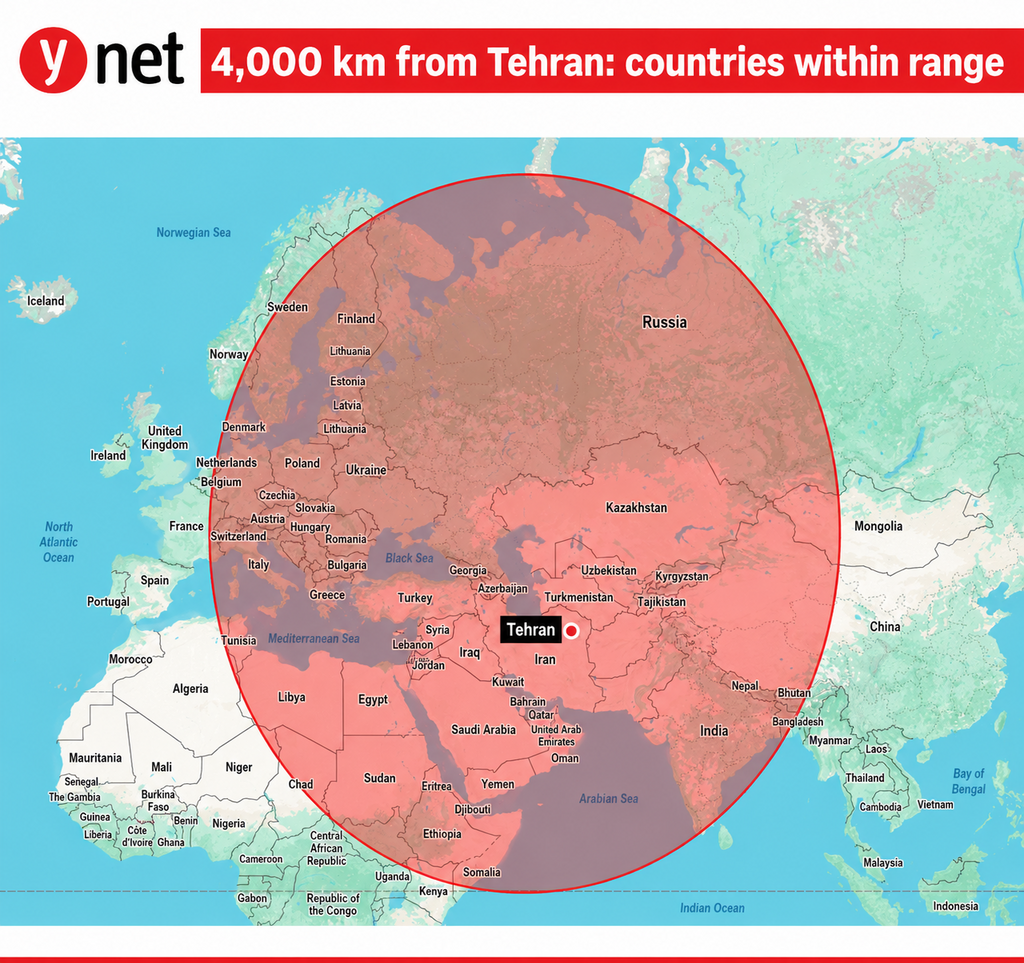
In March, at the height of the war, Iran also fired missiles at Diego Garcia, the island known as the “bomber island” because of the U.S. base located there, about 4,000 kilometers from Iran. The strike raised the possibility that Iran has longer-range launch capabilities than Israel had previously assessed, placing many European countries under the reach of Iranian missiles.
Before the war, Secretary of State Marco Rubio warned that Iran could also fire missiles at Europe. Israel had estimated that the maximum range of Iranian missiles was about 3,000 kilometers. Araghchi said in February that Iran had deliberately limited the range of its missiles to 2,000 kilometers.
A range of 4,000 kilometers would bring additional countries into range. It would allow Iran to fire missiles, in theory, toward Western Europe, including Germany, Italy, Finland and Austria. Countries in northern and central Africa, including Kenya and Ethiopia, would also be exposed to missiles fired at that distance. To the east, such missiles could reach Bangladesh, India and even parts of China.
For now, Trump is presenting the emerging deal as a major achievement centered on one principle: Iran must never obtain a nuclear weapon. But the agreement’s unresolved questions, from Lebanon and Hezbollah to ballistic missiles, drones and the future of Iran’s nuclear program, are already creating pressure on the fragile framework before it is formally signed.