

Arab and Saudi media have been closely following Saudi Crown Prince Mohammed bin Salman's visit to the United States and his anticipated meeting with President Donald Trump on Tuesday. Taking place during a sensitive period in the Middle East, the visit is viewed in Riyadh as a strategic turning point in relations between Washington, Saudi Arabia and the broader region, particularly in light of the proposed sale of F-35 fighter jets to the kingdom.
Saudi newspaper Okaz featured a front-page photo of Trump and bin Salman with the headline: "A Ceremonial Welcome for the Crown Prince at the White House." The paper quoted Trump over the weekend as saying that the upcoming talks more are "moan just a meeting." He also praised Saudi Arabia for its role in promoting regional stability.
The article highlighted the high-level contacts leading up to the visit, aimed at finalizing a series of agreements expected to be signed. These include a joint defense pact, U.S. support for Saudi Arabia’s civilian nuclear program, and a deal for the purchase of 48 F-35 jets. On Wednesday, the Crown Prince is also set to attend a Saudi-American investment conference.
Gallery
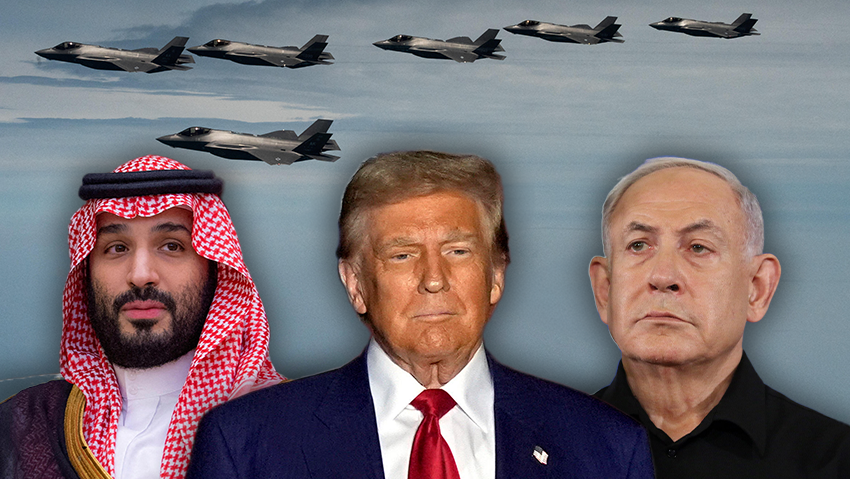
Saudi Crown Prince Mohammed bin Salman, US President Donald Trump and Prime Minister Benjamin Netanyahu
(Photos: Air Force/Senior Airman Trevor Gordnier/Handout via Reuters, Dana Kopel, Carlos Osorio/AP, Bandar Algaloud/Courtesy of Saudi Royal C)
Saudi media has emphasized the global significance of the visit. In Asharq Al-Awsat, an Egyptian columnist described the trip as having “special” importance, arguing that Saudi Arabia has become “a central pillar in a rapidly shifting geopolitical world.” The visit, he said, is significant for both sides: “The host recognizes Saudi Arabia’s strategic value as a balancing force in a turbulent region.”
The visit is seen as an effort to solidify a new phase of economic, political, security and technological cooperation between Riyadh and Washington. Saudi Arabia reportedly views the partnership with the U.S. as essential for regional stability, conflict resolution and peace-building.
In Jerusalem, officials are monitoring the visit closely. “Close relations between the U.S. and Saudi Arabia are in our interest. But the F-35 deal should be conditioned on progress toward normalization with Israel,” said Dr. Yoel Guzansky, a former senior official in Israel’s National Security Council and now head of the Gulf Program at the Institute for National Security Studies (INSS).
Guzansky described the Trump-bin Salman meeting as a "historic event" with the potential to reshape regional dynamics—not only in the context of Israel-Saudi or Israeli-Palestinian relations, but for the Middle East as a whole and the role of global powers in the region.
He pointed to two main concerns with the proposed deal: “One is diplomatic, and the other is security-related. The diplomatic aspect is more immediate and relevant. The more the Saudis are given—be it fighter jets or defense agreements—the less incentive they have to normalize ties with Israel, since most of their interests lie with the Americans.”
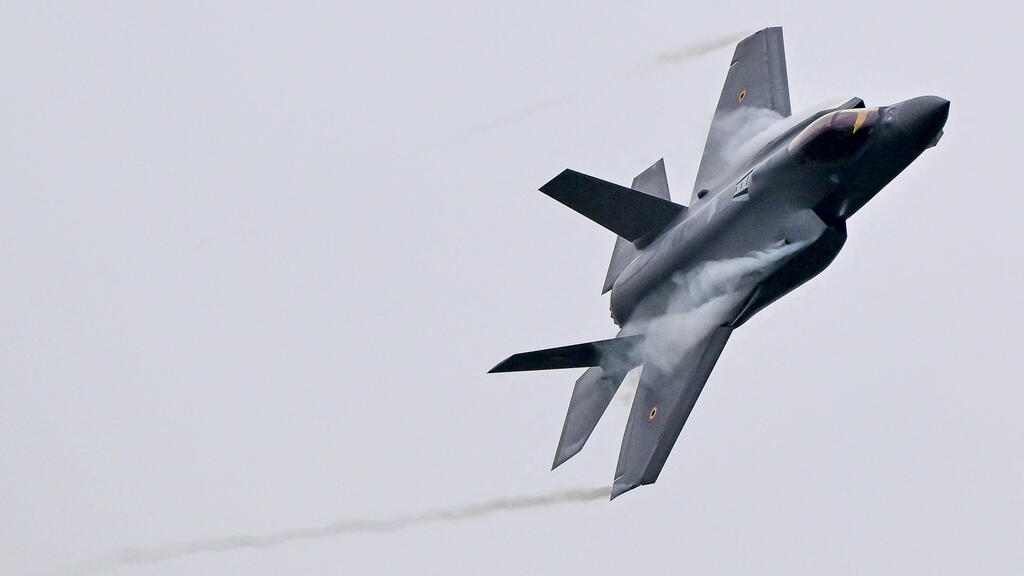
F-35 fighter jet
(Photo: Dirk Waem / Belga / AFP)
He emphasized that in every peace agreement Israel has signed—from Egypt to the UAE—the Arab side received something from the U.S. “For the Saudis, the wish list is long and shiny. They can afford to buy anything. Right now, they’re asking for 100 jets," he said.
Guzansky added: “The move could be postponed. Trump should be advised to delay it and make the sale contingent on Saudi progress toward normalization with Israel. Otherwise, Israel pays twice: no normalization, and the Saudis get jets that erode our qualitative military edge in the region.”
On the potential impact to Israel’s military advantage, he noted: “On paper, yes, it’s a blow. These are advanced jets, and currently Israel is the only country in the region operating them.”
Asked whether Saudi Arabia would receive a downgraded version, he replied: “It’s possible. Even if not, Israel will have time to upgrade and refine its existing fleet. The deal’s completion is still years away. There’s also a strategic aspect; this boosts Saudi Arabia’s standing. They’re not an enemy state. Trump wants to sell F-35s anyway, so it's better to sell to Saudi Arabia than to Turkey or Qatar. It’s the least bad option for now.”