

A Jerusalem yeshiva student identified only as Y. was among the civilians who opened fire on the gunmen who carried out Monday morning’s deadly terrorist attack at the Ramot junction in Jerusalem.
Y., who received his handgun license about a year ago, told Ynet that he always carries his weapon.
“The scenario that something like this could happen crosses my mind every day,” he said. “I grew up in Jerusalem and I remember terror attacks since childhood. Even when I’m studying in kollel, I sometimes think—what will happen if a terrorist shows up?”
Documentation of the moments of the attack at Ramot Junction in Jerusalem
(Video: IPdome)


He described the moments leading up to the attack:
“By a miracle, I was on my way to kollel, and this is a bus line I don’t like to take, but the other buses didn’t arrive, so I got on it. By chance, I was in the right place at the right time, with a weapon,” he said.
He continued: “When I got to the station, I thought to myself that if an attack happened it would be dangerous, because the station was unusually crowded. The bus stopped in the road, and it wasn’t full. Suddenly I heard gunfire. It took me a moment to understand it was an attack. People started running and screaming. I thought about what to do, turned around and ran. One of the civilians outside had already taken up a position and returned fire. I simply joined him. I only had 10 rounds in the magazine, so I couldn’t overthink it. The terrorists fired back, and I moved behind a concrete barrier, crouching. Later, when they moved away, I took up another position behind another barrier. That’s when they were brought down.”
He said he later joined another civilian and Staff Sgt. Sh., a soldier from theHasmonean Brigade.
“We brought them down. I didn’t feel unusual stress, I acted calmly. I gave testimony to the police. I always wondered what would happen if I was caught in an attack, and thank God I acted properly,” he said.

His brother N., a paramedic, was among the first responders.
“I was thinking that I had family at the scene,” he said. “My mother called and told me my brother was there, along with other relatives. This wasn’t my first terror attack, and I treated it professionally, but this time was different because of the personal involvement. My concern for my brother was significant, and I was relieved to see he was okay," he explained. "I’m proud of him. He didn’t just take the licensing test—he did advanced training. He and the others with him knew how to respond. They didn’t start shooting immediately, they waited until the area cleared of fleeing people before opening fire. We know that hundreds of attacks have been thwarted. Unfortunately, this one succeeded, but security forces prevented many others. We salute them.”
Y. praised his brother in turn: “He’s been saving lives ever since he joined United Hatzalah. He does so much.”
N. recalled what he saw at the scene: “When I saw you, you had blood on your hands. I thought you were wounded, but I realized that besides fighting the terrorists, you were also trying to save lives and help the injured.”
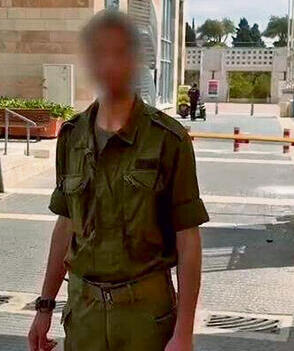
Staff Sgt. Sh., the ultra-Orthodox soldier who neutralized the terrorists
(Photo: IDF Spokesperson's Unit)
Staff Sgt. Sh., the ultra-Orthodox soldier who neutralized the terrorists, also described the attack.
“I heard gunfire and realized I needed to make contact," he described. "I was at the junction and heard the shots. I went toward the bus and saw the terrorists. Along with several civilians, I identified them and we opened fire until we saw they were neutralized. Then we moved in to help the wounded.”
The yeshiva student’s handgun had once belonged to his grandfather, a longtime police volunteer. When the grandfather grew too old to carry a weapon, he passed it on to Y., who already held a license. A few months ago, as part of United Hatzalah’s policy to arm volunteers who respond to terror scenes, Y. received another weapon from the organization, and he passed his grandfather’s handgun to his brother.
Six people were killed in the attack: Rabbi Levi Yitzchak Pash, Yaakov Pinto, Rabbi Yisrael Metzner, Rabbi Yosef David, Rabbi Mordechai Steintzeg and Sarah (Sarita) Mendelson.