

Trump’s declaration that he had decided at the last moment to delay, “for a short time,” a U.S. strike on Iran once again raised tensions across the Middle East. He said he had responded to requests from Gulf leaders who asked for more time for negotiations with Tehran, but also made clear he had ordered the U.S. military to remain ready to launch a “large-scale attack” immediately if talks fail.
On Wednesday evening, the Iranian news agency Tasnim, which is close to the regime, reported that the United States had delivered a new proposal to Tehran. “They transmitted a new text to Iran via Pakistan,” a source close to the negotiations told Tasnim. “Iran is currently reviewing the text and has not yet responded. Pakistan is trying to bridge the gaps, but these efforts have not yet produced final results.” Before that proposal, the Wall Street Journal reported that the U.S. and Israel were preparing new strikes against Iran, possibly as early as next week.
Trump’s declaration that he had decided at the last moment to delay
(Video: X)


Behind this pause lies an unusual balance of power. On one side, a major U.S. concentration of naval, aerial and defensive assets around Iran, giving Washington the ability to quickly resume strikes, defend its bases and allies, and apply maritime pressure on Tehran. On the other side, Iran, which has been significantly weakened in recent months, still retains capabilities sufficient to impose heavy costs: a substantial missile arsenal, drones, regional proxy forces, an enriched uranium stockpile approaching weapons-grade levels, and one critical strategic lever that worries the entire world: the Strait of Hormuz.
Two aircraft carriers, destroyers and thousands of troops around Hormuz
At present, according to USNI News, which tracks the U.S. Navy, two American aircraft carrier strike groups are operating in the Arabian Sea: the USS Abraham Lincoln and the United States Ship (USS) George H.W. Bush. The USS Gerald R. Ford, which had been part of the unusually large regional deployment, has already returned to its home port in Norfolk, Virginia after an 11-month deployment. But the presence of two strike groups still preserves significant firepower against Iran.
Around the carriers operate air wings including F/A-18 fighter jets, F-35C stealth aircraft, EA-18G Growler electronic warfare jets, E-2D command and control aircraft and helicopters. In addition, guided-missile destroyers and other vessels are deployed across the Arabian Sea, the Red Sea and the eastern Mediterranean. USNI also reported that an amphibious force from the USS Tripoli is operating within the U.S. Central Command area of responsibility, alongside Marine vessels and mine warfare ships sent to the region.
This presence enables the United States to rapidly resume strikes on Iran from sea and air, using aircraft, cruise missiles, intelligence capabilities and electronic warfare, while also providing a broader defensive umbrella for U.S. bases, regional partners, Israel and maritime routes in the Gulf. In addition to naval forces, the U.S. has already deployed F-35, F-15E and F-16 aircraft, B-2 and B-52 bombers, KC-135 refueling tankers and extensive intelligence, surveillance and electronic warfare systems in its operations against Iran.
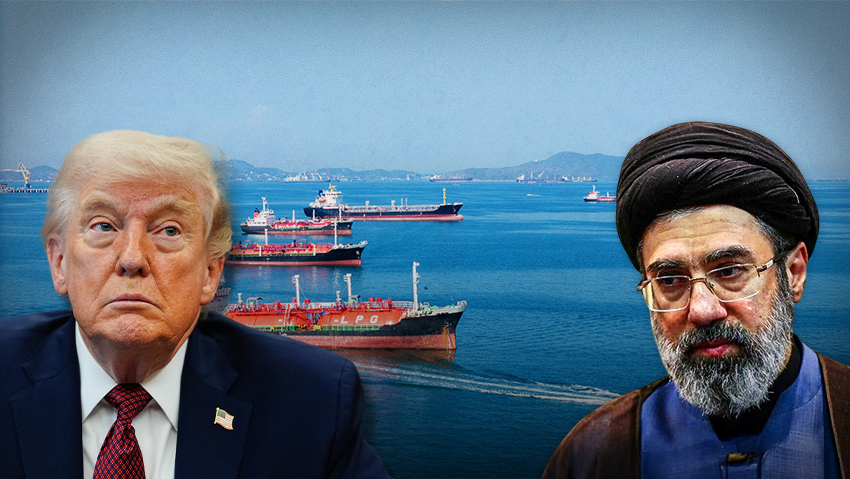
The arena that has become the central bargaining chip and the possibility of NATO involvement
If at the beginning of the current war the focus was on nuclear facilities and the missile program, the Strait of Hormuz has now become an equally central strategic hub. The U.S. has already announced restrictions on maritime traffic to and from Iranian ports but stressed it does not intend to block free passage of vessels heading to non-Iranian ports. At the same time, United States Central Command has launched a mine-clearing operation in the strait after, according to U.S. statements, the Islamic Revolutionary Guard Corps laid naval mines in the area.
Earlier this month, Trump launched “Operation Project Freedom,” aimed at restoring commercial shipping through Hormuz under a U.S. protective umbrella. The move was suspended two days later, but the U.S. continues to maintain a large naval and air presence designed to protect its forces, enforce maritime pressure on Iran and deter attacks on commercial shipping. According to CENTCOM, the force in the Strait of Hormuz includes guided-missile destroyers, more than 100 aircraft from land and sea bases, unmanned systems and about 15,000 military personnel.
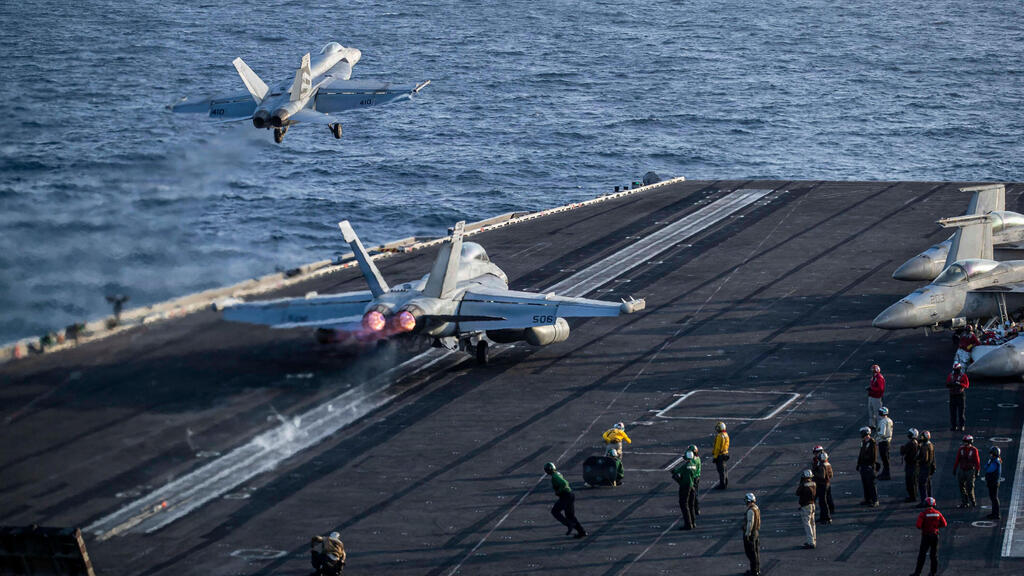
F/A-18E on the aircraft carrier Abraham Lincoln
(Photo: AFP PHOTO / US NAVY / NAVCENT PUBLIC AFFAIRS)
Bloomberg reported that NATO is also considering intervention if the strategic shipping lane is not reopened by early July. According to the report, alliance discussions are underway on assisting safe passage for ships through the blocked strait. A diplomat from a NATO member state said the idea has support from several members but still lacks the unanimous approval required. If approved, such a move would mark a significant shift in NATO policy regarding the U.S.-Israel war with Iran and bring the alliance more directly into efforts to secure freedom of navigation in the Gulf.
For Iran, this is not just a shipping lane but a survival lever. Before the war, the strait carried about a quarter of global seaborne oil trade and about a fifth of liquefied natural gas trade. Any disruption quickly affects energy prices, the global economy and political pressure on Trump at home. Gulf states such as Saudi Arabia, Qatar and the United Arab Emirates do not want to see Iran strengthened, but also understand that another escalation could trigger direct retaliation against energy facilities, ports, U.S. bases and civilian infrastructure in the Gulf.
This is why Hormuz has become the most sensitive focal point. The U.S. can deploy overwhelming naval power there, but Iran does not need to destroy the U.S. fleet to create a crisis. Naval mines, drones, anti-ship missiles, explosive boats or localized incidents are enough to raise insurance premiums, push shipping companies away and trigger panic in energy markets.
Iran’s capabilities have been damaged but not dismantled
After weeks of U.S. and Israeli strikes, there is no doubt Iran has paid a heavy price. Command structures, air defenses, bases, missile sites and military infrastructure have been repeatedly targeted. However, recent assessments are far from a picture of “decisive defeat.” According to reports in the New York Times and Washington Post in recent weeks, based on U.S. intelligence assessments, Iran still retains about 70% of its pre-war ballistic missile stockpile and about 75% of its launchers. In drones, estimates suggest it retains around 40% of its arsenal.
In the nuclear domain, the problem remains unresolved. Iran still holds an estimated 440 kilograms of uranium enriched to 60%, close to the 90% level required for weapons-grade material. Even if some nuclear facilities were damaged, questions about the location of the stockpile, the ability to monitor it and how to remove it from the Islamic Republic remain among the most difficult issues in negotiations between Washington and Tehran.
For Iran, the missile program has become perhaps the central lesson of recent months. Its air force is relatively outdated and inferior to those of Israel and the United States, but its missile and drone capabilities allow it to threaten Israeli rear areas, U.S. bases, airports, ports and energy infrastructure in the Gulf. Even when interception rates are high, the need to intercept hundreds of threats strains interceptor stocks, burdens defense systems and disrupts daily life.
To this is added Iran’s network of regional proxies. Hezbollah in Lebanon, militias in Iraq and the Houthis in Yemen are not in the same position they were before October 7, but they can still open secondary fronts. Iran’s threat is therefore not only direct missile fire from Tehran toward Israel, but an attempt to widen the conflict across the region: U.S. bases in Iraq and the Gulf, shipping in the Red Sea, fire from Lebanon, strikes on energy infrastructure and disruption of trade routes.
Israel’s response: Arrow, David’s Sling, Iron Dome and laser systems
Israel is preparing for a scenario in which renewed U.S. strikes on Iran would trigger a direct response against its home front. That response could be limited as a signal or significantly broader if the regime in Tehran again feels its survival is at risk.
Israel’s air defense architecture is built in layers. The upper layer is the Arrow 3 system, designed to intercept long-range ballistic missiles outside the atmosphere. Beneath it operates Arrow 2, intended to intercept missiles that penetrate the first layer. The third layer is David’s Sling, designed to counter medium-range missiles, heavy rockets, cruise missiles and drones. Below that is Iron Dome for short-range threats, alongside the naval “C-Dome” system deployed on Israeli Navy vessels to protect maritime assets, gas platforms and strategic infrastructure.
A laser system, “Iron Beam,” has also been added, intended to shift the cost equation against relatively cheap threats such as rockets, mortars and drones. Instead of intercepting a low-cost threat with an expensive interceptor, the laser aims to provide much cheaper per-engagement interception. However, laser systems depend on weather conditions, range, line of sight and target rate, making them an important layer but not a replacement for the full system.
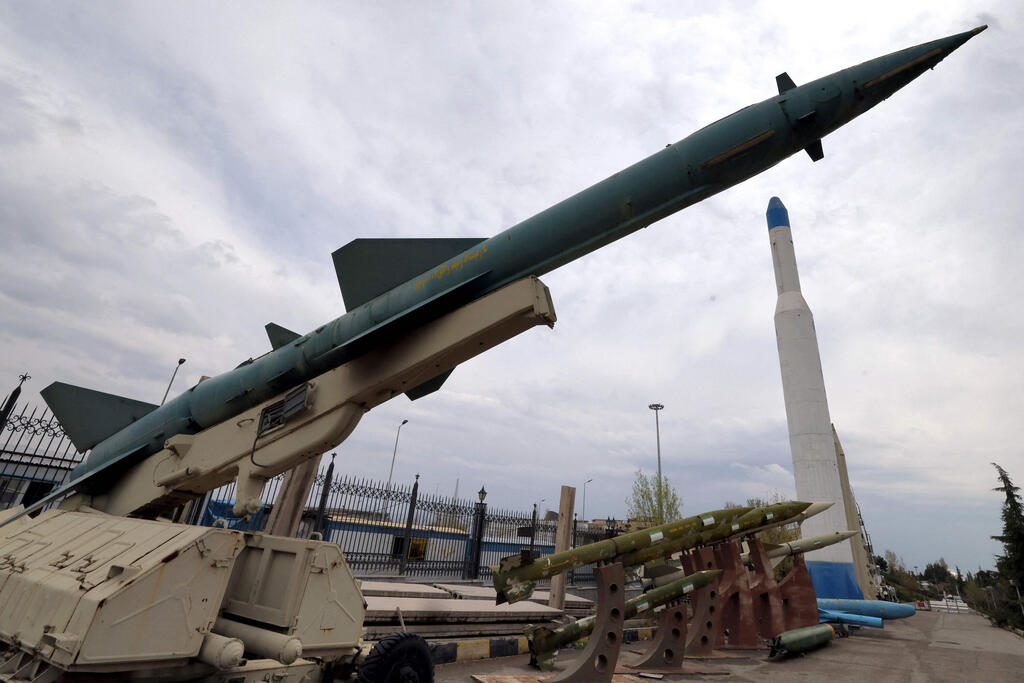
Missile display in Tehran
(Photo: AFP)
Although Israel is among the world’s most advanced countries in air defense, it is not operating alone against Iran, and the U.S. presence in the region increases opportunities for cooperation. The earlier a threat is detected, the greater the chance of intercepting it further away. The closer U.S. forces operate to Iran, the more they can strike launchers before launch or intercept threats at an earlier stage. But this is also why Iran may attempt to target U.S. bases and naval vessels.
US military superiority cannot strike everything
On paper, the balance is clear: the United States has overwhelming air, naval, intelligence and technological superiority over Iran. It can deploy aircraft carriers, bombers, stealth jets, cruise missiles, electronic warfare and advanced defense systems. Iran relies on a different strategy: dispersion, concealment, missiles, drones, proxies and the ability to turn any escalation into a regional and economic crisis.
This is precisely Trump’s dilemma. Another strike could hit additional launchers, missile sites and Revolutionary Guard infrastructure. But even after significant operational gains in the last round, the campaign has not achieved a strategic knockout: the regime remains in place, missile capability has not been eliminated and the uranium remains.
The U.S. also faces constraints. According to an analysis by the Center for Strategic and International Studies, the U.S. stockpile is not expected to run out in a plausible escalation scenario, but heavy use of Tomahawk missiles, Patriot interceptors and other systems is already creating a long-term issue: replenishment could take years and shortages could affect readiness for other theaters, especially China.
So the current balance of power is misleading if viewed only through “who is stronger.” The U.S. and Israel are stronger than Iran in almost every military metric, but Iran can still impose costs in Israel’s rear, in the Gulf, in the Red Sea, in global energy markets and in U.S. domestic politics. That is its core strategy: not to defeat the U.S., but to make any attempt to subdue it expensive, prolonged and dangerous.