


Palestinian Authority President Mahmoud Abbas marked his 90th birthday on Saturday without a public appearance or special celebrations, as public debate over his successor and the political future of the PA reached a peak. Palestinian officials and academics warn that residents of the West Bank are facing two difficult options. Without elections, they say, the system could unravel. With elections, the political map could shift in unpredictable ways.
Abbas is the second-oldest serving leader in the world, behind only Cameroon’s president, Paul Biya, who is 92. He has served as president of the Palestinian Authority since 2005 and also heads the PLO. Despite his advanced age, he continues diplomatic and political activity, but public opinion surveys show a steep decline in support for him.
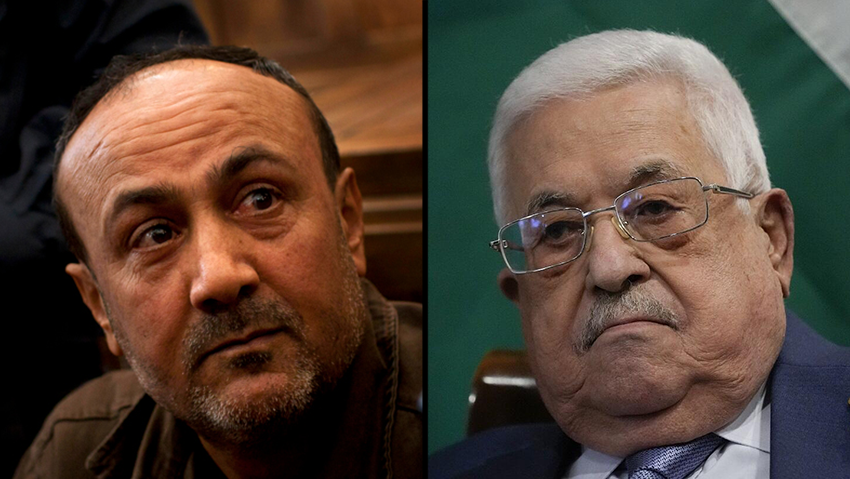
Barghouti and Abbas
(Photo: AP)
“The leadership is speaking openly about the need to find a replacement for him, but it cannot be done without going to the polls,” a senior Palestinian official told Ynet. “I believe Abbas has no chance of being reelected. Fatah fears that the younger generation will push it aside, but it is not the only one that is afraid. Other Palestinian factions are also worried because they do not know how a generation that has not experienced democracy in 20 years will act.”
According to the official, Abbas’s deputy, Hussein al-Sheikh, is not considered a presidential candidate and would at most serve as a technical interim figure until an elected government is formed. He said Palestinian Prime Minister Mohammad Mustafa is also unlikely to win. “He completely failed during the war, salaries were frozen, and he did not present any model of success,” the official said. “The real opportunity in future elections will belong to independent candidates. Business leaders and wealthy figures are alarmed by the situation, so they will distance themselves from the factions and unite around independent contenders.”
In recent weeks, there has been renewed discussion of Marwan Barghouti, who remains imprisoned in Israel. “During the war, his political standing weakened significantly, but the fact that Netanyahu’s government did not release him in the hostage deal guarantees him a sweeping victory in any future election he enters,” the official said. “Had he been released before the war, he might not have won.”
Dr. Nasser Laham, who advised both Yasser Arafat and Abbas, recently published a sharply worded article criticizing the absence of elections in the PA. “There are 1,000 real reasons to postpone elections and one small reason to hold them, to raise a generation that believes in democracy and in changing leadership,” he wrote. “That small reason is more important.”
Laham compared authoritarian regimes in the Middle East with democratic states in the West. “The regimes that talk about democracy imprison and abuse their opponents,” he wrote. “In contrast, other oppressive states hold elections on time.” He added that Israel’s control of the West Bank makes elections difficult because of restrictions on movement and the need for international oversight. Still, he noted, “When there is real political will, elections can be held even inside prisons.”
Without elections soon, he warned, “the Palestinian system will lose international and Arab legitimacy. We have reached a stage where the coconut remains sealed and needs to be cracked open to be eaten. The same goes for the political system. The stagnation must be broken.”