

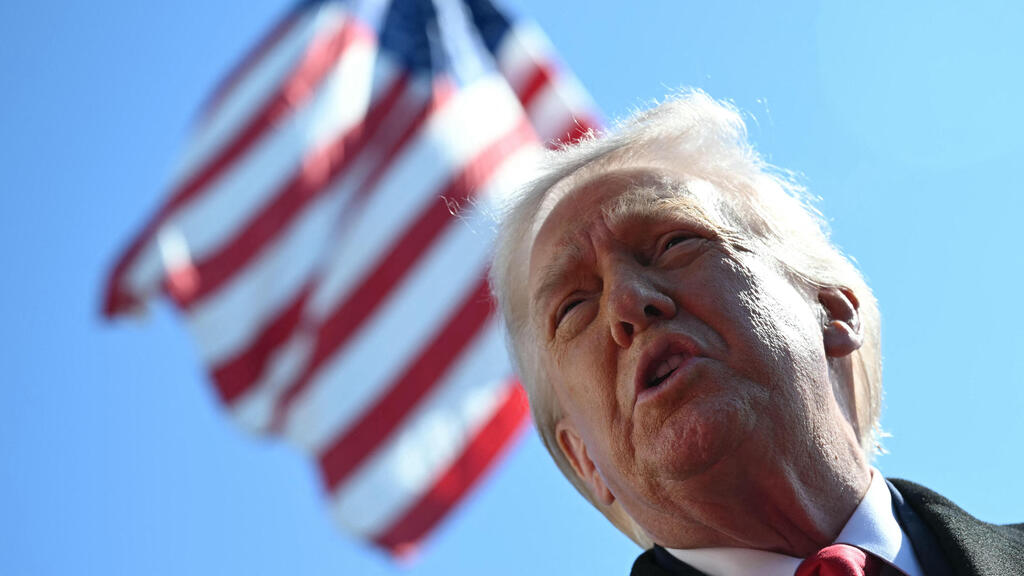
U.S. President Donald Trump claimed overnight between Monday and Tuesday, ahead of the resumption of talks between the United States and Iran later today in Geneva, Switzerland, that “Iran wants a deal.”
Speaking to reporters aboard Air Force One, the American president added: “I’ll be involved in the talks indirectly, and they will be very important.” When asked about the chances of reaching an agreement, he replied: “I don’t think they’re interested in the consequences of not reaching a deal.”
On the American side, envoys Steve Witkoff and Jared Kushner will participate in the talks, while Iran will be represented by Foreign Minister Abbas Araghchi, joined by several diplomats from Tehran. The talks are being mediated by Oman’s foreign minister, Badr al-Busaidi, after the previous round was held in Muscat, the Omani capital.
In the previous round, the discussions were conducted in such a way that Araghchi left the room where the talks were taking place before members of the American delegation arrived, though according to reports, they did shake hands.
Trump appears to be continuing to apply pressure on Tehran on both the diplomatic and military fronts, as the United States continues to deploy military assets to the Middle East. On Monday night, U.S. Ambassador to Israel Mike Huckabee said that Israel, the United States and Jerusalem are coordinated regarding the negotiations.
“I was in Washington last week in meetings that President Trump held with Prime Minister Netanyahu. I’m telling you that the U.S. and Israel are fully coordinated on the issue of Iran,” Huckabee clarified. “We are true allies on this issue of dealing with the nuclear program and the ballistic missile array.”
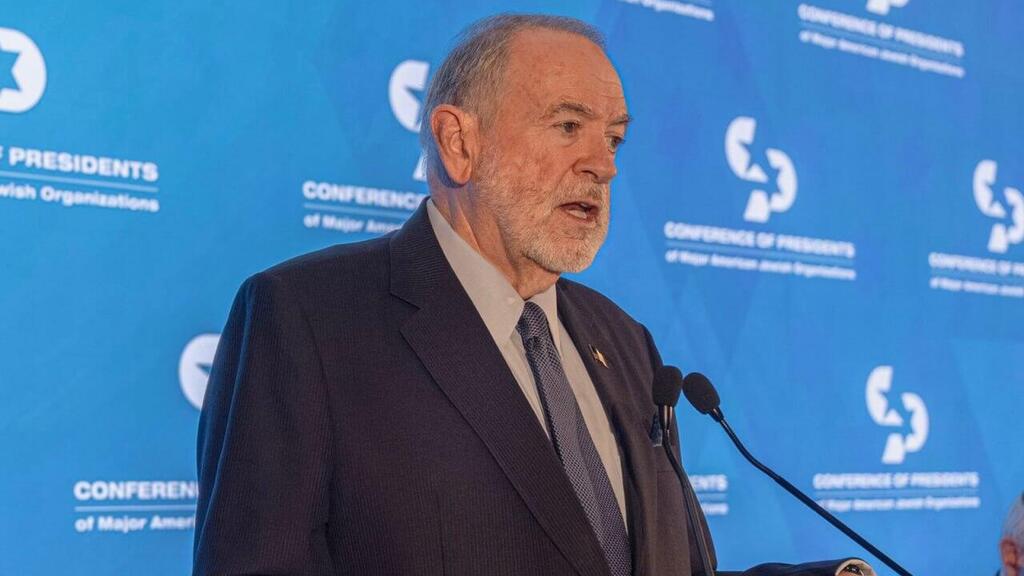
US Ambassador to Israel Mike Huckabee
Huckabee, speaking in Jerusalem at the annual conference of the Conference of Presidents and addressing leaders of American Jewish organizations, noted that “for more than 47 years, since 1979, the Iranian regime has called for the destruction of the United States and Israel. Iran is not just a problem for the U.S. and Israel, it is a problem for the world.” Regarding the talks, he said: “I don’t know whether this round will succeed. I don’t know whether within the framework of the negotiations we will be able to remove the threat of nuclear weapons, ballistic missiles and the financing of terror.”
Also addressing the negotiations Monday night was U.S. Senator Lindsey Graham, a Republican considered close to Trump. After meeting with Netanyahu, as well as former Prime Minister Naftali Bennett, he said at a press conference in Tel Aviv: “I heard from Netanyahu that there are no disagreements between the U.S. and Israel on Iran.” According to Graham, “We are weeks away, not months, from a decision on this matter. The Iranian regime is weak and at its weakest point since 1979. The economy is shattered. The military is weakened. Iranian citizens are in the streets demanding an end to the regime. The opportunity must be seized.”
On Tuesday, Iran will mark the 40th day since the deaths of many thousands during protests that erupted last month and were massacred in a brutal crackdown by the regime. Authorities in Iran are planning ceremonies to be held across the country’s provinces, and the government has invited the public to participate. Iran’s General Staff said it would be “a memorial ceremony for the victims of the American-Zionist rebellion.”
On Monday night, at a small demonstration held in Ilam province in western Iran, protesters chanted “Death to Khamenei,” referring to Supreme Leader Ayatollah Ali Khamenei.
Iran’s military drill and the “economic incentives” for the US
Alongside Trump’s remarks, the U.S. military continues to significantly reinforce its air and naval assets in the Middle East. According to a CNN report, the redeployment of forces and equipment is intended both to deter Iran and to be ready for use should the talks fail. The report, citing sources familiar with troop movements, said U.S. Air Force assets stationed in the United Kingdom, including refueling aircraft and fighter jets, have been repositioned closer to the Middle East.
The United States is also continuing to send air defense systems to the region, according to an official American source. Another source familiar with the matter said that several U.S. units deployed in the region and scheduled to rotate out in the coming weeks have been ordered to extend their stay. Flight-tracking data show that in recent weeks, dozens of U.S. military cargo planes have transported equipment from the United States to Jordan, Bahrain and Saudi Arabia. Satellite imagery revealed 12 U.S. F-15 fighter jets deployed at Muwaffaq Salti Air Base in Jordan since January 25. In addition, flight-tracking data indicate that the U.S. has carried out more than 250 cargo flights to the region.
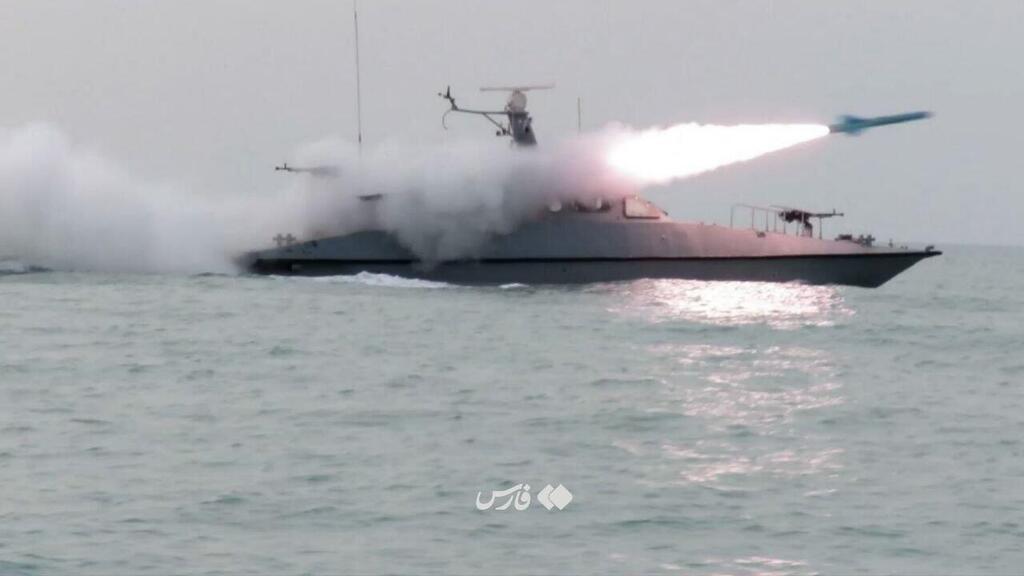
An Islamic Revolutionary Guard Corps military exercise in the Strait of Hormuz
Meanwhile, Iran’s Islamic Revolutionary Guard Corps conducted a military drill yesterday in the Strait of Hormuz, amid the possibility of a U.S. strike if talks between the sides fail. Iranian state television reported that the naval exercise, dubbed “Smart Control of the Strait of Hormuz,” was intended to prepare the IRGC for “potential security and military threats.”
The regime-affiliated Mehr News Agency wrote that “at the center of the drill is the decisive and comprehensive response of the IRGC’s operational forces to anti-security plots in the maritime arena.” Iran has repeatedly threatened to block the Strait of Hormuz, through which roughly 20% of global oil output passes. Iranian television said the first phase of the exercise included the use of strategic weapons on the three islands in the Persian Gulf.
At the same time, two sources familiar with the matter said it appears the Trump administration still lacks a clear understanding of what would happen in Iran on “the day after” the Iranian regime, if it were indeed to fall. CNN cited sources saying the likely alternatives could prove even more problematic for the United States and its allies.
In the short term, they said, the U.S. intelligence community believes the Revolutionary Guards would fill any leadership vacuum. The sources argued that a few weeks ago, when protests were raging, there were legitimate reasons to consider a strike. At that moment, they said, there was a brief window during which strikes could have given Iranians momentum to topple the regime. The sources questioned whether President Trump may have “missed the moment,” and expressed doubt that military strikes weeks after the protests would actually lead to the regime’s collapse.
CNN also cited Middle Eastern sources who said Gulf states are highly concerned about the possibility of military action that would destabilize the region. According to them, those countries are urging that diplomacy be given more time.
“Everyone is pushing back against a strike,” a diplomat in the region told CNN. According to him, the only country in the region supporting a strike is Israel. Israel, the report said, has emerged as a potential participant in joint strikes alongside the United States. It was also reported that potential U.S. targets in Iran include IRGC headquarters and other military facilities — in addition to nuclear sites.
Regarding the negotiations, CNN noted that Iran may attempt to prevent a U.S. strike through “economic incentives.” According to one source, during talks last year the possibility was raised that alongside a nuclear agreement, Washington and Tehran could reach understandings that would grant Americans access to developing Iran’s natural resources — including oil, gas and rare minerals. The source said this issue is expected to arise again in the current contacts between the sides.