


Prime Minister Benjamin Netanyahu has endorsed a Republican proposal to phase out the $3.8 billion in annual U.S. military aid Israel receives and replace it with a relationship based on defense trade and strategic cooperation, the Washington Post reported on Wednesday, citing U.S. lawmakers who discussed the plan with him last week.
The proposal, advanced by Republican Reps. Marlin Stutzman of Indiana and Abe Hamadeh of Arizona, would end direct military assistance when the current U.S.-Israel security agreement expires in 2028 and establish a new framework centered on Israeli purchases of American weapons.
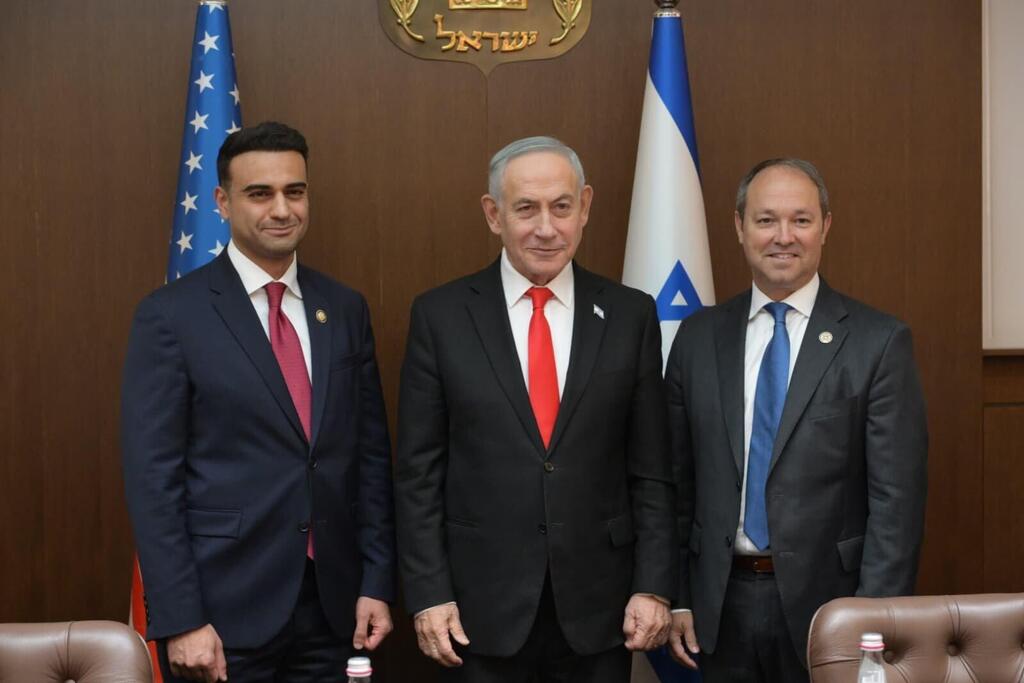
Arizona Rep. Abe Hamadeh, Prime Minister Benjamin Netanyahu and Indiana Rep. Marlin Stutzman in Jerusalem
(Photo: from X)
The initiative marks a major shift in a cornerstone of the U.S.-Israel relationship. While calls to reduce or condition aid have largely come from Democrats critical of Israel's conduct in Gaza, the latest proposal originates from pro-Israel Republicans and has received backing from Netanyahu himself.
Stutzman told The Washington Post that after reviewing a draft resolution during a meeting in Jerusalem, Netanyahu said, "I like it" and added, "This is the direction I’ve been wanting to go for a long time."
During the meeting, which lasted less than an hour, Netanyahu told the lawmakers that "We want to stand on our own feet" without American aid, according to Stutzman.
The initiative calls for drafting a new U.S.-Israel security memorandum of understanding to replace the current agreement, which expires in 2028, and for ending the $3.8 billion in annual U.S. military aid to Israel.
In a formal letter of support sent to Stutzman earlier this week, Netanyahu welcomed the move, writing that Israel values the financial component of U.S. military assistance but that “The time has now arrived for us to move from aid recipient to partner.”
The resolution is nonbinding, but it is notable because it comes from pro-Israel Republicans rather than Democrats seeking to condition or cut aid over the war in Gaza.
Hamadeh, the son of Syrian immigrants and the first Arab American elected to Congress from Arizona, said after returning from Israel that the U.S.-Israel relationship is moving from “aid to trade” and toward “true collaboration as strategic partners.”
National security officials in the Trump administration are discussing the details of a possible arrangement, though Israel is still expected to benefit from U.S. support through other channels.
The move comes amid eroding public support for Israel in the United States, including among younger Republicans, and growing criticism that U.S. taxpayers are funding Israel’s wars. A recent Pew Research Center survey found that 60% of Americans hold an unfavorable view of Israel, up from 53% last year. Among Republicans under 50, the share with an unfavorable view of Israel rose to 57%.
Netanyahu has appeared aware of that erosion. Over the past year, he has issued several statements expressing a desire to end Israel’s dependence on U.S. financial aid by the end of the decade.
U.S. Ambassador to Israel Mike Huckabee appeared to confirm the shift Monday in a post on X, writing that the new memorandum of understanding with Israel “ends aid & will be based on trade.”
Huckabee made the comment in response to criticism from Joe Kent, the former head of the National Counterterrorism Center, who resigned earlier this year over opposition to war with Iran and claimed the United States went to war because of pressure from Israel.
The debate comes as Congress considers a draft U.S. defense policy bill that includes a provision to expand security technology cooperation with Israel.
Section 224, known as the U.S.-Israel Defense Technology Cooperation Initiative, refers broadly to “systems integration” and “data fusion” between Israeli and American security forces.
In practice, the provision would require the defense secretary to appoint an official to coordinate defense technology cooperation between the countries, including research, development, testing, joint production and technology integration.
The measure points to a broader shift that blurs the line between traditional aid and trade-based cooperation.
Rep. Mike Rogers, the Republican chairman of the House Armed Services Committee and one of the provision’s supporters, rejected claims that it would transfer control of U.S. forces to Israel. He said the goal was to add transparency to the coordination of existing initiatives.
Rep. Ro Khanna, a Democrat, has said he is working to remove the provision, arguing that it would deepen military integration and create a dangerous merger of the U.S. and Israeli militaries.