


From all places in the world, the news Ayelet Goldin had waited 11 years for came in London — of all places — while she was on a delegation of families of hostages and fallen soldiers. “I was there with the Rudaeff and Godard families,” she recalls, “and during it, the Rudaeff family received word that their Lior was returning. The next day, the story of Hadar started to roll. And though it wasn’t certain, I knew in that uncertainty I wanted to be home. Those were difficult, tense days. I don’t think there are words to explain the craziness of it. A whole country is waiting, and so were we — every announcement from Hamas makes headlines, and you’re told: ‘Wait, we have no verification,’ and we wait, just wait.”
Were you afraid to hope?
“We are people of experience; Hamas is a sophisticated and evil terror organization. The fear was that they would mess with us again — that even if it was really him, they would keep holding him. A kind of absurdity emerged, as if Hamas had kidnapped him again, this time under the Red Cross’s watch. If you’re not in the picture and you say ‘there’s a deal,’ you just don’t understand. And this happened to many families. Anyone who waited more than a day.”
So when did you breathe a sigh of relief?
“When they called and said: ‘Hadar has come home.’ In those words. We cried. It was a moment for which words are inadequate to contain its emotional force. The feeling was that we’d brought home our little boy. To his land, his place, his home — that he was no longer in the hands of the wicked.”
'Dad, say more words'
Ayelet Goldin‑Kaufman, 46, is the eldest daughter of Simcha and Leah Goldin. After her came Hami, and the twins Tzur and Hadar. She is married to Eyal, and they live in the moshav of Natur in the Golan Heights. They have six children. The two youngest, twin boys, age seven, were born after their uncle Hadar’s fall but were not named “Hadar.” Nor are any of the ten grandchildren of Leah and Simcha. “For me personally, I really wanted to have a ‘Hadar’ alive,” Ayelet says, “but when I discovered we were having twins, I felt I needed to go through a process of letting go of the name because you can’t have Hadar A / Hadar B. So we chose to call them Neta and Yair. ‘Neta’ because he is planted in our hearts, planted in the Land, and ‘Yair’ to light our way, as Hadar’s radiant smile would.”
Let’s go back to August 1, 2014, the cease‑fire in Operation Protective Edge.
“It was a crazy time. Everyone was in reserve. My husband came back that same morning or the night before. At 2 a.m. I was talking with Tzur and Hadar, who told me: ‘There’s a chance we’ll be home by Shabbat.’ There was a festive feeling of a cease‑fire. I remember us on the lawn in Natur, celebrating end‑of‑year kindergarten or nursery, part of the moshav’s year‑end festivities. When we returned, my father called, and I still remember his words: ‘Hadar is either captured or dead,’ and he couldn’t say more. I remember screaming: ‘Dad, say more words,’ because it didn’t make sense. There was no logic in it. He couldn’t say anything more.”
Kidnapped. Did you even understand what that means?
“We didn’t really. We ran to my parents’ home in Kfar Saba, and things rolled from there. We were in the middle of a kidnapping event. They said he was hurt, and they didn’t know what else. It took us until morning to wake up and say: ‘We are strong people, we have to understand ourselves what’s happening.’ And we began activating contacts. I worked then at the Jewish Agency, so I tried to go abroad. My father’s team from the army arrived and we opened an operations room.
“I reached people who had gone through it before us. Wherever I asked, people told me: ‘You are alone in this battle. You are the only one.’ I remember those words as though they were spoken yesterday. Also they told me: ‘You must understand: only you see Hadar. Everyone else sees interest. And you will bring Hadar.’ It was true, but then I didn’t understand. Since October 7, I’ve found myself saying words that families struggle to understand. Because there are processes you must go through.”
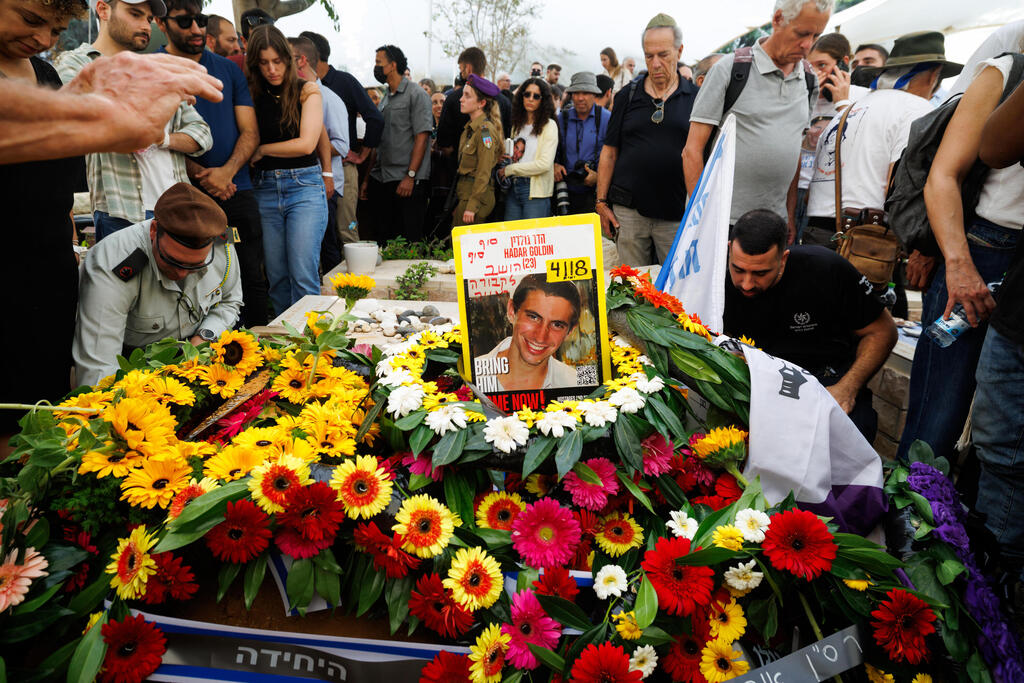
Funeral in Kfar Saba, this week
(Photo: Ziv Koren)
Crowds on the way to Hadar Goldin's funeral:
(Video: Yariv Katz)


“On Saturday night,” she continues, “they told us that the soldiers entered the tunnel after him, found his uniform and brought everything left at the scene. Basically, we were told in gentle language that they knew he was dead. They told us the injury was so severe that even if Hadar got onto a helicopter, he wouldn’t have survived. It’s something you’re supposed to accept, but it was very hard to accept without seeing him.
“The chief military chaplain, Rafi Peretz, the defense minister, Bogie Ya'alon, the head of the manpower directorate, Orna Barbivai and the chief pathologist of the Israel Defense Forces — all of us believed in the army, so we didn’t doubt their words. I remember people pressuring us hard to hold a funeral. Looking back, I can say I hold very deep anger toward the system. I heard many families now talking about it — that they were pressured so heavily to do a funeral. I feel that our story was designed to put the families into closure. To become part of the framework so that afterwards they can say: ‘What do you want? You have a grave,’ like they told us.”
Crisis with the leadership
For 11 years they have been engaged in the struggle. Without financial or media backing like the Hostages’ Families Forum, Simcha (a historian) and Leah (a software engineer) went the world over, from interview to interview and from one leader’s office to another. Over time, others joined them, and the “Bring Back Hadar Goldin” organization became the “Hadar Mission.”
In 2018, during the kite‑terror period, Simcha decided to hold a rally every Friday next to the Black Arrow memorial, directly across from Gaza. These rallies were also attended by residents of the Gaza‑border region who had been kidnapped and murdered on October 7, like Elad Katzir and Tsachi Idan. The banner bearing the faces of the four hostages — Goldin, Oron Shaul, Avera Mengistu and Hisham al-Sayed — was painted by Aviv Kutz, from Kibbutz Kfar Aza, who was himself killed in his safe room while embracing his wife and children.
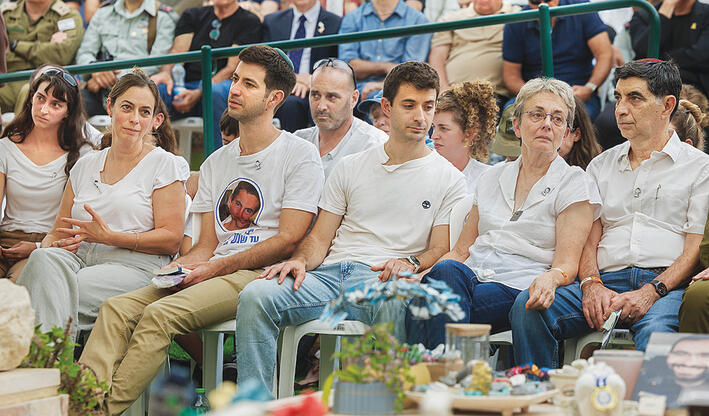
The Goldin family at the funeral, this week
(Photo: Ziv Koren)
“On October 7th, people called me, just like 11 years ago I called someone who knows about kidnappings,” says Ayelet. “The phone never stopped ringing: ‘My son was here, he was there,’ ‘What do I do?’ ‘How do I find him?’ as though I’d become some authority of knowledge.”
During the years of struggle opportunities arose to bring Hadar home.
“There were moments when Hadar, Oron, Avera and Hisham were supposed to come back — and were simply abandoned. Those were deep crises with the systems. I had a very big crisis with the religious leadership that I thought would fight for the most sacred commandment — but it didn’t. That crisis goes on to this day, and will continue until the remaining hostages return.”
They never prioritized a deal for Hadar, she says. “I don’t call it a deal but the end of the war, because a deal makes it small. It’s hard for me to say what would have happened if not for October 7. For many years, we tried to warn and we felt that if they had listened to us, if they understood the value Hamas puts on hostages and didn’t try to turn them into a burden rather than a leverage, October 7 wouldn’t have happened. Hadar became a symbol for them. The generation of young terrorists who entered kibbutzim over the past decade were raised on that value — kidnapping an Israeli soldier.
“At the end, the people brought back the hostages,” she concludes. “All the journey of the funeral, the people lining the roads, bikers who escorted us — the moment we reached Kfar Saba, the city was full. It gives extraordinary power. You realize the people are with you. This was really a very special funeral and shiva. I feel people sense a kind of victory — maybe not victory because we still have hostages — but a feeling of success, that ‘we can,’ that we will bring them, that we can and we will do better.
“For so many years, it was ‘what are you fighting for.’ Today, everyone understands — as my brother Hami said, ‘Don’t mess with the family of Israel.’ They don’t kidnap us, don’t take us, don’t crush us, don’t finish us. That’s what Hadar’s return symbolizes — because of all of them, above all, they thought they couldn’t return. So if he returns, everyone returns. For me, it gave a feeling that this nation will change history.”
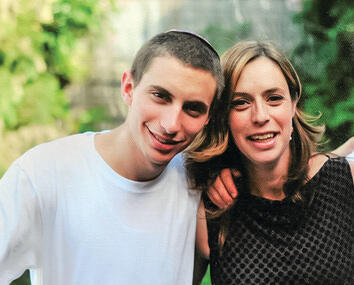
Ayelet with Hadar
She wrote the eulogy on Hadar’s grave at 5 a.m. on the day of the funeral. “In the last two years, I wrote myself all sorts of points and collected them, looked for them. It was very important to me to create an aspect that is human and restores Hadar’s humanity. That he was Hadar. In the whole struggle over the dead, a kind of dehumanization is created. You’re always dealing with the word ‘remains,’ dealing with fragments that de‑humanize the person. And it was important to me to talk about the man he was — not the remains, not just ‘the fallen.’ He was Hadar.”
How do you say goodbye to him?
“These are very personal moments that are hard for me to talk about. I’ll say that the people of Shura (bereavement center) were angels — sensitive and gave us intimacy and space. I felt a spiritual experience. To see, to feel, to finally speak to my younger brother — it brings a lot of warmth into body and heart. The knowledge that he is here, in a safe place. To see with my eyes my little brother. I needed that.
“For me, there are still things as though he left yesterday from the door. My love for him, my desire to hug him, how I see him in my eyes — through all of this, time seems to have stopped for me. As my brother Hami once said: it’s as if when we look at our grandparents who survived the Holocaust, something in their eyes is still ‘there.’ I think the same applies to us. We are a little still back ‘there’. We’ve progressed, but we are still ‘there.’
And now that he’s home?
“I’m only in the shiva right now — he returned two days ago, I still don’t know how I’ll be.”
Proud to be Hadar’s sister
The age gap between Ayelet and Hadar is twelve years. “Because of that,” she says, “I always felt somewhat like a little mother to him. Tzur, his twin, gets annoyed by that, but yes — this was my relationship with them. They were my younger brothers. I feel so much sadness that Hadar is not here and there were times I imagined the children he could have had. My mother always said for many years that we were a captive family — not a bereaved family. If you were captive, in battle, on the run — your whole family is kidnapped. You work on bringing someone back from captivity.”
When Hamas said there were those they would not bring back, that they did not know where they were — were you afraid it would be Hadar?
“That’s a lie. I say this to every family: If Hamas brought back Hadar, they will bring back everyone. We see that all of them are assets for them. The twenty lives brought back prove it — Hamas is keeping them all. The issue they have is not knowledge: they know exactly where everyone is. Their issue is motivation.”
Why did you refuse a visit from Benjamin Netanyahu?
“I do not enter politics, but it’s not true that we refused. It was simply a moment when we really just wanted to be the family. We needed that togetherness and requested that no one come at that time.”
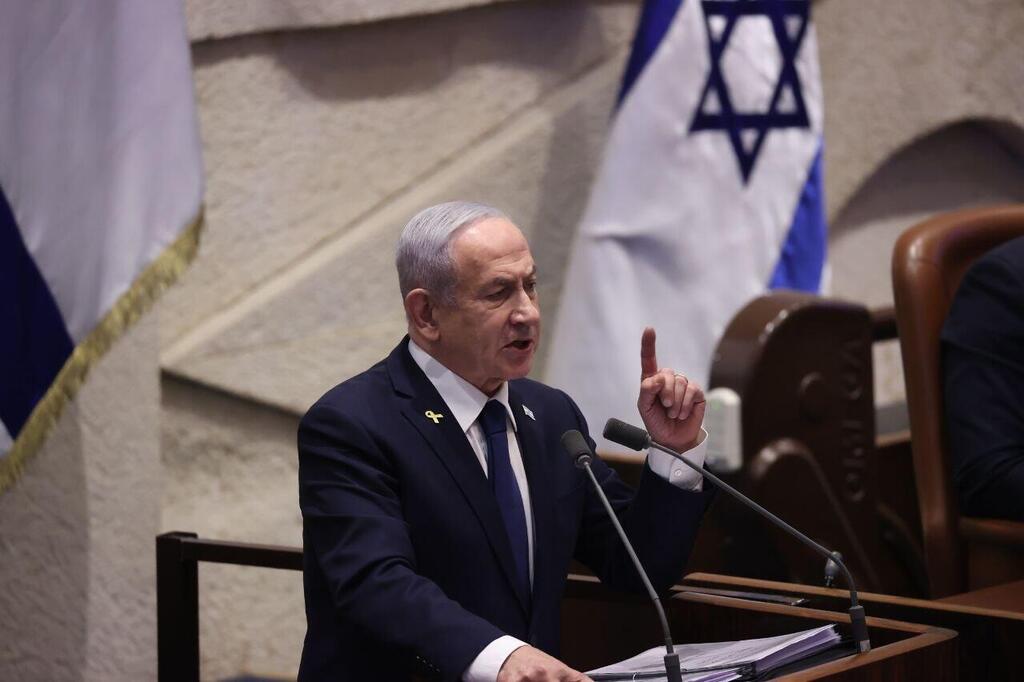
Benjamin Netanyahu
(Photo: Alex Kolomoisky)
Will you be open to future visits?
“My message is not ‘Yes Bibi’ or ‘No Bibi.’ Our home is open to everyone — and we still have hostages to bring home. I will say this: whoever comes here, I don’t need their apology — I need to know what they’re going to do now. Not what they failed to do, but how they intend to fix it.”
Have you thought about a “day after”?
“There is no ‘day after’ yet. First and foremost, all the hostages must be returned. You cannot conclude a war leaving hostages behind. It won’t happen, and we will fight for it. Beyond that, I feel we must continue to fight to change. We have become a nation that abandons its citizens — not acceptable anymore. Much work lies ahead to repair Israeli society. Simply having them return is not enough.
“I hope that along with bringing Hadar home, we also bring the repair of Israeli society itself, because the society here will no longer accept choosing interests over values. The Israeli public understands now that only our values will define us. And you see among the many terrible things also so much good.”
Don’t you want to rest?
“I don’t even know what the word ‘rest’ means. I was raised with the understanding that there is always something to do, to do good. These are the values I grew up with and carried into my adult life through the work I chose. I see it in my brothers, too. Those choices intensified since Hadar is not here, because you feel the mission is now on us. Even in his short life, he left us messages — in his work, in his letters, in how he saw others. For me, if he’s not here, the task is ours to make things better here. The heart of Israeli society is in the right place, but leadership has broken away — and our job is to bring it back.”
You’ve recently started speaking at rallies.
“We are people, all of us, who work in associations or social fields — not used to or comfortable being in the front, and you sometimes don’t understand what it does for people. I think people learned to know me and to know Hadar, and they connect to what we have to offer. In such a cynical and self‑interested era, people look for the right words — the honest, Israeli words.”
How has Hadar’s story influenced your parenting?
“My son, who was in 10th grade at the time of the kidnapping, joined the Givati Brigade; my daughter enlisted, too. They knew Hadar, grew up on his values. I believe that through his death, an added dimension of depth and value was given. Because their uncle — it could’ve been them — he’s not here, there’s a responsibility on me to bring him to them.”
What do you tell the younger children who never knew him?
“Children know everything, hear everything and live it. We tell them who he was, through family stories, through books. They tell about him in class and are very moved. And of course, they were very excited that he came home and that they are here with us for the shiva.”
Would you like to return to being just Ayelet?
“I am proud to be Hadar’s sister — proud of his life and proud even though he is not here. I will continue to speak about him and tell his story. I see Hadar alive through his legacy, through the young men and women in pre‑military programs, in the army, in courses, through what they do. He lives not only in my heart, but in many hearts — and that gives me strength and meaning.”