


President Isaac Herzog’s legal adviser on Tuesday invited the parties in Prime Minister Benjamin Netanyahu’s criminal cases to hold talks at the President’s Residence in Jerusalem in an effort to reach understandings, the first explicit attempt by the president to advance a possible plea agreement in the cases.
The move came after Herzog effectively made clear that a pardon for Netanyahu is not on the table at this stage.
Gallery
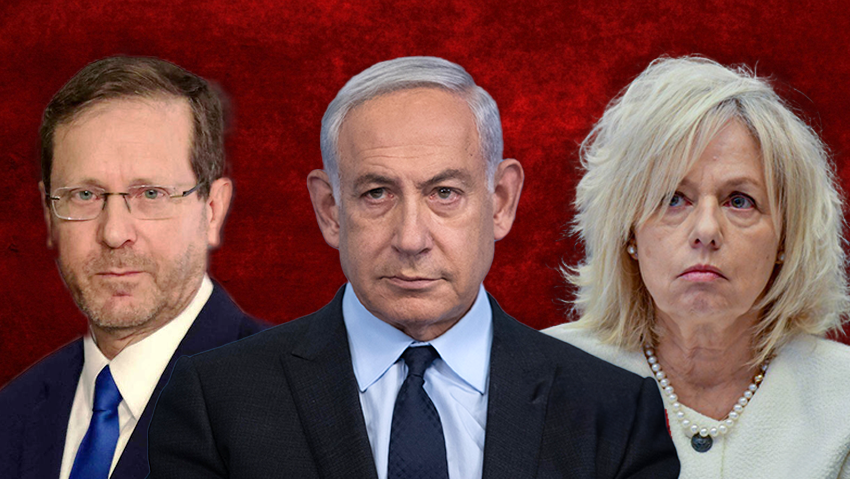
President Isaac Herzog, Prime Minister Benjamin Netanyahu, Attorney General Gali Baharav-Miara
(Photo: Alex Kolomoisky, Rafi Kotz, AFP)
“This process is intended to explore the possibility of advancing understandings and agreements, and constitutes only a preliminary step before the President considers exercising the pardon authority,” the President’s Office said in a statement. “The parties were asked to come at the earliest opportunity, with an open heart and sincere, good intentions.
It was made clear to the parties that participation in the process does not constitute consent or authorization regarding any point of contention, and does not prejudice their arguments in the pending court proceedings.”
The letter was sent to Attorney General Gali Baharav-Miara, State Attorney Amit Aisman and Netanyahu’s defense attorney, Amit Hadad, under the heading “Invitation to conduct discussions at the President's Residence.”
Attorney Michal Tsuk-Shafir, Herzog’s legal adviser, wrote that “The President of the State of Israel, having consulted with me, is of the opinion that prior to considering the exercising of the President's pardon authority relating to the request submitted in the case of the Prime Minister, holding discussions between the parties in order to reach agreements, must be exhausted first.”
Without mentioning the word pardon, Tsuk-Shafir wrote that “It seems there is no dispute over the value of a conciliatory discussions that would result in a settlement. The courts also considers such a process worthy and effective. This, particularly pertaining to such matters that are at the core of the public debate in Israel. The President himself has often expressed his high regard and support for solution-oriented discussions between the parties.”
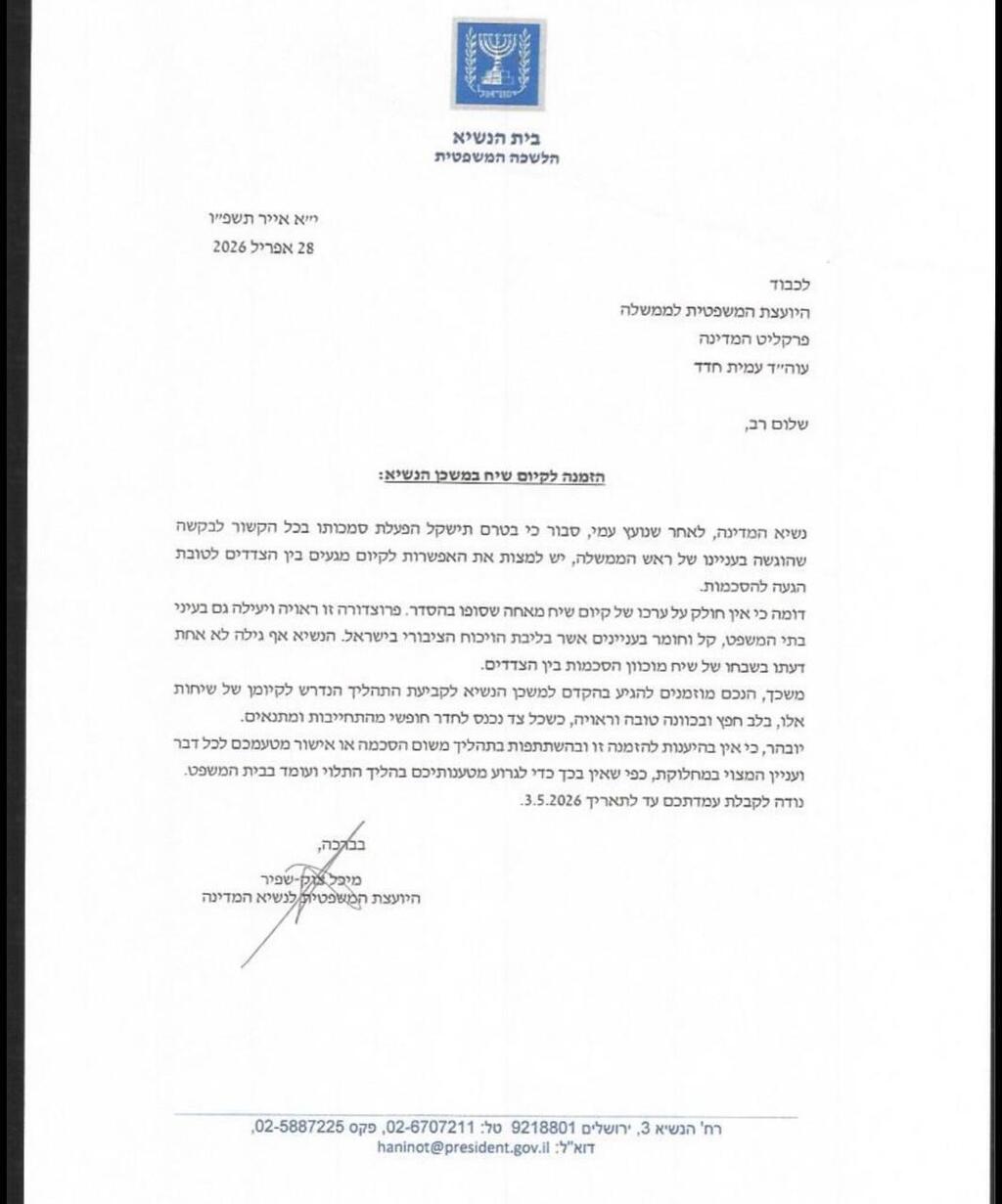
The letter sent by President Isaac Herzog’s legal adviser calling for mediation in Netanyahu's criminal cases
At the end of the letter, she invited the parties “to come to the President's Residence at the earliest, towards agreeing the process required in order for these discussions to take place with an open heart and sincere, good intention, allowing each party to enter the room free of commitment and condition.”
She added that participation in the process would “not constitute consent or authorization of any point of contention, and similarly does not prejudice your arguments in the pending court proceedings.”
Earlier this week, The New York Times reported that Herzog does not intend to grant Netanyahu a pardon at this stage, and will instead seek to advance a plea agreement. According to the report, Herzog does not plan to respond for now to the prime minister’s pardon request. The President’s Office later confirmed the report, saying that “an agreement between the parties is a proper and correct solution.”
The newspaper cited two senior Israeli officials described as having direct knowledge of the president’s thinking. According to them, Herzog believes there are many options beyond the binary choice of “pardon or no pardon,” and that the president’s main role is to foster unity. He therefore does not intend to respond positively or negatively to Netanyahu’s pardon request, preferring instead to resolve the issue through negotiations.
Netanyahu submitted his pardon request in late November. Handling of the request was transferred last month from Justice Minister Yariv Levin to Minister Amichai Eliyahu. Levin said he transferred the matter to prevent “attempts to delay the process by many months, on the grounds that his recommendation should be disqualified due to a conflict of interest.” At the time, the Justice Ministry’s pardons department issued an opinion saying the pardon request did not meet the threshold conditions.
The pardons department’s position and its contents were not made public. Details obtained by ynet indicate that it said, among other things, that it is difficult to define Netanyahu as an “offender” — a basic condition for submitting the request — because his trial has not yet concluded and he has not been convicted. It also said he has not expressed remorse for acts of which he has not been convicted, nor has he admitted guilt.