

Two days after the meeting between U.S. President Donald Trump and Prime Minister Benjamin Netanyahu, concern is growing in Lebanon over the outcomes of the summit held at Trump’s Mar-a-Lago estate.
Political sources quoted on Wednesday by the newspaper “Al-Akhbar,” which is affiliated with the Hezbollah terrorist organization, said it is unclear where Israel is headed, particularly what form of escalation it may pursue and on what scale.
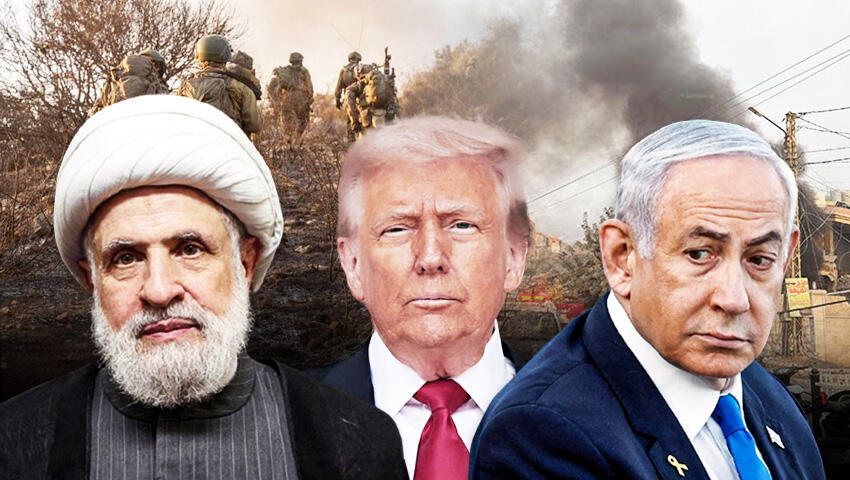
Hezbollah chief Naim Qassem, U.S. President Donald Trump and Prime Minister Benjamin Netanyahu
(Photo: IDF, Amir Cohen/ Reuters, Jessica Koscielniak/ Reuters)
Trump avoided giving a direct answer when asked whether Israel should strike if Hezbollah does not disarm by 2026, responding only, “We’ll see what happens.” According to the sources cited by the newspaper, that ambiguity itself is what is fueling concern in Lebanon.
“It is impossible to predict the consequences for Lebanon, but it is possible to assess that many changes will take place at the beginning of the year,” the sources said.
They added that their assessments are based on developments across several arenas, “from Somaliland to Yemen, Sudan, Iraq and Iran.” At the same time, the Lebanese newspaper “Al-Joumhouria” reported that there is a growing impression that “Trump has given Netanyahu a green light in Lebanon.”
Sources quoted by the paper said the deadline for completing the first phase of damage containment south of the Litani River is limited and will not extend beyond two months, meaning until the end of February.
Benjamin Netanyahu and Donald Trump
(Video: Reuters)


Meanwhile, the Lebanese army issued a statement calling on citizens ahead of the New Year to cooperate in order to maintain public safety and refrain from gunfire. The army reminded the public that weapons carry permits remain suspended until January 2.
At a news conference at his Florida estate, Trump said the Lebanese government is at a disadvantage compared with Hezbollah and again declined to say whether he would support another Israeli strike in the area. “We’ll see what happens. Hezbollah is behaving very badly, so we’ll see what happens,” he said.
ynet analyst Ron Ben-Yishai explained that in both Lebanon and Syria, the United States currently lacks concrete plans to disarm Hezbollah or stabilize the regime in Damascus. As a result, Washington is buying time and backing Israeli threats, hoping this pressure will push both governments to show flexibility and take steps Israel is demanding.
The Mar-a-Lago meeting took place three months after Netanyahu’s previous visit to the United States in late September, when the framework for a cease-fire agreement in Gaza was finalized. After the meeting and a working lunch, Trump said, “We reached many understandings,” adding, “There may still be a few surprises before the New Year.”
Shortly afterward, the Pentagon announced an $8.6 billion contract under which Boeing will supply Israel with 25 new F-15 fighter jets, with an option for 25 additional aircraft. The planes will be the upgraded F-15IA Ra’am, an advanced version of the F-15I.
About two weeks ago, the IDF said Hezbollah had violated the cease-fire agreement more than 1,900 times since it took effect about a year ago. Since early October, at least 30 terrorists have been killed in 30 different villages.
“These terrorists join more than 380 terrorists eliminated since the cease-fire came into force,” the IDF said at the time. “They were involved in terrorist activity in southern Lebanon, including rebuilding terrorist infrastructure, smuggling weapons and coordinating between village residents and Hezbollah headquarters, in clear violation of the understandings between Israel and Lebanon.”