


Prime Minister Benjamin Netanyahu indicated Sunday night that Israel may no longer pursue partial hostage release deals, declaring that the decisive blow against Hamas will come through “sophisticated methods that will surprise” the group. Speaking hours after addressing foreign journalists in English, Netanyahu announced he had instructed the Israel Defense Forces to accelerate the timetable for capturing Gaza City and to act “faster and earlier” in order to end the war swiftly — aligning with U.S. President Donald Trump’s call for a quick resolution.
Following the press conference, Netanyahu spoke with Trump. According to a statement from the Prime Minister’s Office, the two discussed Israel’s plans “to take control of the remaining Hamas strongholds in Gaza to end the war by freeing the hostages and defeating the terrorist organization.” Netanyahu thanked Trump for his “steadfast support” since the conflict began.
Netanyahu acknowledged that international diplomatic pressure on Israel would “end the moment the war ends.” He accused Western leaders of privately supporting Israel’s position while publicly withholding support due to domestic political concerns. Netanyahu also criticized Australian leaders for calling civilians to evacuate areas near Gaza, saying if they had experienced an attack like Israel’s Oct. 7 massacre, they would have responded as Israel has rather than undermining the element of surprise.
Regarding negotiations, Netanyahu said Hamas set “terms of surrender” Israel could not accept — including releasing Nukhba terrorists, international guarantees against renewed fighting and withdrawal from the Philadelphi Corridor. Israeli negotiators reportedly viewed the gaps as bridgeable but Netanyahu said no deal was possible, suggesting Israel ended talks abruptly.
Netanyahu reiterated his commitment to securing the release of all 20 hostages still alive but avoided questions about partial deals or those already killed. “We cannot look our children in the eyes and leave the perpetrators of the massacre just beyond the fence, only meters away from our communities,” he said.
Opposition leaders sharply criticized Netanyahu’s remarks. Opposition head Yair Lapid called the press conference a “horror show by a failed prime minister who replaced reality with a slideshow.” Critics noted a contradiction in Netanyahu’s rationale for prolonging the Gaza conflict, contrasting it with his praise for the “12-day war” against Iran that was shortened to limit damage. Netanyahu said the delay was due to the need to address threats in Lebanon, Syria and Iran.
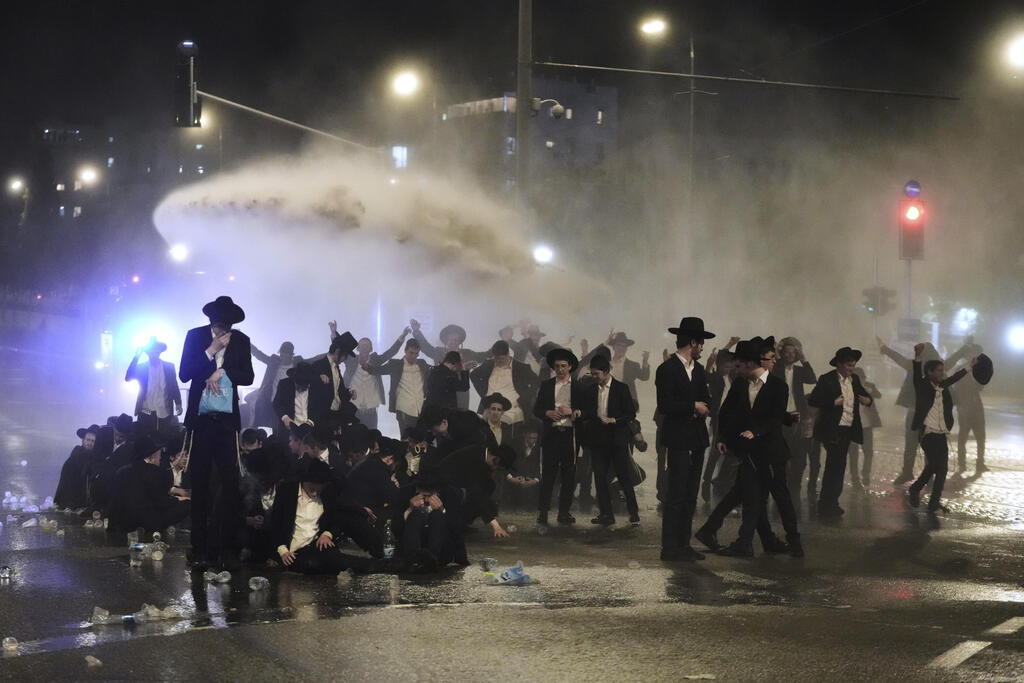
Extreme ultra-Orthodox protest in Jerusalem
(Photo: AP Photo/Mahmoud Illean)
On domestic issues, Netanyahu vowed to advance legislation to draft ultra-Orthodox men into the military, promising the recruitment of 10,000 Haredim “quickly.” He criticized opponents for stalling the bill and said under new leadership in the Knesset committee, the legislation would move forward with personal sanctions for noncompliance.
Amid tensions with military leadership, Netanyahu stressed civilian control over the army, saying, “We are a country that has an army, not an army that has a country.” He insisted the government sets policy and the army carries it out, though he does not dictate military deployments.
Netanyahu defended Shas party leader Aryeh Deri against criticism after recordings surfaced of Deri urging ultra-Orthodox men not to enlist. Netanyahu said he does not support the remarks but noted Deri denied making them directly to him.
On Iran, Netanyahu claimed Israel had dealt significant damage to its nuclear program over the years and stressed readiness for a possible surprise attack.
The press conference included several awkward moments. Netanyahu confused Trump with President Joe Biden and mixed up Hamas and Hezbollah, prompting aides to quietly correct him. At one point, he asked for a glass of water.
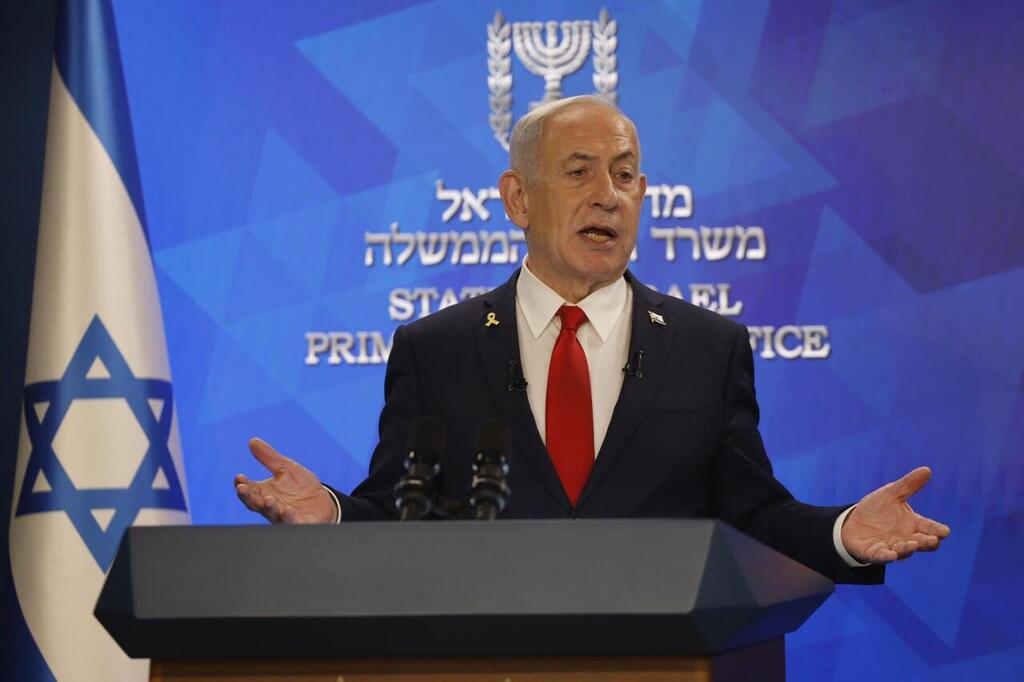
Prime Minister Benjamin Netanyahu
(Photo: Yonatan Zindel/Flash90)
The event was held in a newly renovated media room equipped with a high-tech screen displaying maps of Gaza and Hamas strongholds, which Netanyahu used to underscore the goal of destroying the terrorist group’s last positions.
Netanyahu appeared to simplify his message for public support. While his session with foreign journalists was largely successful, he clashed with Israeli reporters, accusing them of “propaganda speeches” and flawed assumptions. He boasted of being Israel’s most articulate spokesperson, especially in English, despite lamenting that he does not appear often enough.
Get the Ynetnews app on your smartphone: Google Play: https://bit.ly/4eJ37pE | Apple App Store: https://bit.ly/3ZL7iNv
Netanyahu criticized Israel’s traditional public diplomacy apparatus as outdated in an era dominated by “perception campaigns, algorithms and bots.” He hinted that hundreds of millions of shekels transferred to the Foreign Ministry are helping meet these challenges. He cited successes in the “12-day war” against Iran and in preventing two protest flotillas aimed at Gaza but acknowledged Israel’s difficulties countering Hamas’s messaging on starvation and genocide.