

Energy and Infrastructure Minister Eli Cohen said Wednesday evening that the shutdown of Israel’s desalination plants is largely over and that the country’s water system is expected to return to full operation soon after an unprecedented algae-related disruption.
Five of Israel’s six desalination plants along the Mediterranean coast were shut down during the week because of unusually high turbidity in the seawater, apparently caused by algae that officials believe drifted north from the Nile region in Egypt.
Sorek 2 desalination plant
(Video: Meir Turgeman)


“I am glad to say that the shutdown of the desalination plants is mostly behind us and that the water system will soon return to full operation,” Cohen said.
As of Wednesday evening, three of the five affected facilities had resumed partial operations. Two plants, believed to be Ashdod and Ashkelon, remained offline.
Cohen said authorities had compensated for the reduced desalination output by increasing pumping from the Sea of Galilee and groundwater wells.
“We made sure to supplement water sources by pumping from the Sea of Galilee and from wells,” he said. “We have a diverse range of water-production sources.”
He added that reserves had been increased to help the system cope with any further disruption.
Despite the shutdowns, Cohen said no damage had been identified at facilities that had resumed operations, though turbidity in the seawater remained elevated.
According to the minister, the algae event was unlike anything Israel had experienced in decades.
“This is a natural phenomenon the likes of which we have not seen in the past 30 years,” Cohen said. “According to experts in the field, the algae came from the Nile region, raising turbidity to a level we had never seen before. This was definitely a very significant extreme event.”
Desalination facilities supply about 70% of Israel’s water consumption. On Tuesday, water deliveries to farmers in southern Israel were temporarily halted, though officials said there was no current shortage for households or industry.
Water Authority Chairman Yehezkel Lifshitz also described the incident as unprecedented.
“We are still examining the incident,” he said. “There are more than 1,000 wells, and we also have the Sea of Galilee, and that is how we managed to supply water to every home in Israel while desalination plants were shut down.”
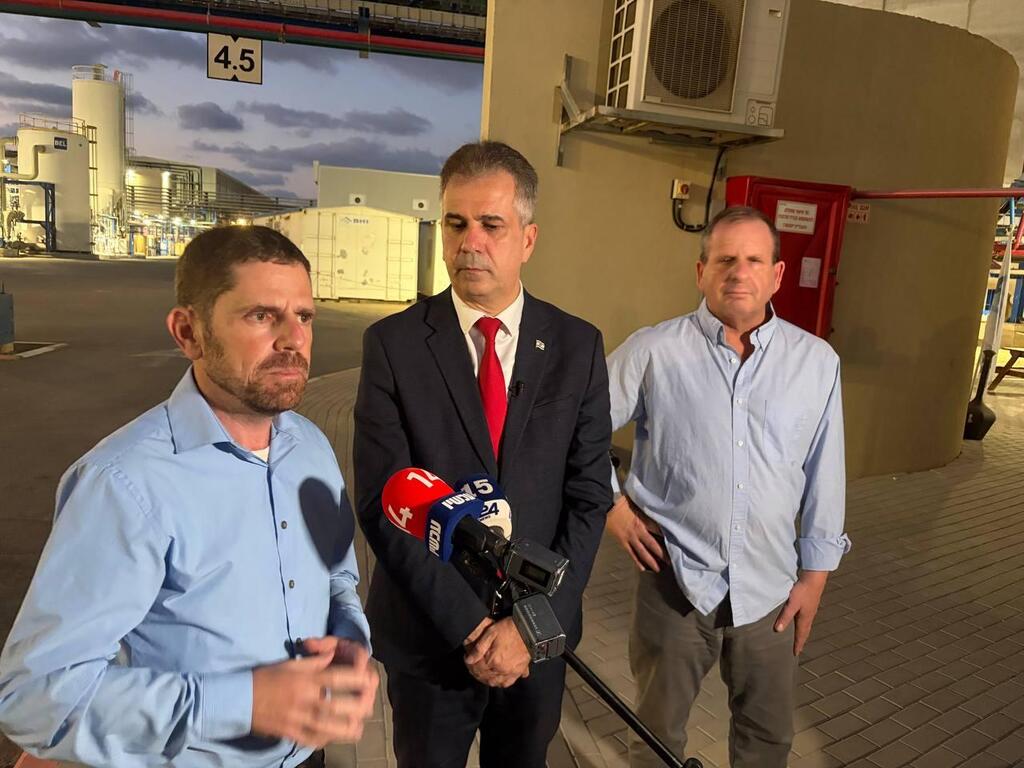
Mekorot Acting CEO Danny Sofer, Energy and Infrastructure Minister Eli Cohen and Water Authority Chairman Yehezkel Lifshitz
(Photo: Meir Turgeman)
“Despite this unprecedented event, no household and no industrial facility is currently suffering from a water shortage,” he added.
The disruption has nevertheless prompted criticism of Cohen and senior water officials over the system’s preparedness and the level of emergency reserves available at the end of summer.
A water-sector official told ynet that Israel should operate desalination facilities at maximum capacity under normal conditions and preserve natural water sources as emergency reserves.
“Desalination plants should function like our checking account, while natural water sources should be our savings,” the official said.
The official argued that Israel’s natural reservoirs were not full at the end of the summer, leaving less room to absorb a major disruption.
According to the official, expanding existing desalination facilities would be faster than building new plants, which could take at least a decade.
“We need to maintain a permanent water surplus to deal with future crises, and they will come, as well as population growth,” the official said.
Cohen said one of the lessons from the current incident would be to diversify water intake points so that a future turbidity event in one area would not force entire facilities offline.
“We intend in the future to diversify the locations from which water is drawn, so that if there is turbidity in one place, we can pump from another,” he said.