


Three Israeli desalination plants remained out of operation Wednesday after an unusual algae-related event forced five facilities along the Mediterranean coast to shut down in succession, raising fresh concerns about the resilience of a water system that depends heavily on a relatively small number of large plants.
The Ashdod and Ashkelon desalination plants had yet to resume operations after being shut because of increased water turbidity. The Sorek A plant, which had restarted for several hours, was shut down again overnight.
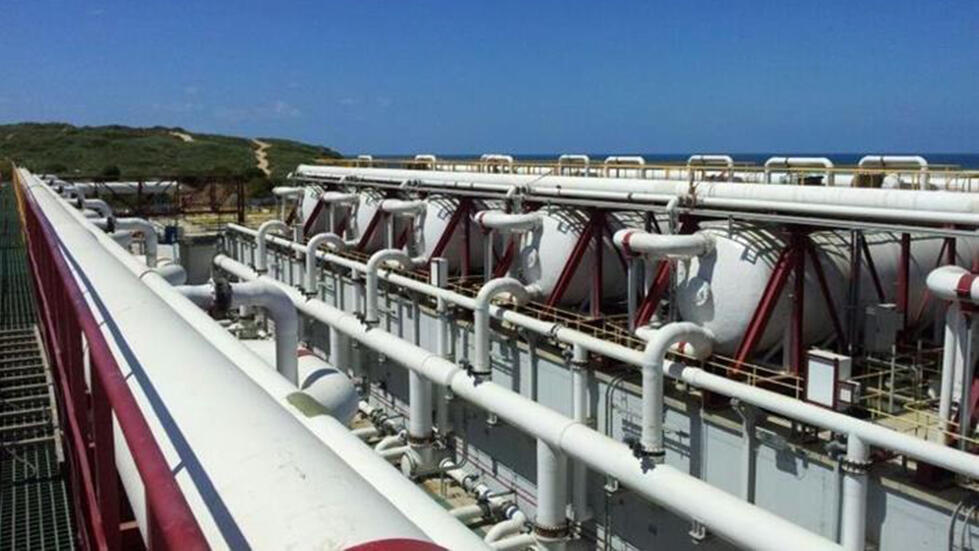
One of Israel’s coastal desalination plants
(Photo: Palmahim desalination plant team)
Sorek B and Palmahim resumed operations Tuesday, while the desalination plants in Hadera and Eilat were not affected by the algae, which is believed to have reached Israel from Egypt.
Despite the disruptions, household water supplies were not affected. Authorities were asked, however, to reduce public landscaping and other water-intensive activities. Water deliveries to farmers in southern Israel resumed Tuesday night.
A water-sector official said the scale of the event had not been anticipated and argued that Israel needs to operate its desalination system differently.
“There was no early warning or expectation of such a serious event,” the official said, arguing that the system is not being managed optimally.
“Desalination plants should operate like our checking account, while natural water sources should be our savings,” he said. “Desalination plants should always operate at maximum capacity. Israel should buy all the water the plants are capable of producing.”
The official said the Sea of Galilee and Israel’s aquifers should function primarily as emergency reserves to be tapped during crises.
“The problem is that we are at the end of the summer and our natural reservoirs were not full,” he said.
Contrary to widespread assumptions, he added, desalinated water can be cheaper than natural water when broader environmental and related costs are taken into account.
He called for expanding existing desalination plants rather than relying primarily on new facilities, which he said could take at least a decade to build.
“We need to maintain a permanent water surplus so we can deal with future crises, and they will come, as well as population growth,” he said. “When there is no water in a crisis, price no longer has any meaning.”
Study warns of overlapping threats
The shutdowns come as a new study by researchers at Ben-Gurion University’s Zuckerberg Institute for Water Research warns that Israel’s dependence on a centralized water system could leave it exposed when several emergencies occur at the same time.
Millions of Israelis depend on a small number of desalination plants, which themselves rely on electricity and on the ability to draw seawater.
Dr. Natalie de Falco, one of the researchers, said the current event demonstrated both the strength and the vulnerability of the system.
“Israel’s water system is an excellent system,” she said. “Think about the fact that five desalination plants were not operating and yet every one of us still had water at home. That shows how much planning went into the system.”
At the same time, she said, the concentration of so much drinking-water production in a handful of large facilities creates a significant point of vulnerability.
De Falco, Prof. Noam Weisbrod and Dr. Carol Bot developed a model examining emergency scenarios that could destabilize the national water system.
The scenarios included drought affecting natural water sources, disruptions to electricity supplies needed for desalination and pumping, war and cyberattacks.
“The war with Iran began, my husband was called up for reserve duty and I was at home with three children,” de Falco said, explaining what prompted the research. “I started thinking about what happens when everything occurs at the same time.”
“What happened here is a stress test,” she said. “What happens when nothing works?”
“If we put 85% of our drinking water in the hands of five desalination plants, and each of them only works if seawater can be pumped in, then there is a vulnerability.”
The researchers examined what could happen if a missile struck parts of the system and also modeled the effects of marine pollution similar to the current algae event.
“These are the worst-case scenarios, in which desalination does not work,” de Falco said.
Israel still has natural water sources, she noted, but those reserves have already been weakened by drought.
“These are crisis multipliers,” she said. “We assessed what happens when problems occur one after another. We built a very extreme model that suddenly seems very relevant.”
According to the researchers, certain combined crises could reduce water supply by about 60%.
The study warns that planning for individual emergencies may underestimate the danger created when drought, war, energy disruption, pollution and other threats occur simultaneously.
De Falco is also preparing further research examining complex threats to desalination facilities in Gulf states.
Among the solutions being considered are an international agreement to protect water infrastructure and the development of smaller, decentralized desalination facilities that could also rely on solar energy.
‘An opportunity to learn’
Prof. Ofir Menashe, head of the master’s program in water engineering at Kinneret Academic College, said the current crisis should be treated as an opportunity to rethink infrastructure planning.
“The water system is relatively strong, but what are we actually learning?” he said.
Menashe said policymakers should consider whether Israel needs emergency reservoirs capable of supporting consumption for two days or for two months.
“That has an operational significance,” he said. “It gives us breathing room. The question is how much we invest in infrastructure.”
Because algae tend to concentrate closer to the surface, he said, authorities should also examine whether seawater intake points could be moved deeper.
“We need to see this situation as an opportunity to learn and understand that, gradually, we are going to see more events like this because of climate change,” Menashe said.
The consequences, he added, extend beyond Israel and could also affect neighboring Jordan, the Palestinian Authority and the Gaza Strip.