


A large share of Israel’s water now comes from seawater desalination, a field in which the country is considered a global pioneer. But since Saturday, most of Israel’s major Mediterranean desalination plants have been shut down because of unusually turbid seawater, forcing authorities to cut water supplies to farmers in the Negev and ask municipalities to stop watering public gardens.
For now, officials say household water supplies are not expected to be significantly affected, although disruptions have already been reported in some places, including Be'er Sheva.
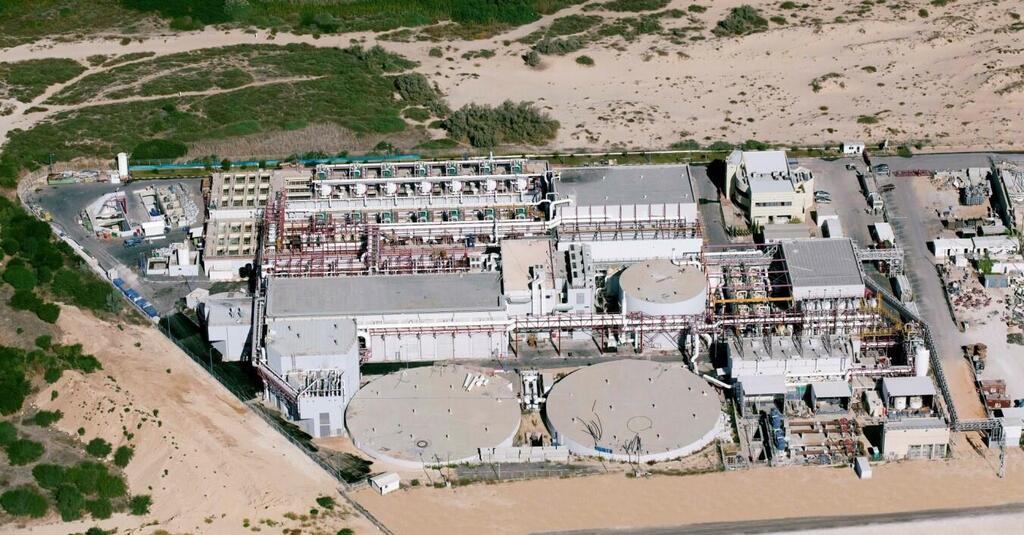
So what caused the shutdown, how much water is Israel losing and why can microscopic algae disable some of the country’s most important infrastructure?
How much water does Israel use?
During a typical summer day, Israel consumes about 3.9 million cubic meters of water, including agricultural use.
The shutdown of the desalination plants created a potential shortfall of roughly 85,000 cubic meters per hour. In practice, cuts to agricultural water supplies amounted to about 300,000 cubic meters a day.
Danny Sofer, acting head of national water company Mekorot, said the system was forced to rely heavily on Israel’s natural water sources after five desalination plants stopped operating.
“Because five desalination plants stopped working, we activated our entire natural water system, which brings us to about 90% of our summer supply capacity,” he said.
“In winter, nobody would have noticed the problem, because consumption is about 50% of the summer level. In summer, we cannot fully overcome it.”
Which desalination plants shut down?
Israel operates six large Mediterranean desalination plants: Ashkelon, Palmachim, Sorek A, Sorek B, Ashdod and Hadera. Of those, only Hadera remained operational during the disruption. Israel also has a desalination plant in Eilat.
Sorek A and Sorek B briefly returned to operation Monday night before the Water Authority announced Tuesday morning that they had been shut down again. Energy Minister Eli Cohen later said Sorek A and Palmachim would be restarted.
What caused the shutdown?
A preliminary investigation by researchers at Israel Oceanographic and Limnological Research points to a bloom of microscopic algae, apparently originating near the Nile Delta.
Satellite images showed large algal blooms in the area, while eastern Mediterranean currents can carry material northward and eastward from the Nile toward Israel.
“It would not be surprising if something that bloomed in the Nile Delta also reached southern Israel,” said Alon Zask, CEO of Israel Oceanographic and Limnological Research.
He noted that Ashkelon, Israel’s southernmost Mediterranean desalination plant, was the first to shut down, fitting that possible pattern.
The problem is that the algae are extremely small and may pass through the filters used at the entrances to desalination facilities.
Algal blooms are a natural phenomenon influenced by weather, sea currents and the amount of organic material in the water. They generally develop over time before collapsing, after which the organic matter they produce decomposes.
Scientists, however, cannot always determine why a particular bloom emerges at a specific place and time.
What kind of algae are they?
Prof. Tamar Guy-Haim of the National Institute of Oceanography said researchers believe the organisms belong to a group known as picophytoplankton.
“We are in the preliminary stages of characterizing the algae,” she said, adding that researchers are working with Prof. Edo Bar-Zeev of Ben-Gurion University.
“We believe it is probably cyanobacteria, small photosynthetic bacteria that are a natural part of the ecosystem and form the base of the food web.”

Picophytoplankton
(Photo: Tali Kobas)
Researchers have not yet identified the exact species and are awaiting molecular test results.
The algae are not believed to be toxic through food or contact, and beaches have therefore remained open.
How does desalination actually work?
Desalination removes dissolved salts from water to produce water suitable for drinking, agriculture and other uses.
Modern Israeli plants largely rely on reverse osmosis. In the process, salty water is pushed at very high pressure through membranes that allow water molecules to pass while blocking salts.
About half of the seawater entering the system becomes desalinated water. The remainder becomes concentrated brine and is discharged back into the sea.
Technological advances in membrane performance and energy recovery have sharply lowered the cost of reverse osmosis, making it far more energy-efficient than older evaporation-based methods.
The Water Authority says water produced by Israel’s seawater desalination plants is of very high quality and must meet standards stricter than basic drinking-water requirements before entering the national system.
Who is being hit hardest?
For now, farmers in southern Israel are bearing the brunt of the shortage.
Growers were told to stop using desalinated water for irrigation, and some say their taps have effectively run dry.
Roy Yosef, a farmer from Be’er Milka who has grown tomatoes and cherry tomatoes for 15 years, warned that even a short interruption could destroy crops in the Nitzana region.
“Never before have they shut off agricultural water,” he said. “We are the main suppliers of tomatoes in Israel for the holidays.”
“Twenty-four hours without water can already cause irreversible damage. More than that? The entire crop dies.”
Doron Hevel, another Be’er Milka farmer who grows about 65 dunams of tomatoes and cherry tomatoes, described the situation as “a survival event.”
“We are at the peak of the season,” he said. “A medium-sized farm invests about NIS 2 million in the ground, and there will be no way to get that money back.”
Was Israel warned this could happen?
Yes.
A State Comptroller report published in November 2024 found that between 2007 and the end of 2023, there were 14 incidents in which seawater contamination forced desalination plants to stop production.
Shutdowns lasted anywhere from several hours to five days.
About 57% of the incidents were caused by microbial contamination, 29% by fuel and oil pollution and 14% by turbidity linked to storms and an earthquake.
The comptroller recommended that the Health Ministry conduct periodic surveys of algal toxins and other toxins released into the water, and develop a plan for coping with such events.
Can future shutdowns be prevented?
Experts say probably not completely.
Prof. Edo Bar-Zeev of Ben-Gurion University’s Zuckerberg Institute for Water Research said Israel needs contingency systems capable of keeping water production running during exceptional events.
“In my opinion, it is impossible to completely prevent events like this,” he said. “What must be done is to prepare backup solutions in advance.”
He warned that the current episode could be a preview of a much more severe threat: a large oil spill.
“This event is only a teaser for similar events that could happen in the future, especially oil incidents,” Bar-Zeev said. “A major oil spill will happen. The only question is when.”
Such an event, he warned, could shut desalination plants for much longer, potentially for months.
“Oil reaching the desalination plants would be a tragedy,” he said. “There is currently no contingency plan for that scenario either. The current contingency plan is simply to take the switch at the desalination plants and turn it off.”