

Arriving to testify at his corruption trial, Prime Minister Benjamin Netanyahu confirmed on Tuesday that Israel has launched its ground incursion into Gaza City. The IDF said that an estimated 40% of the city's residents have left.
The long-anticipated operation began on the city’s outskirts, where the military in recent days escalated strikes and accelerated the demolition of high-rise buildings, one of the officials said. The same official added that the incursion would start in a phased and gradual manner.
Airstrikes in Gaza City


Palestinian media reported massive airstrikes in northwest Gaza City overnight, with strikes lighting the sky orange. Tanks were reported on al-Jalaa Street in the city center, sparking panic and mass flight. By Monday evening, more than 350,000 Palestinians had left the city, considered Hamas’ main stronghold, and Israeli security officials expect the exodus to grow as the advance continues.
According to Palestinian reports, the attacks focused on three main neighborhoods: Sheikh Radwan, al-Karama and Tel al-Hawa. Residents reported booby-trapped robotic devices and heavy aerial bombardment, while artillery and helicopters pounded northern Gaza. Local reports said 37 strikes were carried out within 20 minutes. Explosions from the bombardment were heard as far away as Tel Aviv and the Sharon region.
Defense Minister Israel Katz wrote Tuesday: “Gaza is burning. The IDF strikes with an iron fist at terrorist infrastructure, and our soldiers fight with bravery to create the conditions for freeing the hostages and defeating Hamas. We will not relent until the mission is complete.”
The offensive was initially expected to proceed only after a mass evacuation of Gaza City, home to more than a million people, but only a fraction of residents have left, an Israeli military official said Monday. About 320,000 Palestinians had fled by that point. The United Nations has warned that the invasion risks forcibly displacing civilians on a massive scale.
People fleeing Gaza City
Local officials said dozens of wounded Palestinians, including children, were brought overnight to hospitals such as Al-Shifa and the Baptist Hospital. Videos from the facilities showed bloodied children and parents grieving over bodies wrapped in white shrouds.
Families of hostages protest in Jerusalem
As news of the strikes spread, the Hostages’ Families Forum warned that the bombardment could endanger those still held in Gaza. “This may be the last night in the lives of the hostages who are barely surviving,” the group said. “It may also be the last night in which it is possible to locate and bring back the bodies of those who have been killed.”
That night, families of hostages demonstrated outside Prime Minister Benjamin Netanyahu’s residence in Jerusalem. Among them were Einav Zangauker, mother of hostage Matan; Ofir Braslavski, father of hostage Rom; Anat Angrest, mother of captive soldier Matan; and Michel Illouz, father of slain hostage Guy. Survivors of Hamas captivity, Arbel Yehud and Ilana Gritzewsky, also joined.
Police blocked access to the residence, but Zangauker declared: “We will pitch tents here. If Matan doesn’t come home, I have nothing to lose.” She accused Netanyahu of fleeing the residence when he heard of the protest. “Netanyahu ran away like a coward. We will chase him everywhere, day and night,” she said. Addressing Sara Netanyahu, the prime minister’s wife, she added: “Come outside and say how you lied to my face. You told me you were bringing a deal to bring them all back.”
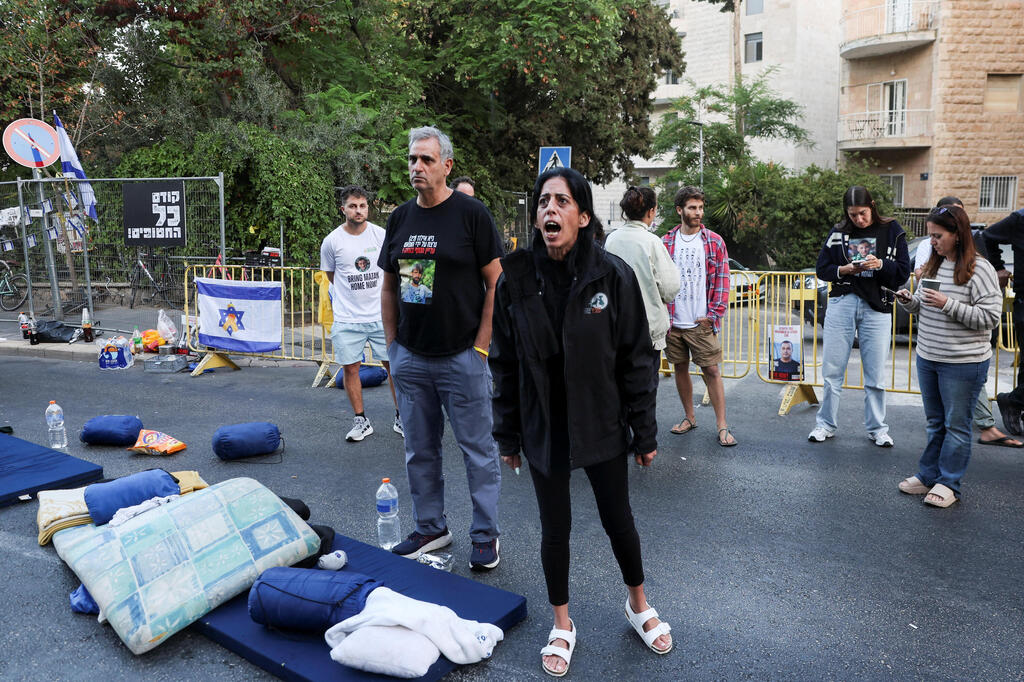
Hostage families outside PM's office
(Photo: REUTERS/Ronen Zvulun)
The families accused Netanyahu of deliberately sacrificing the hostages for political reasons, ignoring the positions of senior military officials. “He bears personal responsibility for the fate of the hostages,” the forum said.
Debate over risks of offensive
At a recent high-level meeting, IDF Chief of Staff Lt. Gen. Eyal Zamir warned that a full-scale operation to capture Gaza City would come at a heavy cost, with dozens of Israeli soldiers possibly killed. He also cautioned that the risk to hostages would increase once ground troops entered.
Prime Minister Benjamin Netanyahu countered that most military assessments suggested the offensive would heighten pressure on Hamas and could lead to a decisive outcome.
As news of the strikes spread, the Hostages and Missing Families Forum warned that the bombardment could endanger those still held in Gaza. “This may be the last night in the lives of the hostages who are barely surviving,” the group said. “It may also be the last night in which it is possible to locate and bring back the bodies of those who have been killed.”