


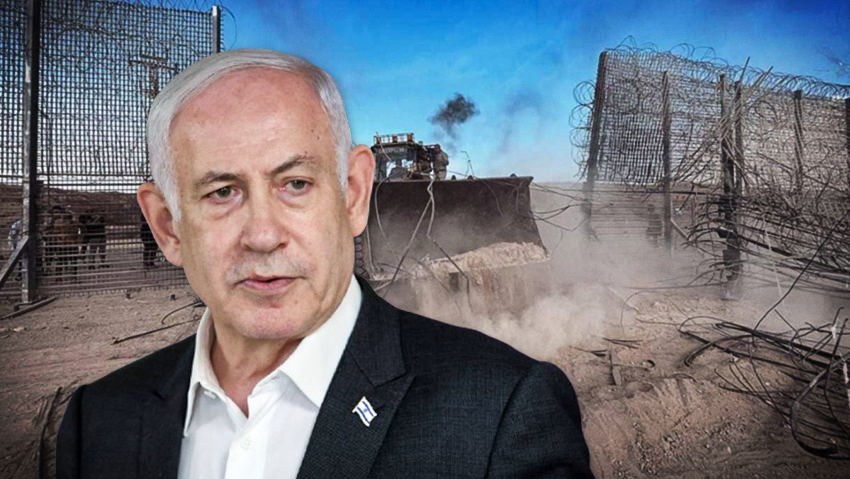
The bill to establish a political inquiry commission into the October 7 massacre, approved Monday night in its first Knesset reading, is not expected to advance further in the current Knesset. The practical meaning is that for at least the next six months, no inquiry commission of any kind is expected to be established, even nearly three years after Hamas’ surprise attack.
Although the legislation is not expected to be passed into law in the current Knesset, the coalition insisted on approving it in its first reading in order to preserve it for the next parliament through the continuity rule. Under that mechanism, any bill that passes a first reading in the plenum can be resumed in the next Knesset from the stage at which it stopped.
In other words, if the current coalition wins a majority in the next election, it will be able to continue advancing the political inquiry commission and prepare the bill for its second and third readings.
The immediate result is that more than three years after the October 7 massacre, Israel is still unlikely to have any commission of inquiry, whether national, political or state-appointed, in the near future.
There are now two main scenarios.
If Prime Minister Benjamin Netanyahu forms another government with a similar coalition makeup, it could continue the legislation already begun. Under the bill submitted by Likud lawmaker Ariel Kallner, the inquiry commission would be appointed by politicians. Coalition lawmakers would appoint three representatives and opposition lawmakers would appoint three.
The current opposition has already said it will not cooperate with a political inquiry commission. In that case, according to the bill, the commission would be able to operate with only three members, meaning only the representatives appointed by the coalition.
The second scenario is that if a unity government or a “change government” is formed, the expectation is that it would promote a state commission of inquiry. Under Israeli law, such a commission is appointed by the chief justice.
At the same time, due to criticism from some bereaved families toward Chief Justice Yitzhak Amit, who has presided over High Court hearings in recent years, there is also the possibility of advancing President Isaac Herzog’s compromise proposal. Under that proposal, the makeup of the commission would be determined in coordination with Deputy Supreme Court President Noam Sohlberg, who is viewed as more acceptable in right-wing circles.
Netanyahu was absent from Monday night’s vote in the plenum. The opposition boycotted the vote, and the bill passed with the support of 59 coalition lawmakers and no votes against. If approved, the bill would allow the government to oversee an inquiry into the events of the day of the disaster and the events that preceded it.
According to the proposal, the commission would investigate “the events of the October 7 massacre, the war and the circumstances that led to them.” Its report would be submitted to the Knesset speaker and the government.
The commission would include six Israeli citizens, three chosen by the opposition and three by the coalition. The bill also sets restrictions on who can serve. A person would be barred from membership if, in the 18 years before October 7, they served in one of several senior positions: Supreme Court justice, prime minister, minister, officer at the rank of major general or above, Shin Bet chief or deputy chief, attorney general, military advocate general or Shin Bet legal adviser.
The proposal also states that the commission would include four special-status observers from among bereaved families of fallen soldiers and representatives of released hostages, as defined by law. The observers would be chosen by the commission members, would receive pay and expenses, and would take part in the commission’s discussions and consultations, but without voting rights.
The commission would be allowed to set rules for how the observers participate in proceedings, including cases in which their participation would be limited because of classified documents or materials that cannot be shown to them.
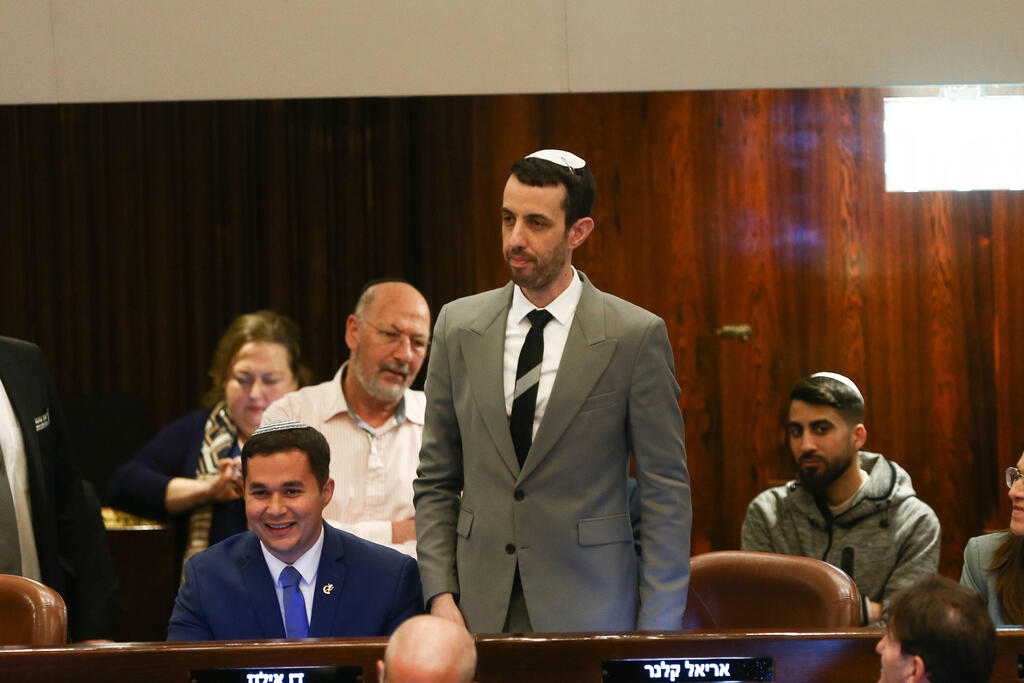
Likud lawmaker Ariel Kallner
(Photo: Alex Kolomoisky)
The bill’s approval in the plenum drew harsh responses from opposition lawmakers and bereaved families.
Opposition leader Yair Lapid said the opposition would not take part in what he called a false display intended to whitewash the disaster.
“The opposition will not be part of a charade whose entire purpose is to cover up and prevent an investigation into the greatest disaster that happened to the Jewish people since the Holocaust,” Lapid said. “In the first month of the next government, we will establish a state commission of inquiry into the October 7 massacre.”
Yachad chairman Naftali Bennett said that without an investigation, Israel cannot repair what went wrong.
“Without an inquiry, there is no correction,” Bennett said. “A government that runs away from an inquiry is sentencing Israel to more and more disasters. In the next government, we will establish a state commission of inquiry that will allow Israel to be fixed.”
The October Council, which represents more than 1,500 bereaved families, survivors of Hamas captivity and survivors of the massacre, condemned the vote.
“The voice of the blood of our brothers, our children and our loved ones cries out to us from the ground,” the group said. “Every Knesset member who raised his hand today in favor of the political whitewash commission should know: for him, this was a first reading; for the bereaved families, it was nothing less than a second tearing.”
The group said the government that led Israel “with eyes closed into the worst massacre in its history since the Holocaust” had lost all legitimacy.
“A state commission of inquiry will be established, and all of you will bear responsibility and guilt,” the October Council said. “This is the will of the fallen who fought to their last drop of blood. This is the request of the hostages who wasted away in the tunnels. This is the demand of the observers who were burned to death and the young women who were brutally raped on your watch.”