


Former Shin Bet chief Yoram Cohen, considered one of the most senior figures alongside Gadi Eisenkot in his political party, said he hopes a future government will pass legislation barring an indicted lawmaker from being tasked with forming a government, a measure that could prevent Prime Minister Benjamin Netanyahu from returning to office while his criminal trial continues.
“I don’t want to get into specific names, but it was discussed in the previous Lapid-Bennett government, and because of a certain person,” Cohen said, as members of the audience shouted out the name of former minister Ayelet Shaked, “it was not possible to pass it then, which was a great shame. I very much hope we will manage to do it.”
Gallery
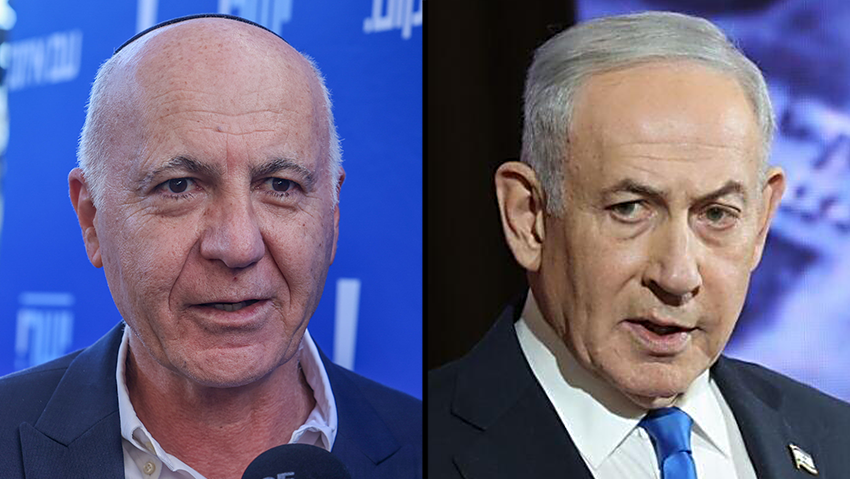
Former Shin Bet chief Yoram Cohen and Prime Minister Benjamin Netanyahu
(Photo: Ido Erez, Alex Kolomoisky)
Cohen made the remarks Thursday at a parlor meeting in Shoham attended by an audience identified with liberal religious Zionism. Recordings of the event were obtained by ynet.
The proposal, widely known in Israel as the “defendant law,” would amend Basic Law: The Government to prevent a lawmaker under indictment from receiving the mandate to form a government.
Under the version advanced during the Bennett-Lapid government, a lawmaker charged with an offense carrying a potential sentence of at least three years in prison would be barred from forming a government unless it was determined that the offense did not involve moral turpitude.
Current law does not prevent an indicted lawmaker from being tasked with forming a government or serving as prime minister. The legislation was therefore widely seen as a measure that could have prevented Netanyahu, whose criminal trial has continued alongside his premiership, from forming the current government. The proposal was never enacted.
Cohen also promised that his political camp would establish “a government with no more than 24 ministers.”
Both Eisenkot and Cohen have previously said they would be prepared to establish a minority government if their bloc failed to reach 61 seats. Asked repeatedly whether they would form one with the outside support or abstention of the Islamist Ra’am party, Cohen avoided giving a direct answer.
“We want 61 Zionists,” he said. “I don’t want to get into the other solutions that exist if we don’t achieve that.”
‘The challenge is Netanyahu himself’
Cohen, who was among the former Shin Bet chiefs who opposed David Zini’s appointment to head the security agency, also addressed Zini’s performance in office.
“There are cracks that we see today in the organization’s statesmanship,” he said. “I hope they do not widen and that he works to close them.”
But Cohen said the greater challenge facing the Shin Bet chief was not Zini himself.
“The big challenge is not Zini himself, as much as it is Mr. Netanyahu himself,” Cohen said. “To this day, the prime minister has approached Shin Bet chiefs, and I am one of them, with demands that were either illegal or illegitimate and that would benefit him.”

Shin Bet chief David Zini
(Photo: Shalev Shalom)
“What you need is a Shin Bet chief made of iron, with a backbone, who can tell the prime minister, ‘I cannot do this because it is illegal, or unethical, or not part of my job.’”
Cohen said preserving the Shin Bet as a professional, apolitical state institution should be Zini’s foremost priority.
“The Shin Bet knows how to pursue terrorists in Nablus. Zini will not interfere with that,” he said. “But if, God forbid, the political echelon, any political echelon, approaches the head of the Shin Bet and wants to use its capabilities against citizens, for political reasons, for the prime minister’s personal needs, or to advance one worldview or another in the name of security, and it is always in the name of security, that would be extremely serious.”
Such conduct, he warned, would damage public trust, “destroy the organization from within” and introduce political influence into the agency.
Palestinian state ‘not relevant’
Cohen also addressed the Palestinian issue, saying he does not consider the establishment of a Palestinian state a realistic option.
“A Palestinian state is not relevant,” he said. “I think that perhaps in the future, perhaps, if the leopard changes its spots, then yes, maybe we could reach something called autonomy. Autonomy would be the maximum.”
For now, he argued, Israel should retain security control in the hands of the IDF and the wider defense establishment while allowing Jewish communities in the West Bank to develop according to government policy rather than the agenda of any individual political faction.

Graffiti sprayed on a mosque in the village of Deir Istiya by settlers
Israel’s actions, he said, must remain legal and should not undermine its long-term national interests internationally.
Cohen also rejected the prospect of full Israeli annexation of the West Bank.
“I can talk about this for 20 hours, but theoretically I’m simply speaking from logic, not ideology,” he said.
Suppose U.S. President Donald Trump were to revive a scenario from several years ago and tell Israel to pursue “full annexation,” Cohen said. The central question would be whether annexing the entire West Bank actually served Israel’s interests.
“There is a group that thinks it does, but it is a small group among the people of Israel,” he said. “The larger group thinks it would turn us into a binational state, lead us into a greater confrontation, put us at odds with the entire world, destroy our peace agreements and make us pay endless prices in blood. Therefore, I don’t think it is right either.”
Warning over election interference
Drawing on his experience as a former Shin Bet chief, Cohen also discussed the possibility of attempts to interfere with Israel’s elections and the agency’s role in protecting the vote.
“The Shin Bet is one of the bodies that must help the Israeli government conduct elections properly,” he said.
The agency already works routinely to protect the country against foreign cyberattacks and threats to critical infrastructure, Cohen said.
“There is a concern, and I can’t tell you how serious it is because I am not familiar with the data, that there will be foreign involvement aimed at harming our databases,” he said. “I very much hope they will not manage to do that and disrupt the elections that way.”
He also warned of potential domestic attempts to create disorder at polling stations.
Certain individuals, he said, could use “bullying or other things” to create chaos at selected polling places, forcing police to intervene and potentially close them on public-safety grounds.
“I very much hope that does not happen,” he said, adding that the Shin Bet should coordinate on the issue with Israel Police, the National Cyber Directorate, the government and Supreme Court Justice Noam Sohlberg.
Shin Bet ‘cannot replace the police’
Cohen also broke with positions previously voiced by political allies Naftali Bennett and Yoaz Hendel, who have proposed involving the Shin Bet more extensively in combating serious crime in Israel’s Arab community.
Cohen said the agency could provide limited assistance to police in specific cases, but warned strongly against turning it into a substitute for law enforcement.
“The Shin Bet is generally an excellent, effective organization that does sacred work,” he said. “The second thing is that it is extremely busy. In Israel it has no reservists, and it is stretched quite considerably because of its involvement in all the different arenas, including some outside the borders of the State of Israel that people are less familiar with.”

Police Commissioner Danny Levy during field operations in Arab communities
(Photo: Israel Police)
The Shin Bet can assist police in narrowly defined cases, Cohen said, as it has previously done when crimes involved symbols of government, such as shootings at local councils or the killing of a deputy mayor.
“In cases like that, the Shin Bet can become involved because of the symbolic significance and try to assist Israel Police with intelligence,” he said. “But the Shin Bet cannot replace the police.”
“The police are a story in themselves that requires change and improvement. The Shin Bet cannot replace the police on the scale that the State of Israel requires. Whatever assistance it can provide is welcome, but it must be very focused and at a relatively low level, not on a large scale.”
Cohen identified three additional risks in expanding the agency’s involvement in ordinary crime.
The first, he said, was the diversion of the Shin Bet’s attention from its core national-security missions. The second was the danger of exposing classified capabilities and methods because evidence gathered in criminal investigations generally must be disclosed in court proceedings.
That could result in intelligence collected by the Shin Bet, as well as its operational methods, being exposed to Israel’s enemies or, in criminal cases, to the people it is investigating, he said.
The third risk, Cohen said, was the effect on relations between the state and Arab citizens of Israel.
“There is already a sense of alienation among Israeli Arabs today, that they are second-class citizens,” he said. “Now the government comes along and decides that the Shin Bet will operate only against Arabs. Why? If the Shin Bet is dealing with crime, let it operate against Jews too. Why only against Arabs?”
Those concerns, he said, were powerful arguments against giving the Shin Bet a broad policing role.