

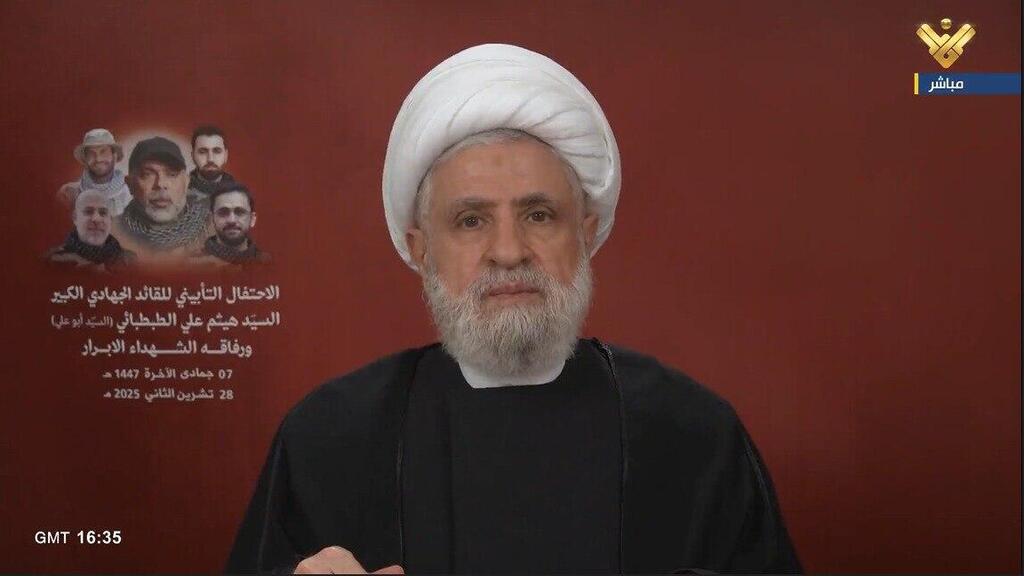
Hezbollah Secretary-General Naim Qassem delivered his first speech Friday since the killing of the group’s acting chief of staff and No. 2 official, Haytham Ali Tabatabai, issuing a direct threat to Israel. “The assassination of Tabatabai and the other operatives is blatant aggression and a despicable crime. We have the right to respond, and we will determine the timing,” Qassem said.
Qassem eulogized Tabatabai, saying he played a “significant role” in the latest fighting with Israel, including the “planning, organization, timing of drone launches and coordination of fire.” He added, “The goal of the assassination was to undermine our morale and create confusion. The goal has not been achieved and will not be achieved. I say to the Israeli enemy, we are continuing.”
He also referenced an unusual clash overnight in the southern Syrian village of Beit Jann, where six fighters were wounded by fire from the terrorist group al-Jamaa al-Islamiyya. “The operation proves that the Syrian people will not accept surrender to Israel. This is a positive sign,” he said.
According to Qassem, Tabatabai had been asked to travel to Yemen for training and left his mark there. “He won the deep affection of the Yemenis. We say to the Israelis, Abu Ali has many brothers,” he said, using Tabatabai’s nom de guerre.
Qassem thanked “everyone who sent condolences, especially Yemen, Iran, Iraq and also the Palestinian factions.” He said Hezbollah had been tasked with delivering a letter to the pope that “will be published in the media,” adding that the group welcomed the pope’s visit to Lebanon “at this decisive moment.”
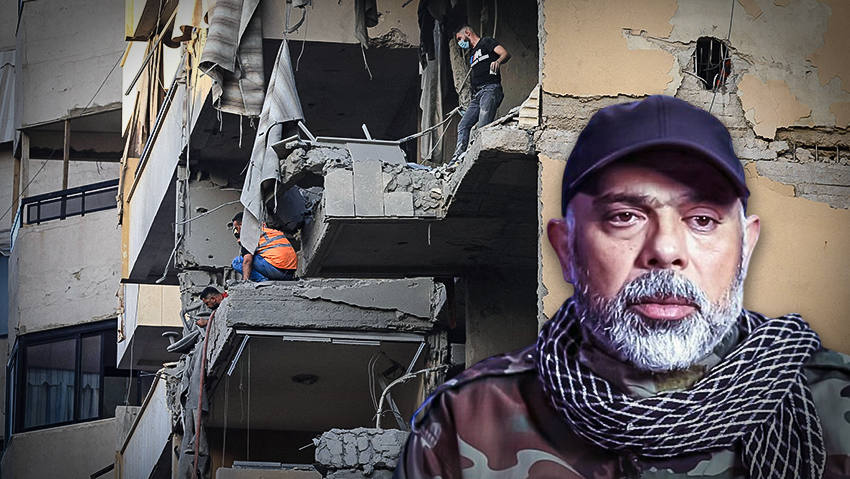
Tabatabai and the assassination scene in Dahieh
(Photo: Mohamed Azakir/Reuters)
Marking one year since the ceasefire with Israel, Qassem called it “a day of victory for the resistance, Hezbollah, the people and Lebanon, because we prevented the enemy from achieving its goals, foremost ending the resistance.”
Qassem leveled criticism at Lebanon’s government, which has sought to disarm Hezbollah as part of its ceasefire commitments. “Israeli aggression is aggression against all of Lebanon. All of Lebanon is responsible for defense, and the government bears the main responsibility because it approved the agreement and declared its intention to take the initiative,” he said. “The primary responsibility for deterrence lies with the state, which until now did not liberate or defend, and today it must prevent the enemy from entrenching itself.”
Tabatabai was killed earlier this week in an airstrike in Beirut’s Dahieh district. He was a key figure in the terrorist organization and helped lead its postwar rebuilding effort as Lebanon’s government intensified attempts to strip Hezbollah of its weapons. Lt. Col. Y., head of the Lebanon desk in the IDF Military Intelligence Directorate’s Research Division, told ynet in an exclusive interview that Tabatabai “was one of the most significant figures left in Hezbollah. He worked with Iran to bring in additional tools and capabilities and reconnected Hezbollah’s organizational structure.”
Tabatabai “grew up in field roles in the terrorist organization and also had a very significant part in staff positions,” Lt. Col. Y. said. Among other posts, he commanded the Radwan unit and other units responsible for Hezbollah’s ties with Iran, Syria, Iraq and Yemen. “For 30 years, Tabatabai was a very central figure,” he said.