



President Isaac Herzog reiterated his call for Israel's political parties to avoid another election Wednesday, following results that have left neither political bloc with a governing majority.
"One thing must be clear, and I said this before the elections too: we must do everything we can, certainly after yesterday, to avoid another round of elections," Herzog said. "So I expect everyone who comes here to come with an open mind.”
Gallery
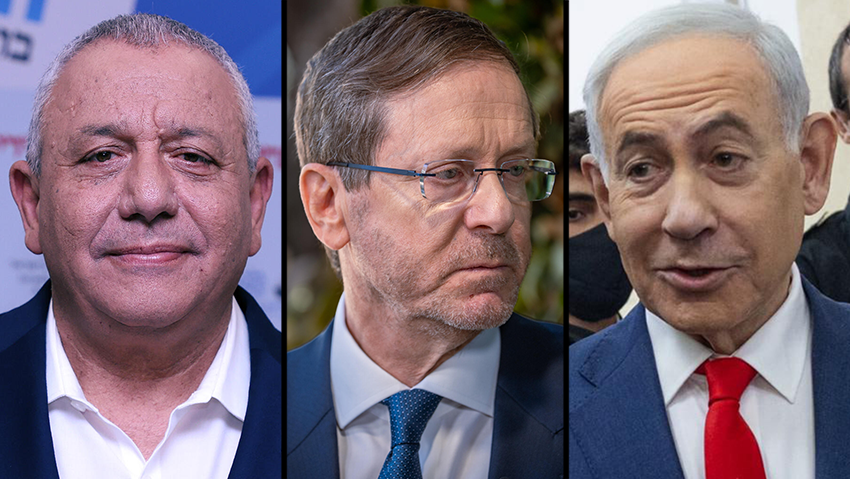
Who will Herzog choose to form a new government, Eisenkot or Netanyahu?
(Photos: Chaim Goldberg/Flash90, Shalev Shalom, Ryan Preuss)
“Yesterday’s election day was truly impressive, with the highest turnout in decades. It is a badge of honor for Israeli society, and it was remarkable to see how deep the desire for democracy is in Israel," he said. “I will receive the official election results next week, when Justice Sohlberg presents them to me. I will then begin the process of the consultations here, hearing from each and every faction, asking questions, and holding discussions."
According to the latest results, with 93% of polling stations counted and before the tallying of double-envelope ballots, Netanyahu's bloc holds 53 seats, Eisenkot's bloc 48 and the Arab parties 19. That places Herzog in a particularly consequential position. He must decide who will receive the first mandate to form a government: Benjamin Netanyahu, Gadi Eisenkot or potentially another candidate.
Sources close to the president said Tuesday that he prefers to wait until the official results are available before addressing the question and inviting party representatives to the President's Residence. Central Elections Committee Chairman Justice Noam Sohlberg, deputy president of the Supreme Court, told Herzog Tuesday that he expects to formally deliver the results next Wednesday, although they are expected to be published several days earlier.
Officials at the President's Residence believe Herzog will begin quiet political contacts once the final results become available, potentially as early as Friday. Formal consultations with parliamentary factions will begin only after next Wednesday.
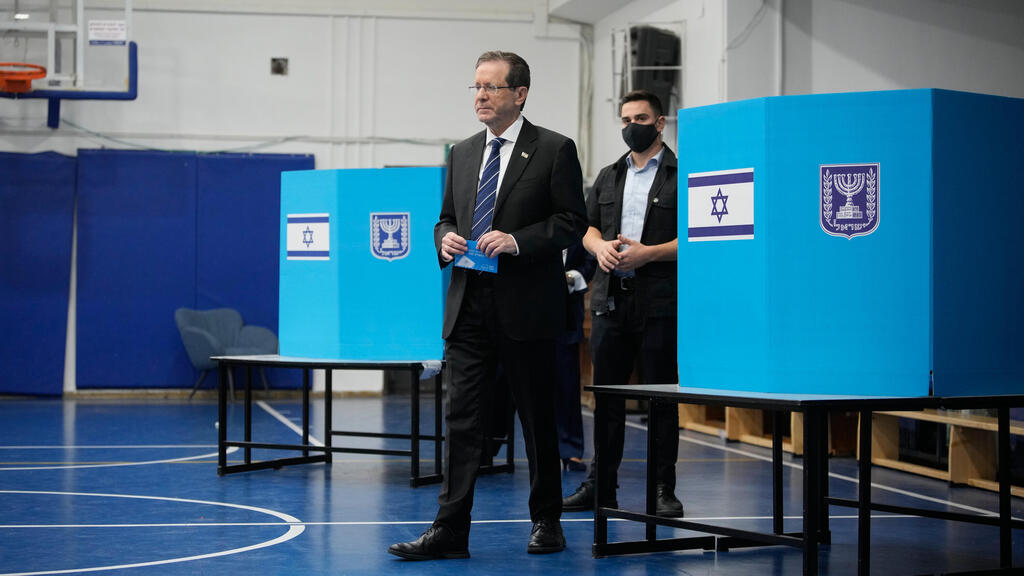
President Isaac Herzog casts his ballot on Election Day
(Photo: Ohad Zwigenberg/AP)
The president will then assign the task of forming a government to the candidate he believes has the best chance of succeeding. Officials at the President's Residence stressed that the mandate will not necessarily go to the leader of the largest party.
The first candidate selected will have 28 days to form a government, with the possibility of a 14-day extension. If more than 61 lawmakers recommend Eisenkot, for example, including representatives of the Arab parties, the article's assessment is that Herzog would be highly likely to give him the first mandate. If Eisenkot fails, the president could turn to Netanyahu. Should Netanyahu also prove unable to form a coalition, Herzog may seek to intervene and encourage the establishment of a national unity government.
Speaking at a ynet and "Yedioth Ahronoth" conference about two weeks ago, Herzog addressed the possibility of an inconclusive election. "I am doing everything I can to ensure Israel has a stable government," he said. "More than that, I will do absolutely everything in my power to prevent repeat elections. We must understand that the national challenges facing us are enormous."
He also expressed confidence that the public and political leadership would accept the results. "I believe everyone will accept the election results. I think Israeli citizens will go out and vote. I constantly call on Israelis to vote, and I remind everyone: Elections are not a civil war.
"Elections are the way to resolve issues, make decisions and understand that the day after, we are still together. Those who lose and those who win must all understand that they belong to the same people. Those who are elected must also look after those who were not."
This is the timetable for forming Israel's next government
November 4
Final deadline for the official publication of election results, eight days after election day
November 11
Final deadline for the president to assign the task of forming a government, seven days after the official results are published. The president must notify the Knesset speaker of his decision
December 9
Expiration of the initial 28-day mandate, if assigned on November 11. The actual deadline could be earlier
December 23
Latest possible expiration of an extended mandate. The president may grant an extension of up to 14 days, for a maximum of 42 days
December 26
If the first candidate fails to form a government, the president must decide on the next course of action within three days
If the first candidate fails to establish a government within the allotted time, the president has two options. He can assign the task to another Knesset member, who would receive 28 days without the possibility of an extension. Alternatively, he can inform the Knesset speaker that he sees no viable possibility of forming a government. Before choosing either option, the president may hold further consultations with parliamentary factions.
If Herzog declares that no government can be formed, or if a second candidate also fails, a majority of Knesset members may submit a written request within 21 days asking him to assign the mandate to a specific lawmaker who has agreed in writing to undertake the task. That candidate would then receive 14 days to form a government.
If no such request is submitted, or if the candidate fails during the third round, the Knesset will be considered to have voted to dissolve itself before the end of its term, triggering another election within 90 days.
If a candidate succeeds in forming a government at any stage, the candidate must notify the president and Knesset speaker. A parliamentary session to establish the new government must then be scheduled within seven days.