

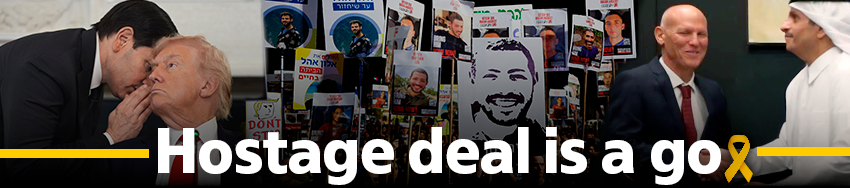
The historic announcement early Thursday by U.S. President Donald Trump of an agreement between Israel and Hamas — marking the first stage of his Middle East peace plan — dominated headlines across the globe, from the United States to Australia, Brazil to Italy.
The deal, which includes the release of all hostages held in Gaza in exchange for a partial Israeli withdrawal, was widely described by international outlets as a “historic breakthrough” that could position Trump for a Nobel Peace Prize. Yet, reports also raised doubts over how the plan will be implemented, including Israel’s demand that Hamas disarm and the question of who will govern Gaza once the war ends.
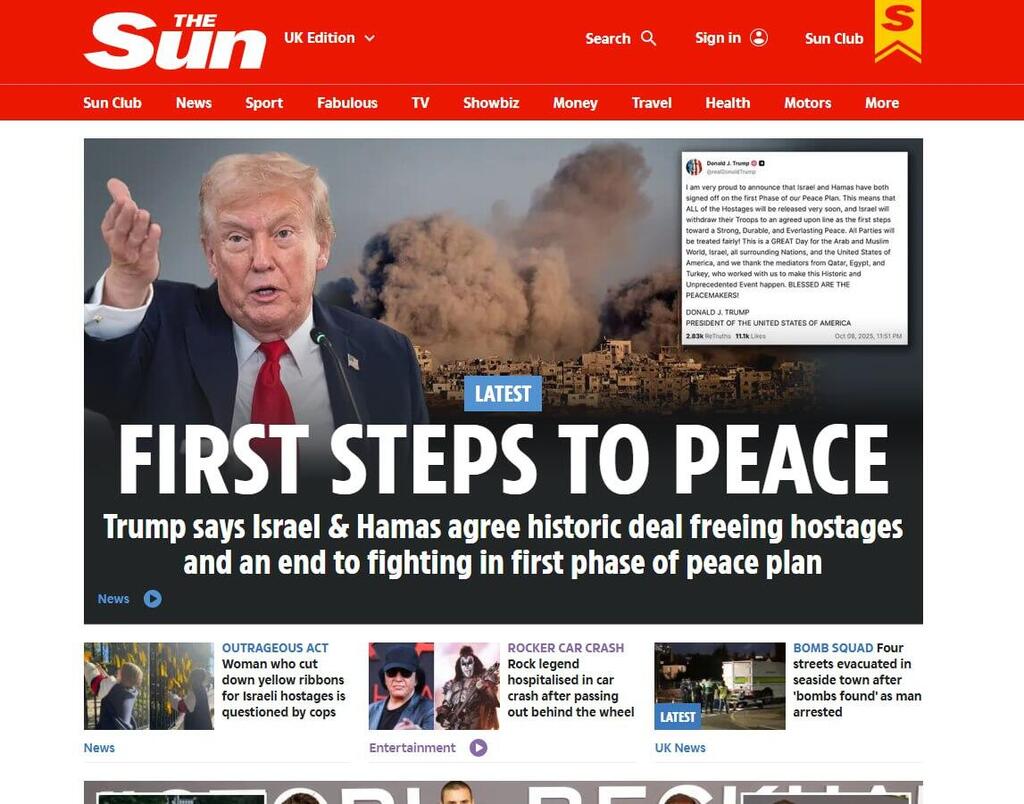
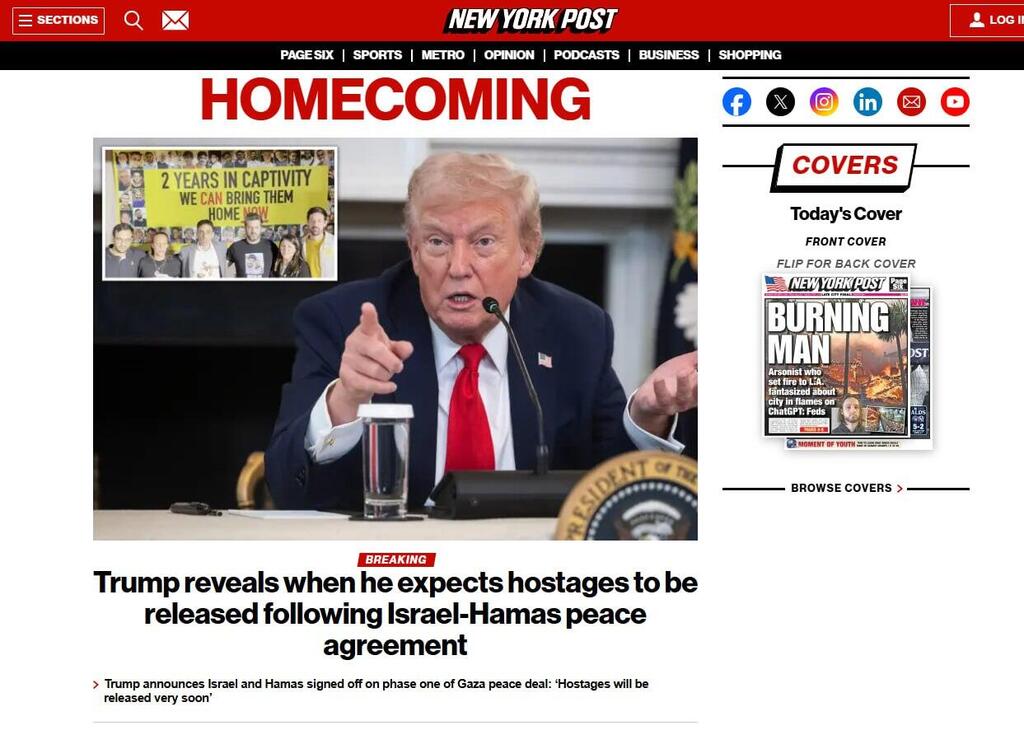
'Homecoming.' The headline in the New York Post
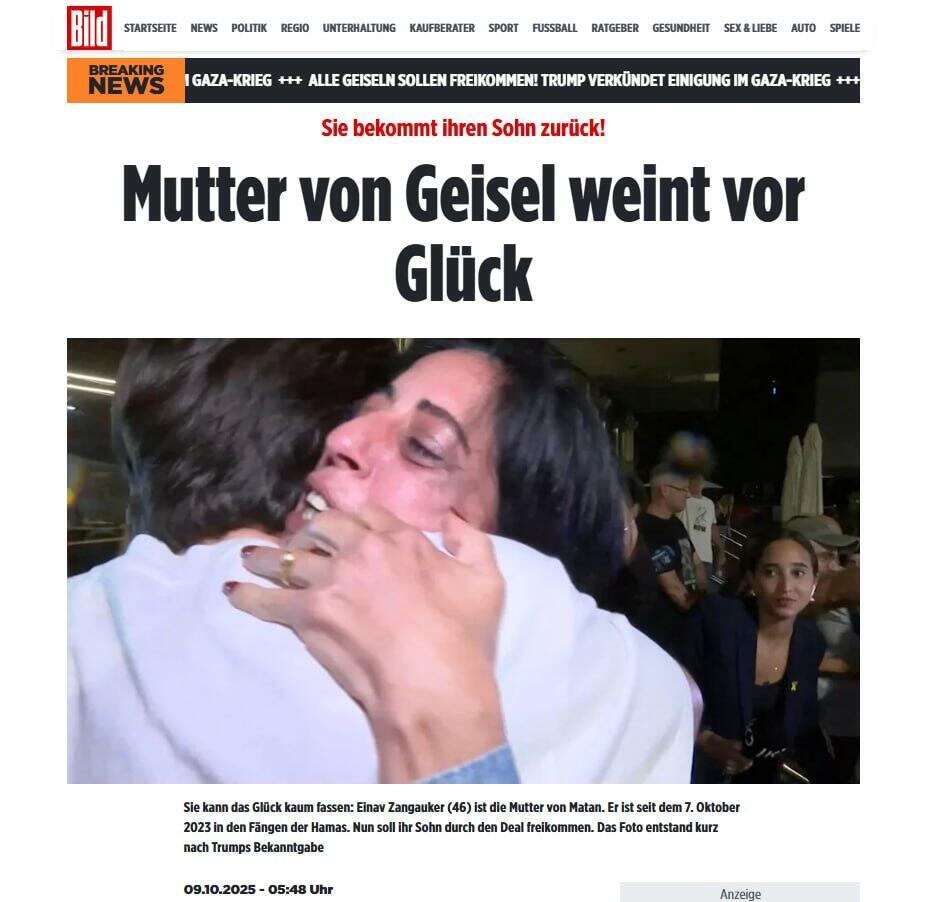
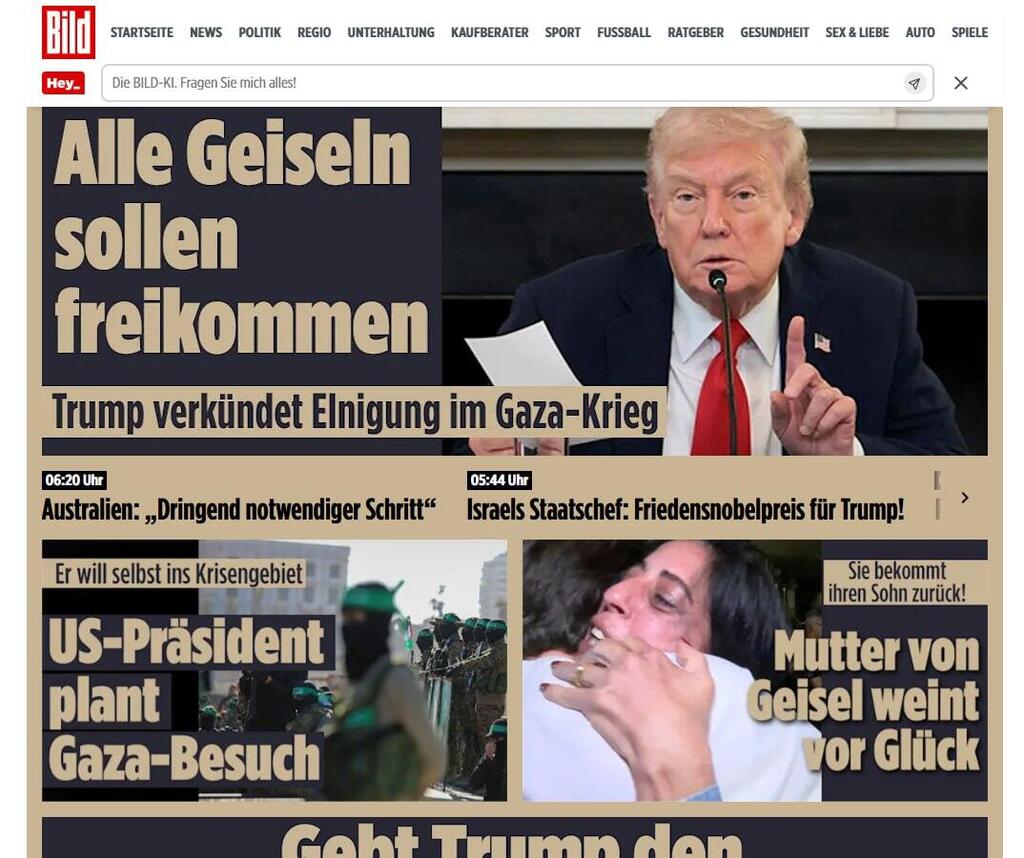
Einav Zangauker, mother of hostage Matan Zangauker, on the homepage of Germany's Bild
The Associated Press called the deal “the biggest breakthrough in months” in the two-year conflict, though it noted “divisive aspects of Trump’s plan remain unknown." "It was unclear from Trump’s statement how much progress had been made on Hamas’ potential disarmament and the future governance of Gaza, or how those issues were linked to the exchange of hostages for prisoners.” AP added that “both sides appear closer than they have been in months to ending the war that has killed tens of thousands of Palestinians, destroyed much of Gaza and fueled wider regional conflicts.”
“The war, which began with Hamas’ deadly attack on Israel on Oct. 7, 2023, sparked global protests and accusations of genocide, which Israel denies,” AP wrote, noting that Israel is “more isolated than it has been in decades” while the Palestinian dream of statehood “appears more distant than ever.”
The New York Times described Trump as being “on the verge of the biggest diplomatic achievement of his presidency,” reporting that Prime Minister Benjamin Netanyahu was “politically elated” but ultimately “restrained by Trump.”
BBC analyst Hugo Bachega called the announcement “a significant moment” but cautioned that “there is no guarantee a peace deal will materialize,” pointing to unresolved issues such as Hamas’ disarmament, the scope of Israel’s withdrawal and future governance in Gaza. “The major difference this time,” he wrote, “was Trump’s personal involvement, applying pressure not only on Hamas but also on Israel.”
Bachega added that the move “represents a diplomatic achievement for a man seeking to be seen as the one who ended the war — and perhaps to be rewarded for it,” alluding to Trump’s reported hopes of winning the Nobel Peace Prize. He wrote that Trump, frustrated with Netanyahu, “used the leverage only an American president has — leaving the Israeli leader little choice but to join the process.”
The BBC and other outlets also highlighted the role of regional powers, including Turkey, which joined mediation efforts in Sharm el-Sheikh for the first time.
In the New York Times, columnist David Sanger wrote that “Trump is now on the verge of the biggest diplomatic achievement of his presidency,” describing the moment as “the ultimate test of the image he has crafted — that of a dealmaker and peacemaker — and a possible path to the Nobel Prize he has coveted.”
Still, Sanger warned, “a lot can go wrong in the coming days — and in the Middle East, it often does.” He added, “The ‘peace deal’ Trump announced on Truth Social could prove to be just another temporary pause in the war that began with Israel’s founding in 1948 and has never truly ended. But if Trump manages to sustain it — if Hamas releases its final 20 living hostages and gives up its last leverage — it would mark a remarkable step toward the kind of peace plan both Trump and his predecessor, Joe Biden, sought to advance despite endless setbacks.”
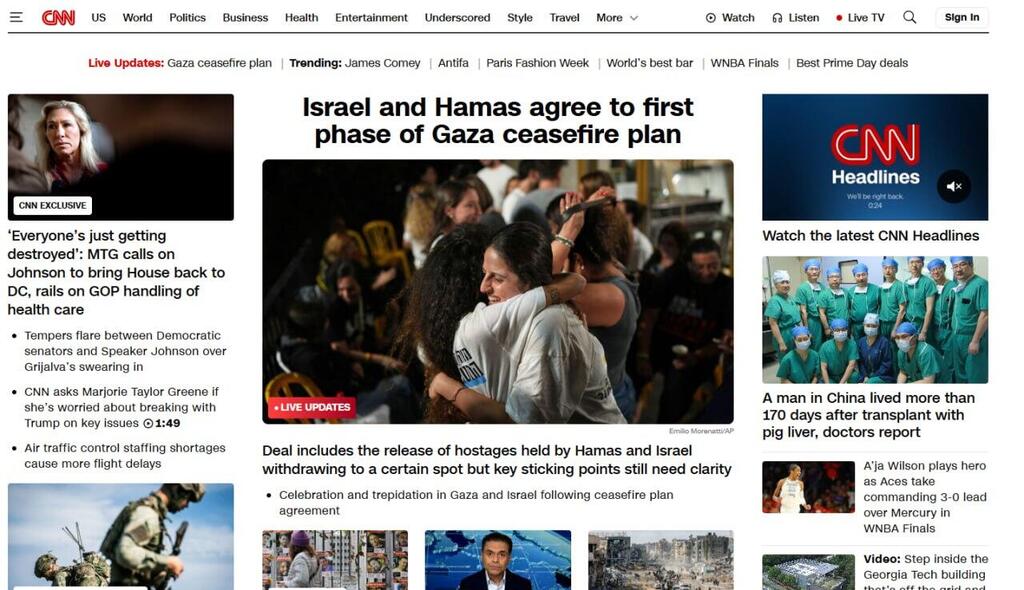
The CNN headline about the deal
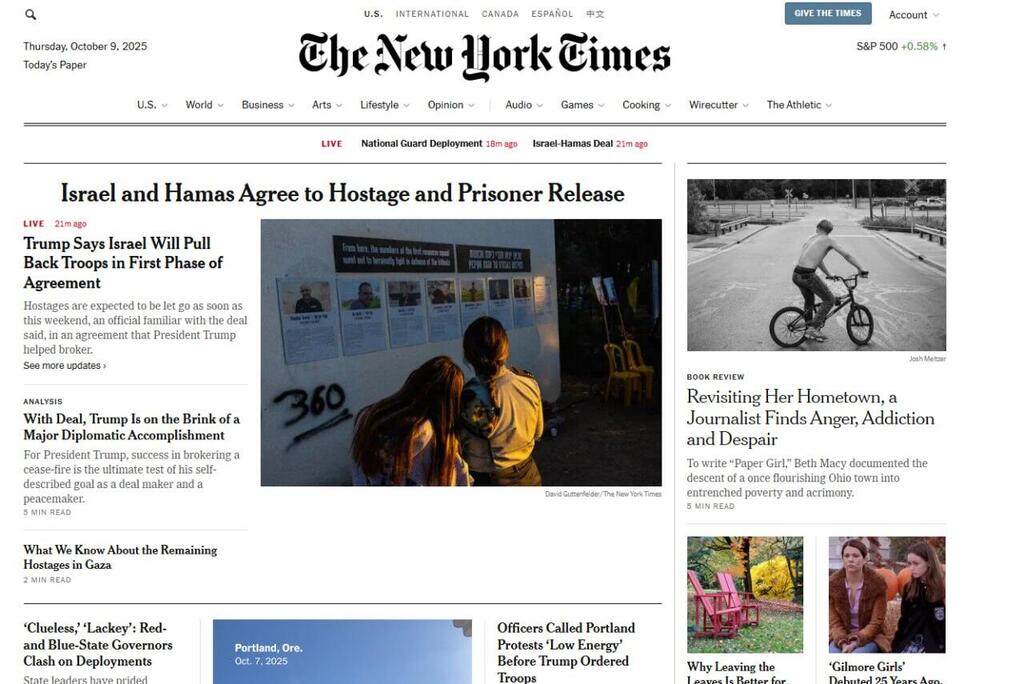
The headline in the New York Times
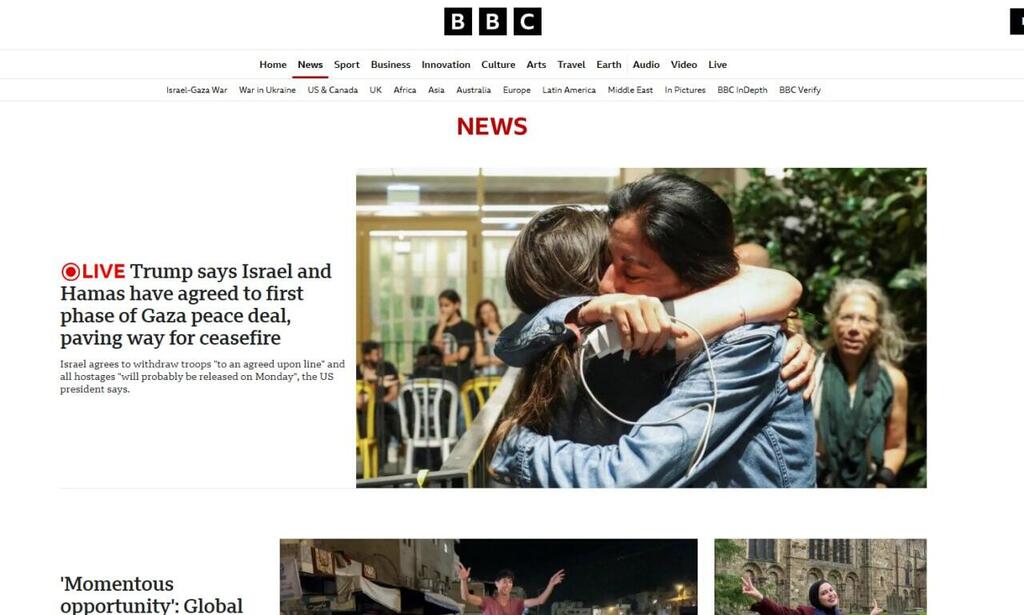
The hugs in the square of the kidnapped in the BBC's headline

NBC also has the deal in the headline
In Bild, Germany’s largest tabloid, a front-page photo of Einav Zangauker, the mother of hostage Matan Zangauker, was headlined: “A moment that touches millions of hearts!” The accompanying article described her tearful reaction at Tel Aviv’s Hostage Square: “Einav Zangauker, who long criticized Israel’s ground operations, saying they endangered the captives, collapsed in the arms of friends and supporters after hearing that her wish had come true — an agreement to free them all.”
In the New York Times, Sanger also noted Israel’s growing international isolation as a key factor in Prime Minister Benjamin Netanyahu’s decision to accept Trump’s terms. After two years of war, he wrote, Israel is “stronger than ever, yet more isolated than ever,” warning that repairing “the moral and political damage” caused by the war and the devastation in Gaza “could take a generation of peace or more.”
Sanger portrayed Netanyahu as being on a “political high,” recalling Israel’s military operations that “shocked the world,” from the Hezbollah pager strike to the surprise attack on Iran that killed senior military and nuclear figures. “But Netanyahu overreached,” Sanger wrote. “Trump and his team saw an opportunity to rein him in.” He cited “the scale of destruction in Gaza that horrified the international community” and the failed Israeli strike in Doha last month targeting Hamas leaders — “a move that stunned the White House.” According to Sanger, Trump forced Netanyahu to apologize to Qatar during their White House meeting, “and in the process maneuvered him into accepting Trump’s 20-point plan — one the Israeli leader had bet Hamas would reject.”
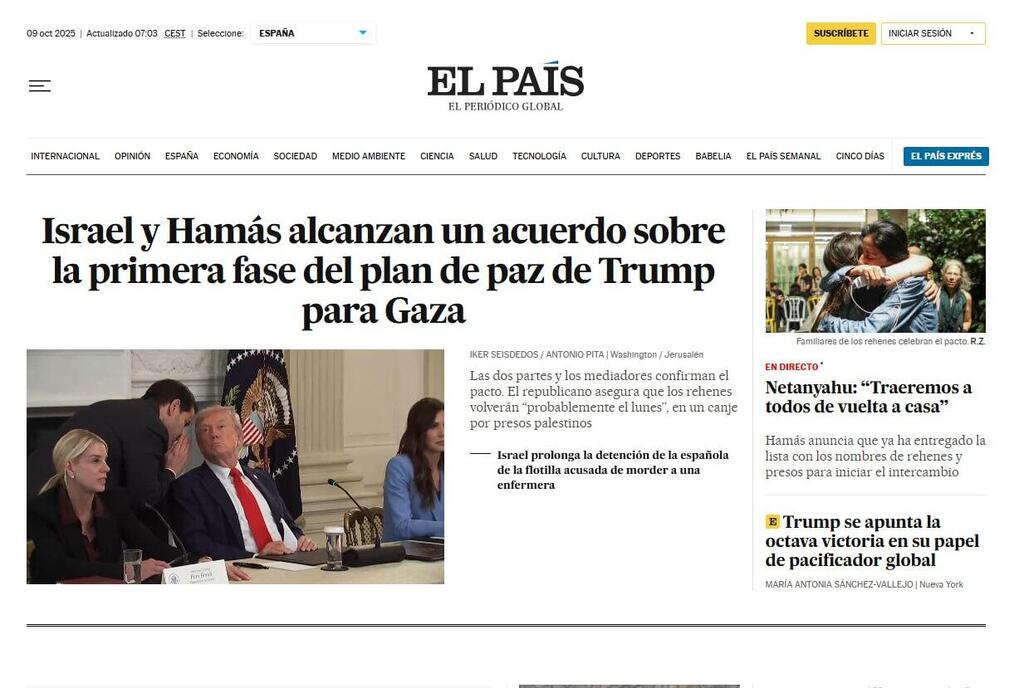
Reports on the deal in the Spanish newspaper El Pais

The Italian newspaper La Repubblica featured the celebrations in Gaza in the headline
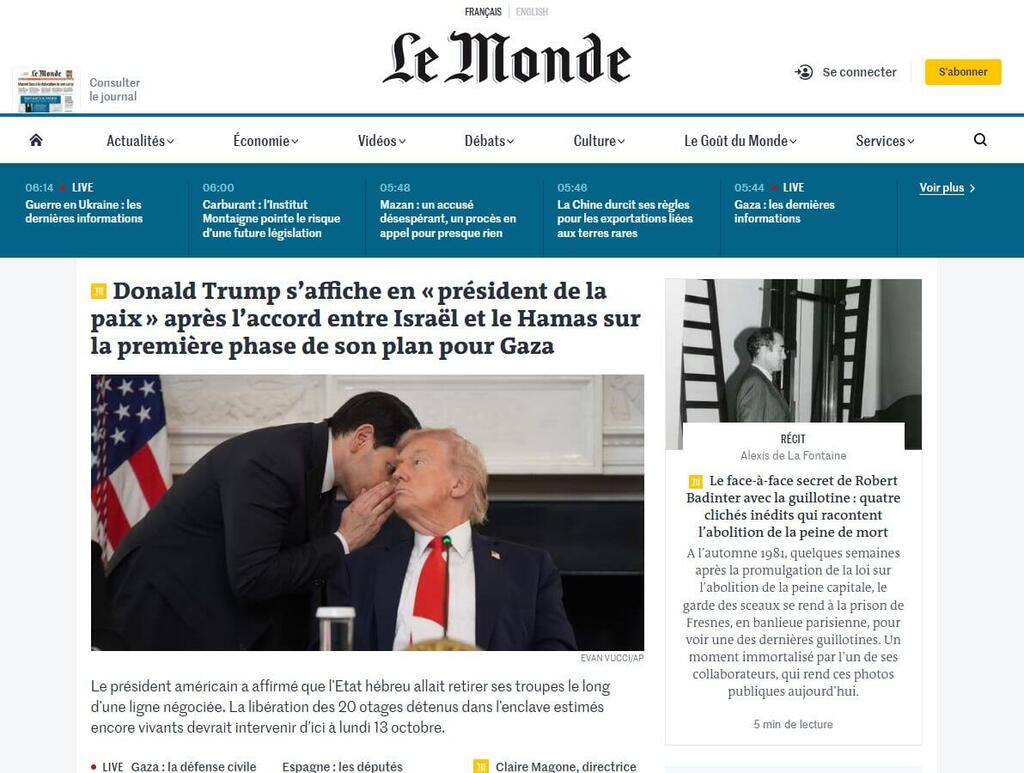
Whispering in Trump's ear in the French Le Monde headline
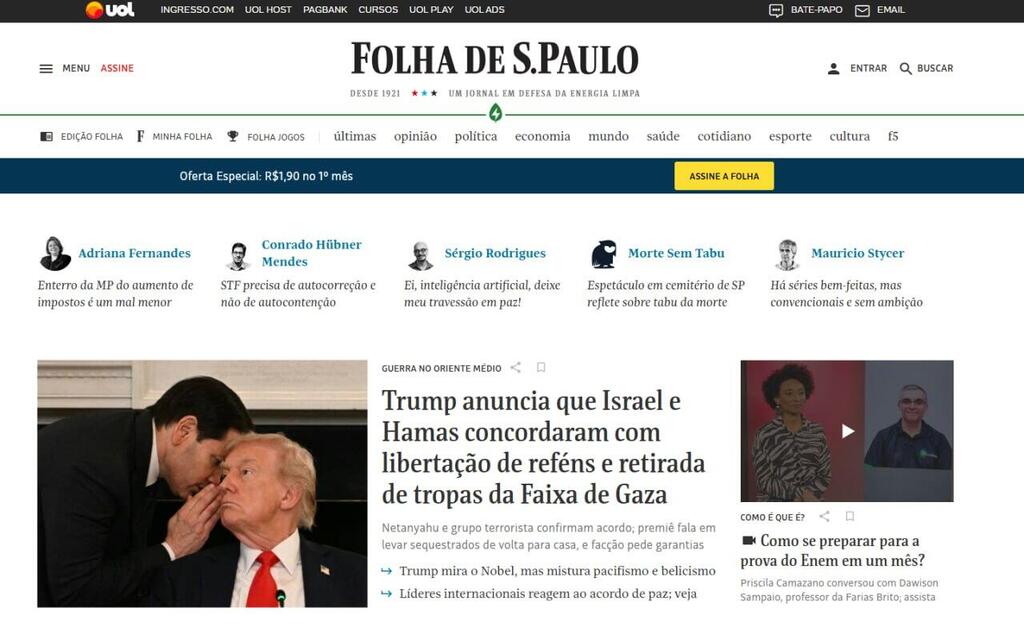
The Brazilian Folha de S.Paulo also reported the deal in the headline
Spain’s El País highlighted the intense diplomatic pressure that led to the deal, writing that “the mediators put all their eggs in one basket.” The paper reported that Trump sent senior envoys Steve Witkoff and his son-in-law Jared Kushner to Sharm el-Sheikh, while Qatar dispatched its prime minister Mohammed Al-Thani and Egypt and Turkey sent their intelligence chiefs. In an accompanying analysis, El País called it “Trump’s eighth victory as a global peacemaker,” noting that “the U.S. president, who hopes to win the Nobel Peace Prize, presents himself as the only man capable of achieving an agreement — after threatening to buy Gaza and unleash hell on Hamas.”
Across Europe and beyond, major outlets featured scenes of joy and relief in Israel. Italy’s La Repubblica led with images of celebrations in Gaza, while France’s Le Monde ran a front-page photo of Trump being whispered to during the announcement. Brazil’s Folha de S.Paulo also placed the story on its front page.
At the same time, international coverage noted celebrations among displaced Palestinians in Gaza. Ayman Saber, who fled Khan Younis during the war, told the Associated Press that he hopes to return and rebuild his home, destroyed in an Israeli airstrike last year. “We will rebuild the house,” he said. “We will rebuild Gaza.”