

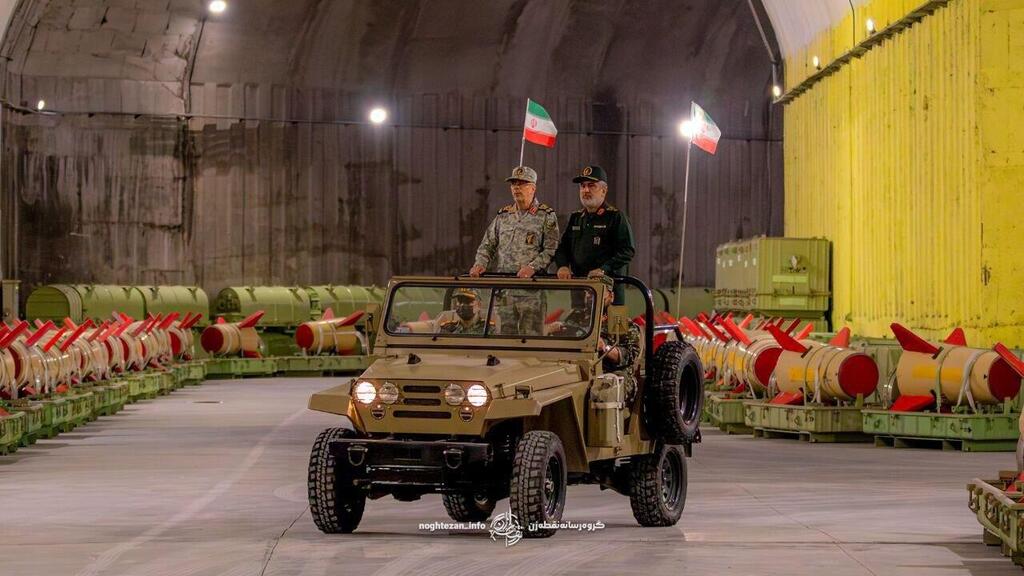
The Wall Street Journal reported Thursday that after decades in which Iran invested heavily in building underground bunkers to protect its vast missile arsenal from destruction, the strategy is now beginning to look like a major miscalculation less than a week into the war.
According to the report, U.S. and Israeli fighter jets and armed drones are now flying above dozens of the underground missile bases and striking launchers as soon as they emerge from tunnels to fire. In addition, waves of heavy bombers have dropped munitions on some of the sites, in some cases damaging entrances and potentially trapping Iranian weapons underground.
Footage from an IRGC drone tunnel used to launch attacks on US bases


Satellite images taken in recent days show the remains of several Iranian missiles and launchers destroyed in U.S. and Israeli airstrikes near the entrances to what Iranian officials have long called “missile cities,” the underground facilities where Tehran stores much of its missile arsenal.
The newspaper noted that Iran has launched more than 500 missiles since the war began Saturday, targeting Israel, U.S. bases and other sites in the Persian Gulf region. However, the size of the barrages has decreased in recent days, which analysts say may indicate that the joint U.S.-Israeli strikes are degrading Iran’s ability to continue firing missiles.
“We’re hunting Iran’s last remaining ballistic missile launchers to eliminate what I would characterize as the remnants of their ballistic capability,” Adm. Brad Cooper, the top U.S. commander in the Middle East, said in a video briefing Tuesday. “We’re seeing Iran’s ability to hit us and our partners is declining.”
Adm. Brad Cooper
U.S. Central Command, which is overseeing the air campaign, said Iranian missile launches have fallen by about 86% within four days.
Analysts told the newspaper that a significant portion of Iran’s remaining missile stockpile — including thousands of short- and medium-range missiles — likely remains stored in underground bases whose locations are largely known to the U.S. and Israeli militaries.
That situation exposes a basic weakness in the underground missile strategy, said Sam Lair, a researcher at the James Martin Center for Nonproliferation Studies in California.
“What used to be mobile and difficult to locate is now less mobile and easier to strike,” he said.
Analysts told the newspaper that with much of Iran’s air defense network degraded, the United States and Israel are able to keep surveillance aircraft flying over known missile bases and strike quickly with fighter jets or armed drones when activity is detected.
Satellite images suggest that a cluster of missile facilities near the southern city of Shiraz has been struck several times. Images analyzed by researchers show mobile launchers that appear to have exited one underground site into a nearby canyon but were destroyed before they could fire their missiles.
One satellite image taken March 2 — three days after the war began — showed a reddish plume near a destroyed launcher, which analysts said likely indicates leaking nitric acid fuel from a missile. Additional launchers were apparently destroyed nearby, igniting fires that appeared to spread through the canyon area.
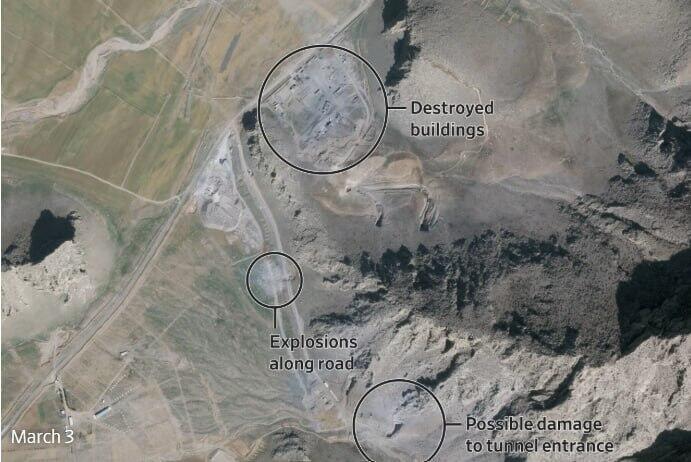
At another missile facility near Isfahan, satellite imagery from March 1 showed what appeared to be an intact launcher traveling along a road near the base. A crater in the road suggested a strike may have attempted to hit the vehicle but missed.
(Photo: Wall Street Journal)
Images taken the following day showed signs of heavy bombing near several entrances to the underground complex. Debris consistent with bunker-penetrating munitions was visible around the tunnel entrances, though it was unclear whether the tunnels themselves had collapsed.
Satellite imagery also indicated damage to roads and entrances near a missile base north of Kermanshah after what analysts said were likely strikes by heavy U.S. munitions.
According to the report, the Pentagon and the IDF have spent years mapping Iran’s underground missile infrastructure. Analysts say U.S. strikes appear to be focusing mainly on bases in southern Iran, while Israeli fighter jets are concentrating largely on facilities in the north.
In total, analysts reviewing satellite imagery identified signs of strikes or structural damage at underground missile facilities in multiple locations across Iran, including near Tabriz, Khorgo, Haji Abad and Jam.