

Eased Home Front Command restrictions will take effect at noon, and the IDF explained that the decision — which will allow workplaces to reopen while parents with children must remain at home because schools are still closed — was based on a trend of declining but stabilizing missile launches from Iran.
There was a 100% interception rate overnight, because defense systems find it easier to deal with isolated rocket launches. On the other hand, this steady “drizzle” of missile fire still causes public unease. The guidelines issued Wednesday were based on these considerations: on the one hand protecting lives, and on the other enabling functional continuity and national resilience. Toward the end of the week, another situation assessment will be held regarding the guidelines for next week.
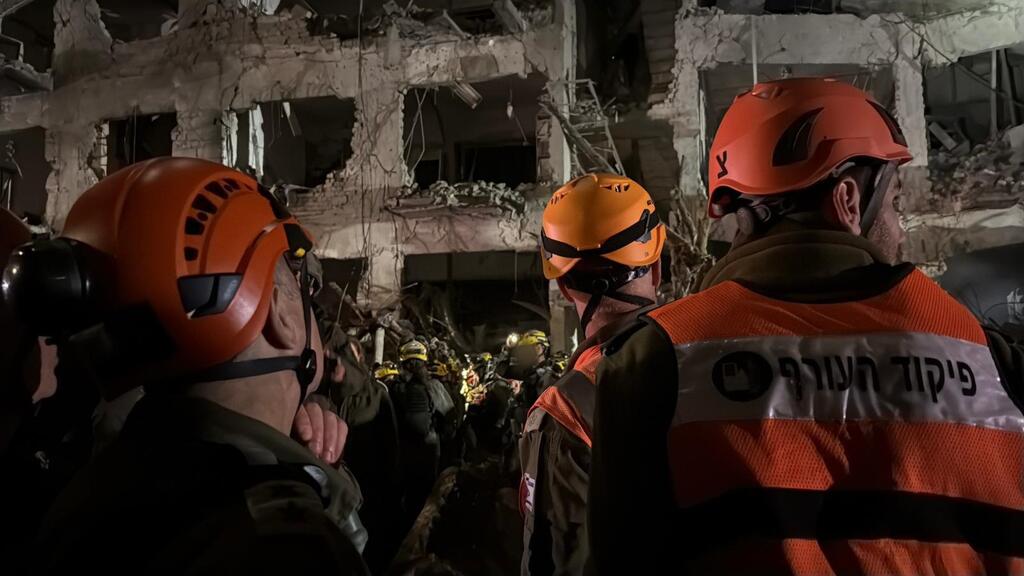
Scene of a missile fall in Tel Aviv; the IDF has no evidence of coordination between Iran and Hezbollah
(Photo: IDF Spokesperson's Unit)
IDF spokesman Brig. Gen. Effie Defrin addressed the eased Home Front Command guidelines in a statement Thursday morning. “Following a situation assessment, the Home Front Command updated the defense guidelines last night. Under the changes, all areas of the country will move to a limited policy level, and gatherings of up to 50 people will be allowed, provided a standard protected space can be reached,” he said.
"It is important to remember that the threat still exists and the enemy still has the capability to fire toward Israel. When an alert is issued, enter a protected space. Together we will get through these challenging days. I will continue to update,” Defrin added.
Defrin addressed the question of how parents can go to work if their children are not attending school. “In light of the changing situation, we decided to ease the Home Front Command guidelines. Follow the instructions. The threat has not ended, and we are constantly conducting situation assessments. We will make decisions and update in real time.”
The IDF believes the Iranian regime is deliberately targeting population centers and national infrastructure in an attempt to cause mass casualties, and the Home Front Command has so far counted 13 destruction sites.
Security officials said Hezbollah also is launching large numbers of drones and rockets, though still not in the quantities seen during Operation Northern Arrows beginning in September 2024. The Lebanese terrorist organization is firing at military positions, but also at communities and maneuvering forces operating inside Lebanon.
Damage from direct hit on house in Hatzor Glillit


The IDF has noted that the barrages from Iran and Lebanon appeared “coordinated,” but said there is currently no intelligence indicating a specific coordination. Defrin said Thursday morning, as he asserted on Wednesday, that “there is no concrete intelligence indicating coordination between Hezbollah and Iran.” According to him, “it appears coordinated. Hezbollah is an Iranian proxy and serves it, but the coordination is not that tight.”
The IDF now maintains operational control from the Litani River southward, unlike the situation during Operation Northern Arrows, and launch areas that had previously been spread across that region have disappeared. This has been compounded by numerous targeted killings of field operatives, some of them highly significant.
Still, the IDF says Hezbollah has many more cards it could play. There will be no early warnings of launches from Lebanon because there is no time for that — once a launch occurs, a siren sounds.
For now, the Houthis remain on the sidelines. The IDF understands that the Houthis possess capabilities they could use and is preparing accordingly. The reason they have not fired so far is not entirely clear, but the military understands this could change at any moment — and is preparing for the possibility that the campaign could expand from that direction as well. The working assumption in the IDF is that they may eventually join the fighting.