


Less than a day after U.S. President Donald Trump unveiled his plan to end the Gaza war and secure the release of the hostages, questions are mounting over its practical details—particularly regarding Israel’s security freedom in the Hamas-controlled enclave and the effectiveness of the international mechanisms meant to replace the IDF on the ground.
Beyond the clause requiring the release of all remaining 48 hostages within 72 hours, the sections of the agreement dealing with an international force to manage Gaza and oversee aid deliveries are raising deep concerns among right-wing figures, whose vision for ending the war differs entirely.
Trump: If Hamas rejects the proposal, Israel will have full backing to 'finish the job'
(Video: Reuters)


Prime Minister Benjamin Netanyahu landed back in Israel, with the government set to convene at 8 p.m. to confirm David Zini’s appointment as Shin Bet chief. In the meantime, senior ministers are signaling that if Hamas agrees to the deal, they will oppose it, even at the cost of quitting the government.
Behind the euphoria in Washington and Jerusalem, many questions remain about the fine print of the 20-point plan—until Monday referred to as a 21-point plan—whose interpretation and implementation could have long-term consequences for Israel’s security interests.
The main achievement of the agreement is the release of all hostages, living and dead, within 72 hours, while the other commitments would begin only afterward. Still, post-war realities hold major uncertainties, particularly regarding future security arrangements and whether the deal can be implemented as written, assuming Hamas accepts it in its current form.
According to the plan, the United States will work with Arab and international partners to establish a temporary stabilization force that would immediately enter Gaza. One of the central questions is how much operational freedom Israel would retain once the force assumes control. The force would be supervised by moderate Arab states and overseen by a “Peace Council,” chaired by Trump and former British Prime Minister Tony Blair.
Would Israel be able to act freely against any terrorist buildup it identifies in Gaza? Could the IDF preempt threats with the same latitude it retains in Lebanon? Critics warn that, unlike Lebanon, where Israel faces no international constraints on its actions, the ISF would be identified with Western and Gulf states with which Israel has alliances and shared interests. That could limit Israel’s ability to act against terrorism without straining those partnerships.
Gallery
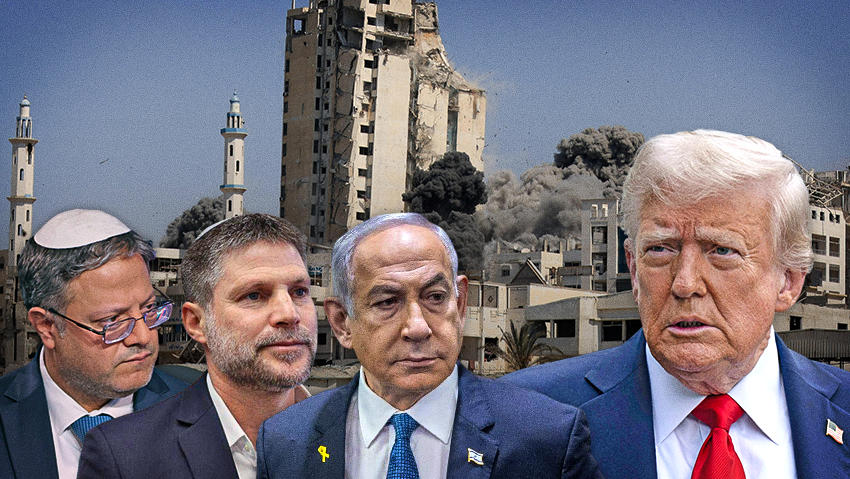
(Photo: Alex Kolomoisky, Yariv Katz, Chaim Goldberg/Flash90, Brendan Smialowski/AFP, REUTERS/Dawoud Abu Alkas)
The agreement states that Israel will maintain “a peripheral security presence until it is fully ensured that there is no terrorist threat from Gaza.” But it remains unclear whether that means only guarding the borders—or also freedom of action inside the enclave itself.
Maintaining Israel’s freedom of military action is seen as a consensus across the political and security establishment, based on the clear understanding that no body made up of Gazan Palestinians, even under the supervision of ostensibly friendly states, will actually disarm Hamas or prevent it from rebuilding its military capabilities.
Supporters of the agreement argue that it need not explicitly spell out Israel’s basic right to self-defense, since it is obvious that Israel will act against terror activity and rearmament along its borders. Israel’s past experience with its enemies, they say, proves that what matters is not what is written in an agreement, but the policy carried out in practice.
Another critical issue concerns oversight of aid and materials for Gaza’s reconstruction, especially dual-use items such as iron, cement and other supplies. The agreement stipulates that “aid will be delivered without obstruction by either side, through the United Nations and its agencies, the Red Crescent and other international organizations not affiliated with either party. The Rafah crossing will open in both directions under the mechanism set out in the Jan. 19, 2025 agreement.”
During the war, Hamas exploited humanitarian shipments for smuggling and financial gain. Under the current plan, the monitoring body would be responsible for ensuring the group does not rearm. But deep concerns remain in Jerusalem about the reliability of outside oversight. In the January framework, for example, the Palestinian Authority was said to be involved in operating the Rafah crossing, despite Israeli denials.
Coalition resistance
Finance Minister Bezalel Smotrich and National Security Minister Itamar Ben-Gvir are openly opposing the agreement. Their clash with Netanyahu, who endorsed the plan alongside Trump, is deeper than questions of implementation. It reflects a fundamental ideological divide, particularly over promises involving the Palestinian Authority and the possibility of a future Palestinian state.

Netanyahu (center) with Finance Minister Bezalel Smotrich and National Security Minister Itamar Ben-Gvir
(Photo: AP Photo/Ohad Zwigenberg)
In a recent Cabinet meeting, Smotrich declared: “We did not pay all these prices only to transfer Gaza from one Arab to another.” Netanyahu, by contrast, has rejected calls for military government in Gaza despite pressure from the army chief of staff. He has also shown little interest in extending Israeli sovereignty in the West Bank, putting him at odds with Smotrich’s long-held agenda.
For two years, Smotrich believed he was steering Netanyahu toward supporting military rule in Gaza—at least behind closed doors—but the prime minister never embraced that position.
For now, the government’s fate hinges on Hamas’ response. Should the group accept Trump’s plan, Smotrich and Ben-Gvir are expected to leave the coalition. That would not necessarily topple the government: Blue and White leader Benny Gantz has signaled readiness to join in order to advance the deal. Together with the ultra-Orthodox parties, his support would give Netanyahu a majority of 61 seats, even without Smotrich, Ben-Gvir or Avi Maoz, who does not consistently vote with the government.
Meanwhile, Smotrich and his Religious Zionist Party and Otzma Yehudit allies are waiting for Netanyahu and his delegation to return from Washington, eager to hear Strategic Affairs Minister Ron Dermer’s interpretation of the deal and answers to their concerns.
Separately, Yisrael Beitenu leader Avigdor Liberman urged Netanyahu to take a hard line: “He should declare right now, clearly and unequivocally - if Hamas does not accept Trump’s plan, then immediately we shut down all crossings into Gaza. No humanitarian aid, no electricity, no water, no fuel. That’s it.”