

U.S. President Donald Trump announced Saturday evening from his Mar-a-Lago estate that the United States will take control of Venezuela’s governance “until such time as we can do a safe, proper and judicious transition.”
Trump did not specify how long this interim administration would last, under what conditions power would be transferred or how Washington intends to manage daily life in Venezuela. He said only that an undefined “group” would assume responsibility for the country, adding, “It won’t cost us a thing.”
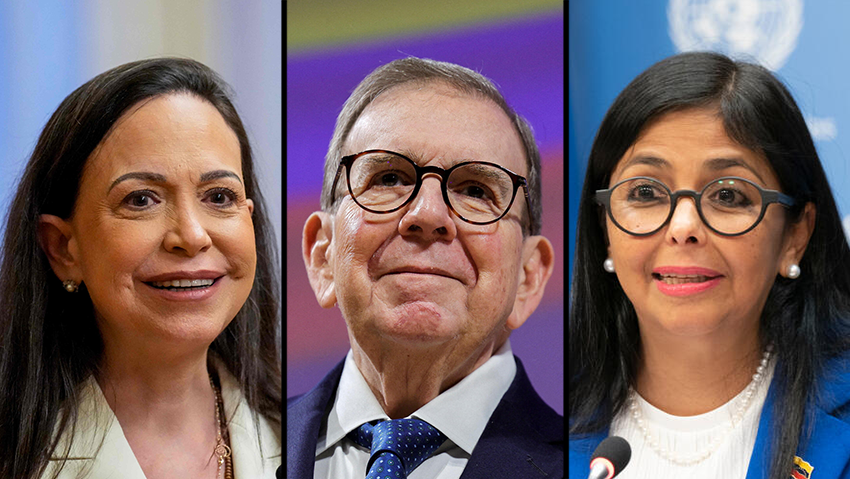
María Corina Machado, Edmundo González, Delcy Rodríguez
(Photo: Lev Radin/Shutterstock, Ole Berg-Rusten / NTB / AFP, REUTERS/Yara Nard)
He also claimed that Secretary of State Marco Rubio had spoken with Delcy Rodríguez, Venezuela’s vice president, who allegedly told him she would “do whatever the U.S. needs” from her.
The key question now is who will replace Nicolás Maduro, captured by U.S. forces in a dramatic overnight raid. Two things appear certain: any successor will require Washington’s approval, and such approval will hinge on agreeing to Trump’s demand that large portions of Venezuela’s vast oil reserves be transferred to American oil companies.
While Rodríguez is technically next in line, the White House is unlikely to recognize her legitimacy—particularly given its close ties with opposition leader María Corina Machado, a Nobel Peace Prize laureate who fled Venezuela in 2024 to receive the award in Oslo and has not returned since.
In a surprising turn during the press conference, however, Trump questioned Machado’s standing, saying she lacks sufficient public support within Venezuela.
Earlier in the day, Machado expressed support for the U.S. operation in a statement on social media, calling for national unity and naming who she believes should take power: Edmundo González, whom she called the true winner of the July 2024 presidential election. She said he must assume office “immediately.”
González, 75, won 67% of the vote, compared to 30% for Maduro, according to independent observers. Despite the result, Maduro clung to power, forcing González to seek refuge in the Dutch and Spanish embassies in Caracas before eventually fleeing to Madrid, where he remains.
While the White House is expected to weigh Machado’s views on Maduro’s successor, both she and Washington understand that any future Venezuelan government will be expected to cede significant control over the country’s oil reserves—the largest in the world. Trump made this clear, saying, “We can’t take the risk of letting someone else run Venezuela right now. We’re deciding what happens there.”