

More than 1,900 Iranian regime soldiers and commanders have been killed since the start of the war, IDF Spokesperson Brig. Gen. Effie Defrin said Monday night.
According to him, the Israeli Air Force struck Iranian regime sites across Tehran, Isfahan and southern Iran, including attacks on military airfields and aircraft linked to Iran’s Quds Force.
IDF strikes in Tehran
(Video: IDF)


Defrin said the air force completed a series of strikes on six major Iranian military airports overnight. The attacks destroyed multiple aircraft, including transport planes used by the Islamic Revolutionary Guard Corps’ Quds Force and Iranian combat helicopters.
Runways and air defense and detection systems intended to operate against air force aircraft flying over Iran were also struck, he said.
The military spokesman said 16 transport aircraft were destroyed, part of efforts to dismantle the Quds Force’s logistical network used to move weapons and funding to terrorist proxies across the Middle East, including Hezbollah, Hamas and the Houthi rebels in Yemen. The targeted airfields were used by the Iranian regime to arm and finance those groups, according to the IDF.
The strikes are part of a broader campaign aimed at weakening the Iranian regime’s military capabilities and establishing air superiority over Iran. “Air force aircraft are striking in Iran even at this moment,” Defrin said, adding that operations are continuing to deepen damage to Iranian regime's military systems.
In Lebanon, the IDF said it has struck more than 700 Hezbollah targets, including about 100 belonging to Hezbollah’s elite Radwan force.
IDF strikes in Beirut
Buildings used as terrorist infrastructure in Beirut were also targeted, the military said.
Overnight, IDF forces carried out a targeted raid in southern Lebanon, locating terrorist infrastructure and killing terrorists. Officials said such operations are intended to strengthen defenses for northern communities.
Defrin warned that the threat to civilians remains despite the military campaign. “Our air defense system is the best in the world, but the defense is not hermetic,” he said.
The military is also reviewing reports that sirens were not activated in Ramla and Beit Shemesh during a rocket attack earlier in the day. Defrin said warning systems are functioning properly but the incident is being examined together with cellular providers.
The IDF said Home Front Command guidelines remain unchanged following a new situation assessment.
(Photo: IDF)
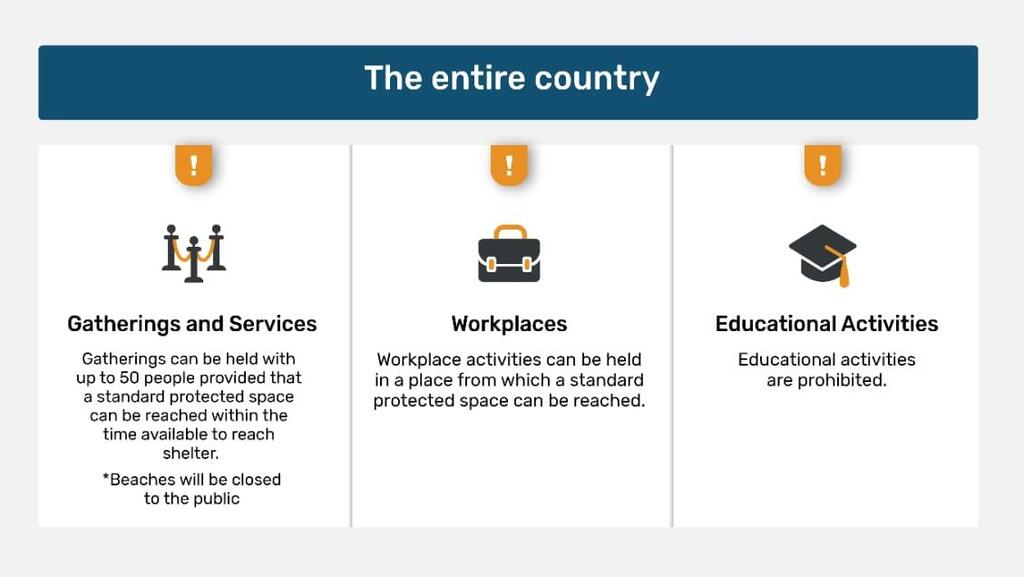
Under the nationwide “limited activity” policy, formal educational activities remain suspended, including schools, day care centers and universities. The Education Ministry said the education system will remain closed for in-person learning nationwide through the end of the week.
The ministry said a phased reopening plan for areas classified as “yellow,” developed together with local authorities, is currently expected to take effect at the beginning of next week, subject to approval by Home Front Command and ongoing security assessments.
Limited informal activities may take place for groups of up to 30 children near a standard protected space, accompanied by at least two adults.
In northern confrontation line areas and the northern Golan Heights, such activities may be held only inside protected spaces.
Public gatherings are limited to 50 people, provided participants can reach a protected space within the required warning time. Outdoor funerals are limited to 20 participants.
Workplaces may operate only in locations where workers can reach a protected space during a rocket alert.
The current guidelines remain in effect until Saturday, March 14 at 8 p.m.