


A dispute over daycare subsidies for ultra-Orthodox families deepened the onoging coalition crisis Tuesday, after Prime Minister Benjamin Netanyahu’s Likud party told ultra-Orthodox lawmakers it could not secure a majority to advance the legislation.
The bill is intended to bypass a freeze on daycare subsidies for families in which fathers are required to enlist in the military but do not serve. Military service is compulsory for most Jewish Israelis, but many ultra-Orthodox men have long received exemptions while studying in religious seminaries, an arrangement that has become increasingly contentious during years of war on several fronts.

The proposal would determine eligibility for subsidized daycare based only on the mother’s employment status, rather than the status of both parents. That would allow subsidies to continue for families in which the father is a full-time yeshiva student who has not reported for military service.
Ultra-Orthodox lawmakers expected the bill to be brought for a first reading in the Knesset plenum Monday, but it was left off the agenda. In response, ultra-Orthodox parties said they would stop voting with the coalition, and the plenum was closed.
On Tuesday, Netanyahu’s representatives told the ultra-Orthodox parties that the coalition did not have enough votes to pass the bill.
The two factions that make up United Torah Judaism, the non-Hasidic Degel HaTorah and the Hasidic Agudat Yisrael, reacted angrily.
“There was a commitment by the prime minister and Likud to bring the daycare bill for approval,” Degel HaTorah said. “We insist on this and will not accept any delay or retreat.”
Agudat Yisrael said the entire faction stood with Degel HaTorah in demanding that Netanyahu fulfill his promise.
“Failure to pass the law means an admission by the prime minister that he definitively wants to dissolve the Knesset and go to elections,” the faction said.
A senior United Torah Judaism official said the faction was united behind the bill and would not support coalition legislation until it is advanced.
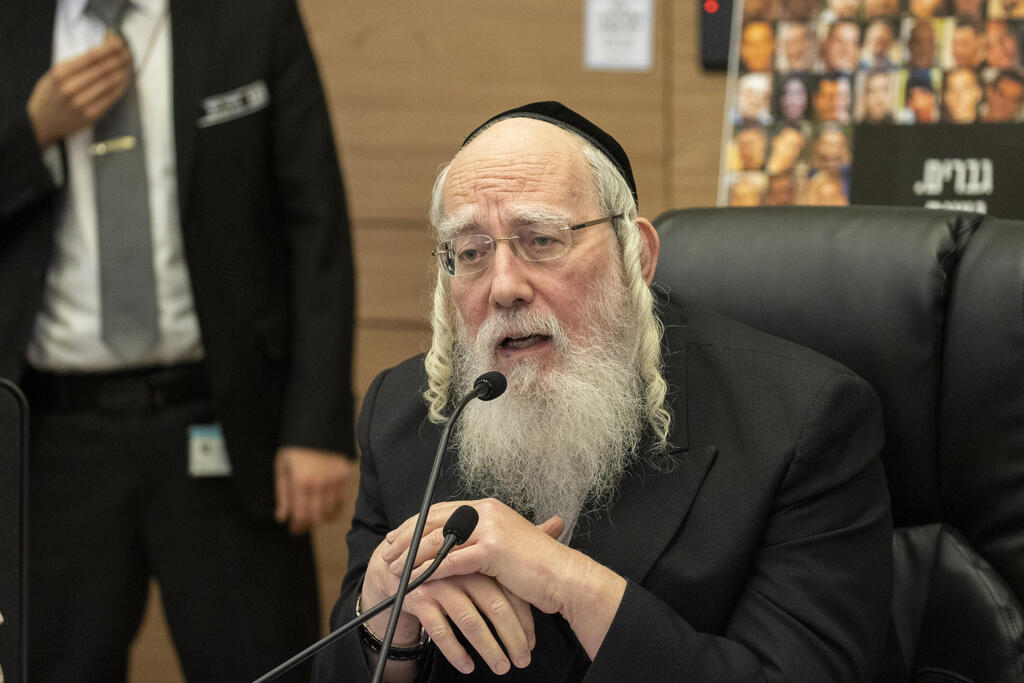
Israel Eichler
(Photo: Amit Shabi)
“If Netanyahu thinks he can play with us over the daycare law, he should remember that this is a bill proposed by Israel Eichler of Agudat Yisrael and now submitted by Moshe Gafni of Degel HaTorah,” the official said. “The whole faction is united like a fist behind this law, and we will not vote with the coalition on anything until it is advanced.”
The dispute comes as Shas, another ultra-Orthodox coalition party, is pressing to advance a separate Basic Law on Torah study. Israel’s Basic Laws function as the country’s constitutional framework.
Former minister Michael Malchieli of Shas told Kol Barama radio that the party understood it could not pass its central legislation through ordinary law and had therefore returned to the Basic Law proposal.
“It has legal meaning and will solve part of the madness of the courts,” Malchieli said, adding that Shas chairman Aryeh Deri had been working on a move that could help resolve the issue of arrests of draft dodgers.
The daycare bill passed a preliminary reading May 27. The proposal, submitted by Eichler and other lawmakers, would change the criteria for admission to subsidized daycare centers and family daycare programs under state supervision.
The bill has drawn opposition from coalition lawmakers and ministers, particularly because of anger over the burden carried by reservists and combat soldiers during the war.
Finance Minister Bezalel Smotrich said his support would be conditioned on benefits for male and female reservists. But Ofir Sofer, a minister from Smotrich’s party, said he would not support the bill.
Likud lawmaker Dan Illouz was the first coalition member to say he would vote against the proposal, despite receiving a call from Netanyahu urging him to support it. Yuli Edelstein, a Likud lawmaker who chairs the Knesset Foreign Affairs and Defense Committee, also said he would not back the bill.
The proposal also faces legal objections. Attorney General Gali Baharav-Miara has said the daycare bill is unconstitutional because it would “encourage improper evasion” of military service and deepen the harm to those who serve.
Before the Ministerial Committee for Legislation approved the bill, Baharav-Miara sent a letter to Cabinet Secretary Yossi Fuchs accusing him of acting without authority by asking the accountant general to instruct the Labor Ministry’s accountant to act contrary to the attorney general’s guidance.
“You are not authorized to instruct a civil servant to act contrary to the law and to intimidate a civil servant,” she wrote.
Fuchs later responded by accusing Baharav-Miara of creating a constitutional crisis. “Your conduct against the government is becoming a constitutional crisis, complete anarchy, when legal advice to the government instructs public employees not to carry out valid government decisions,” he wrote.
Political officials said final passage of the bill against the attorney general’s position could lead to a direct clash between branches of government, leaving unclear how government ministries would be expected to act.