

Nine days before Israel's October 27 election, a major investigation published Sunday by TIME magazine reveals previously undisclosed documents and correspondence showing Israel's direct involvement in facilitating nearly $2 billion in Qatari payments to the Gaza Strip over more than a decade.
According to the report, governments led by Prime Minister Benjamin Netanyahu did more than authorize the transfers: They encouraged the payments to continue, helped determine how the money would be distributed and worked to preserve the funding arrangements even as Israeli officials publicly accused Qatar of financing Hamas.
Gallery
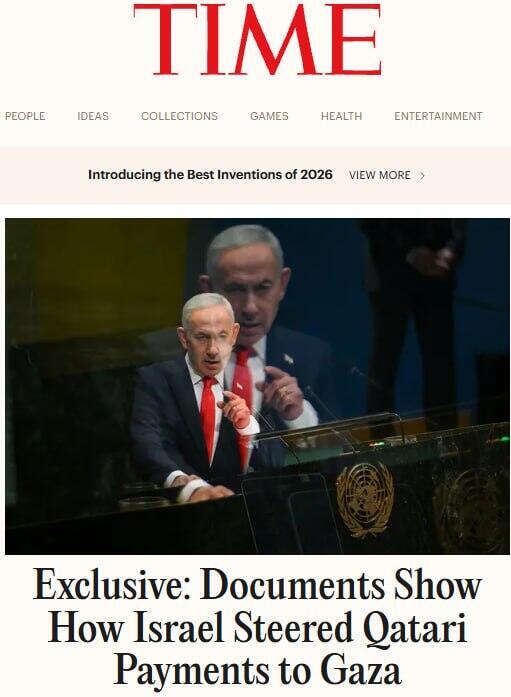
TIME magazine's lead investigation into Israel's role in Qatari payments to Gaza
(Photo: TIME)
An earlier investigation by Ronen Bergman and Yuval Rubovitz, published by ynet and Yedioth Ahronoth, uncovered intelligence documents and testimony showing that Netanyahu had received warnings beginning in 2019 from the Shin Bet domestic security agency, Military Intelligence and Egyptian officials that Qatari money was being diverted to Hamas' military buildup.
The investigation also revealed a separate, covert channel through which Qatar transferred funds directly to Hamas, in addition to the diversion of money originally designated for humanitarian assistance. According to the findings, the combined funding, which Netanyahu was allegedly aware of, covered roughly half the budget of Hamas' entire military wing. Despite explicit warnings and opposition from former Shin Bet directors Nadav Argaman and Ronen Bar, Netanyahu continued the policy, the investigation found.
One of the most striking documents uncovered by TIME is a December 2020 letter from then-Mossad director Yossi Cohen to Qatar's emir, Sheikh Tamim bin Hamad Al Thani. The letter, filled with praise for Doha, was written after Netanyahu had already received warnings that Qatari funds were contributing to Hamas' military capabilities.
In the letter, Cohen expressed Israel's gratitude and appreciation for Qatar's humanitarian assistance to Gaza over the preceding years. He wrote that the efforts had "played a crucial role in improving the humanitarian situation" and contributed to regional stability and security.
The TIME investigation, published amid continuing scrutiny of Netanyahu's policies toward Hamas before the October 7, 2023, massacre, draws on official documents, correspondence between Israeli and Qatari officials and interviews with Israeli, American and diplomatic figures involved in the funding arrangements. The documents suggest that Israel's role was considerably more extensive than Netanyahu has publicly acknowledged. The Prime Minister's Office declined to comment to TIME.
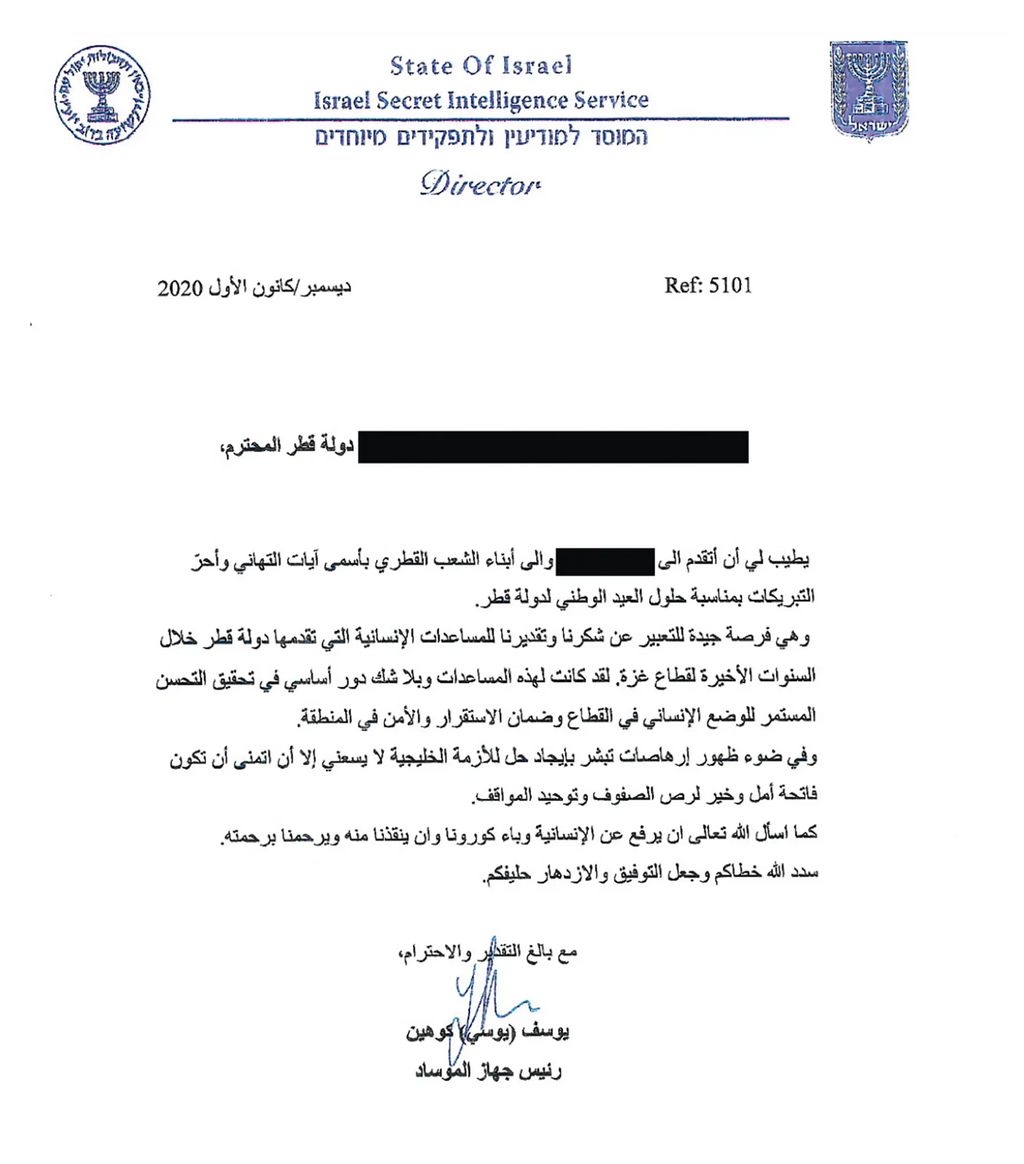
The December 2020 letter from former Mossad director Yossi Cohen to Qatar's emir
(Photo: TIME)
A former Israeli defense official told the magazine that the policy had begun with good intentions but ultimately proved to be a failure that successive prime ministers had perpetuated. The official said Netanyahu was "unquestionably at the center of it," having promoted and accelerated the program while his government oversaw its implementation.
Israel vetted recipients and urged Qatar to keep the money flowing
According to TIME, Qatar began transferring money to Gaza in 2007, after Hamas seized control of the territory, while Ehud Olmert was prime minister. Israel was not initially directly involved in the transfers, but that changed under Netanyahu. Beginning in 2012, his government helped establish a system that involved Israeli authorities in delivering food and medical supplies, determining which Palestinian families qualified for financial assistance and expanding Gaza's electricity supply through Qatari funding.
By 2018, Qatar had transferred approximately $1.1 billion to Gaza, according to figures presented to Israeli ministers and previously reported by Haaretz. The money was designated for humanitarian assistance, fuel purchases and government salaries. That year, Qatar began demanding formal documentation confirming Israel's involvement in the arrangements, partly because Israeli officials were publicly condemning Doha while privately asking it to continue providing the funds.
A senior official in the first Trump administration who was familiar with the negotiations told TIME that the contradiction frustrated the Qataris. Israeli officials would criticize the transfers in public, only to privately approach Doha and request that the payments be renewed.
In October 2018, Israel, Qatar and the United Nations signed an agreement to finance fuel deliveries to Gaza. The arrangement later developed into a three-party mechanism under Israeli and international oversight. Qatar financed fuel and electricity purchases from Israel, funded projects through the United Nations and provided monthly payments to impoverished Palestinian families.
In August 2021, Qatar signed another agreement worth $40 million to provide nearly 100,000 Palestinian households with $100 per month for four months. According to diplomats familiar with the arrangement, Israel vetted the lists of beneficiaries and supervised the distribution mechanism. Funds were transferred through the UN World Food Programme, and eligible families received text messages directing them to locations where they could collect the assistance.
Another document obtained by TIME, dated July 2019, shows Qatar notifying Netanyahu's government of a $6 million transfer to 20,000 Gaza residents, with each beneficiary receiving $300. The magazine said it remained unclear how many recipients selected through the Israeli mechanism were affiliated with Hamas or had relatives belonging to the organization.
In 2020, during the coronavirus pandemic, an Israeli National Security Council official identified as R. L. Maoz contacted Qatari officials to emphasize the importance of maintaining the financial assistance arrangements. The correspondence called for the continued transfer of Qatari humanitarian funds through the established system.
The official also requested that Qatar's assistance not be routed through other countries or intermediaries, but instead continue through Ambassador Mohammed al-Emadi, who headed the Qatari Committee for the Reconstruction of Gaza. The letter expressed appreciation for the cooperation and open dialogue, describing the relationship as important to preserving regional stability and security and bringing the two countries and their peoples closer together.