


The head of IDF Central Command told Prime Minister Benjamin Netanyahu last week that public backing for violence in the West Bank must not be tolerated, saying such support complicates law enforcement efforts.
Maj. Gen. Avi Bluth made the comments during a Thursday meeting at the Prime Minister’s Office, according to officials familiar with the discussion. As an example of what he described as public support for violent acts, Bluth showed participants a video posted by Knesset member Limor Son Har-Melech of the hard-right Otzma Yehudit party. “You must see this,” Bluth told those in attendance.
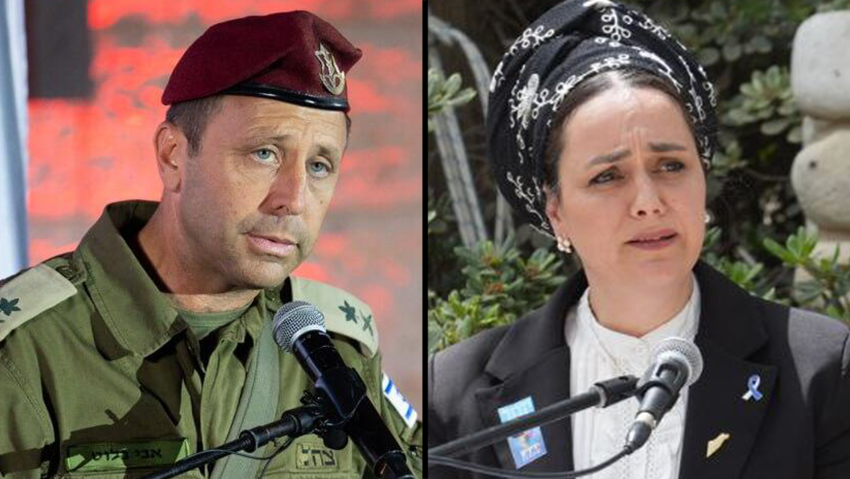
Central Command chief Maj. Gen. Avi Bluth, Limor Son Har‑Melech
(Photo: IDF, Tomer Shunem Halevi)
In the video, recorded earlier this month near the wildcat outpost of Tzur Misgavi, Son Har-Melech appears at the site as security forces were carrying out an evacuation. Clashes broke out during the evacuation between security forces and residents. Son Har-Melech later posted another clip of a resident thanking her on behalf of the outpost.
“There is very harsh violence. They are not letting people go up so the images will not get out. We were hit with stun grenades and gas grenades,” she said in the video. She added that discourse about a Palestinian state signals “destruction” for Israel, calling it “a disgrace” and “a terrible message to our enemy.” Two Border Police officers and several residents were injured in the confrontations.
National Security Minister Itamar Ben-Gvir sharply criticized Bluth during the meeting. “Are you not ashamed?” he said. “Her husband was murdered. She is a terror widow. She speaks against a Palestinian state, speaks about settling the land. She did not say a single word supporting violence. Where do you see backing for arson? For attackers?”
Netanyahu held two meetings on Thursday on recent unrest in the West Bank and on how to address the involvement of hilltop youth linked to wildcat outposts and nationalist-motivated crime. According to data presented at the discussions, about 1,000 youths live in farms and hilltop areas in the West Bank. Not all are local residents; some come from outside the region, including from ultra-Orthodox communities. Officials said 800 work in agricultural farms and about 300 are involved in unlawful activity. Roughly 70 are considered part of the hard core that leads violent incidents, some of them adults who draw younger followers into the activity.