


Syrian President Ahmed al-Sharaa said Sunday in an interview with Al Jazeera that he is interested in reaching a security agreement with Israel “that will pave the way for comprehensive peace," even as tensions rise on the front and Syria claims IDF forces have advanced into villages inside Syrian territory.
“We are avoiding confrontation with Israel. We have no interest in it,” al-Sharaa said. “We are working to reach a security agreement with Israel with the participation of a group of countries. If the security agreement with Israel succeeds, it will pave the way for comprehensive peace without relinquishing Syria’s right to the Golan.”
Gallery
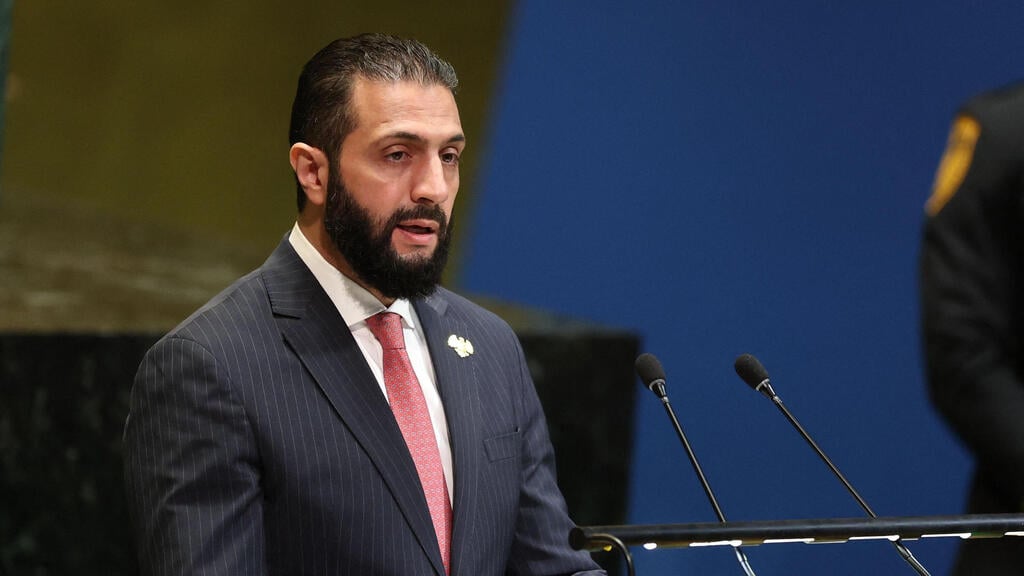
Al-Sharaa: 'A security agreement that will lead to comprehensive peace'
(Photo: Angele Weiss / AFP)
In the interview, al-Sharaa claimed Syria has no intention of intervening militarily in Lebanon, despite remarks by U.S. President Donald Trump promoting the idea.
“We are discussing solutions with the Lebanese government to help bring it to safety. The solution in Lebanon is not necessarily a security one. Any chaos in Lebanon will directly affect Syria, and we support the Lebanese state’s monopoly on weapons and decisions regarding war and peace,” Trump said.
Al-Sharaa made the remarksafter Trump’s statements that Syria’s president “will know how to deal with Hezbollah better than Israel” — and on a day when Syria reported advances by IDF forces in Daraa province.
“We are concerned that the war will escalate in the region,” al-Sharaa said. “Lifting the economic sanctions will not be effective without removing Syria from the list of states that sponsor terrorism. There is a slowdown in the implementation of the agreement with the Kurds, but we are still relying on it.”
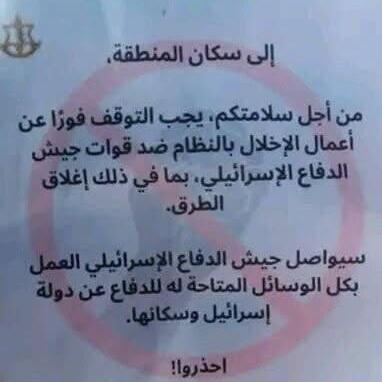
Leaflet that the IDF distributed in Syria:
According to Syria’s SANA news agency, IDF forces advanced Sunday into the villages of Maariya and al-Arda, in the western rural area of Daraa. The report said three military vehicles and a bulldozer entered the two villages in the early morning hours, and the force set up a military checkpoint inside al-Arda.
The report also claimed that the IDF distributed leaflets in the area warning residents against blocking roads or interfering with the forces. In the leaflets, the IDF demanded an end to roadblocks and disruptions to troop activity. “We will continue to act using all means at our disposal to protect Israel,” the leaflets said. At the same time, Syria’s Al-Ikhbariya channel reported that the IDF fired artillery shells in the area of the village of Tranja, near Quneitra.
Meanwhile, the Lebanese army accused IDF forces Sunday afternoon of “continuing attacks and violations of the existing understandings and international law through the systematic destruction of homes, shelling and machine-gun fire in several areas in the south of the country, including the villages of Tibnit, Hadatha, Kounine, Naba Ibl al-Saqi, al-Mansouri, Buyut al-Sayyad and Majdal Zoun. They are also seizing ruins in the border areas, blowing up the water project of the National Authority of the Litani River, and burning olive trees and agricultural land.”
Lebanese army forces enter the village of Zutar al-Gharbia in southern Lebanon as part of the agreement with Israel


According to the Lebanese military, “all this is happening in parallel with gunfire near Lebanese army positions, which interferes with its activity. The Lebanese army continues to monitor the return of residents to the town of Zawtar al-Gharbiyeh and is carrying out its duties there to ensure the safety of civilians, as well as in the areas of the villages of Froun and Srifa,” the “pilot areas” from which the IDF withdrew and which were handed over to the Lebanese.
It added that “the continued attacks delay the army’s full deployment in accordance with the existing agreements and prevent residents from returning to their villages and towns, thereby blocking the establishment of stability in the south.”
At the same time, during a Cabinet meeting held Sunday afternoon, government ministers received security briefings on Lebanon as well, and were shown maps of the “pilot areas” now controlled by the Lebanese army.
Prime Minister Benjamin Netanyahu said in that context: “In one of them, we were not present even with a single soldier, and therefore we did not withdraw from a place where we were not. In the second place, north of the Litani, we were not in most of it at all, and in the other part we temporarily took territory beyond the original yellow line. Therefore, we are maintaining the original security zone and not moving from it.”
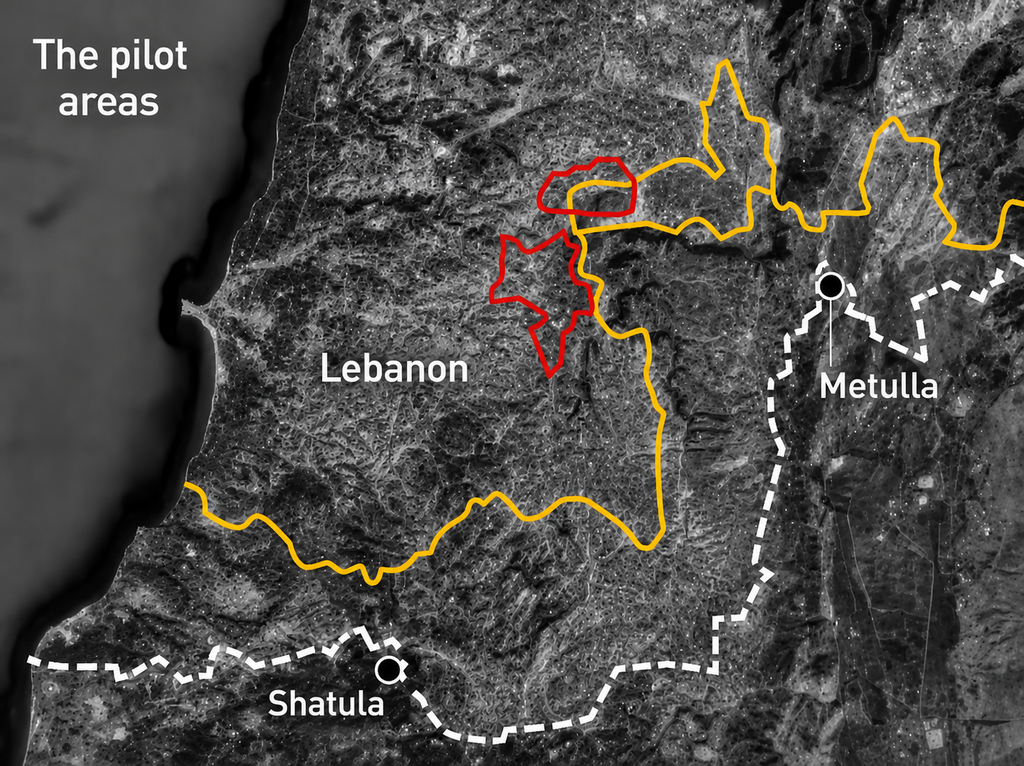
Despite Netanyahu’s remarks, the town of Zawtar al-Gharbiyeh is located within the areas of the yellow line, as can be seen on the map. As part of the implementation of the agreement announced by the U.S. State Department, the Lebanese army also controls the villages of Froun and Srifa, which are outside the yellow line and over which the IDF maintains control through observation and fire, without placing forces on the ground. Last week, Lebanese army forces entered those communities, with military vehicles first documented entering Zawtar al-Gharbiyeh alongside armored vehicles.