

Millions of text messages were sent in recent months to the cellphones of U.S. citizens under the names Emma, Sarah or John, who identified themselves as members of a group called “Friends for Peace.”
“How do you think the U.S.-Israel peace talks with Iran will affect global security?” they ask. A Wall Street Journal investigation revealed that the messages are written using artificial intelligence, promoted by a longtime adviser to U.S. President Donald Trump and funded by the Israeli government.
Gallery
Israel spent tens of millions of dollars to inluence public opinion in the US
(Photo: Shutterstock)
In an investigation published this week by Time magazine, it was revealed that Israel paid about $1.5 million a month to Brad Parscale, who ran Trump’s digital campaign in 2016, as part of an effort to influence American public opinion, especially young conservatives and MAGA supporters. The Journal now reports that the government-funded contract is worth more than $45 million.
The report noted that about 60% of American adults now have a negative view of Israel, according to a Pew Research Center survey, against the backdrop of the wars in Gaza and Iran. As a result, Israel is pouring tens of millions of dollars into an effort described as “quixotic” — naive and unrealistic — to overcome that wave, relying on AI-driven strategies and direct payments to conservative media.
Six companies and dozens of agents: 'Integrating narrative messages'
Israel has hired at least six companies over the past year to assist in its public influence efforts in the United States. Dozens of people, many of them marketing professionals, have registered as foreign agents for Israel.
According to Nick Cleveland-Stout, a foreign influence researcher at the Quincy Institute for Responsible Statecraft, Israel is on track to spend more than any other country on American influence efforts known to the federal government. He noted that other countries, such as Qatar, have spent large sums over the years on influence campaigns.
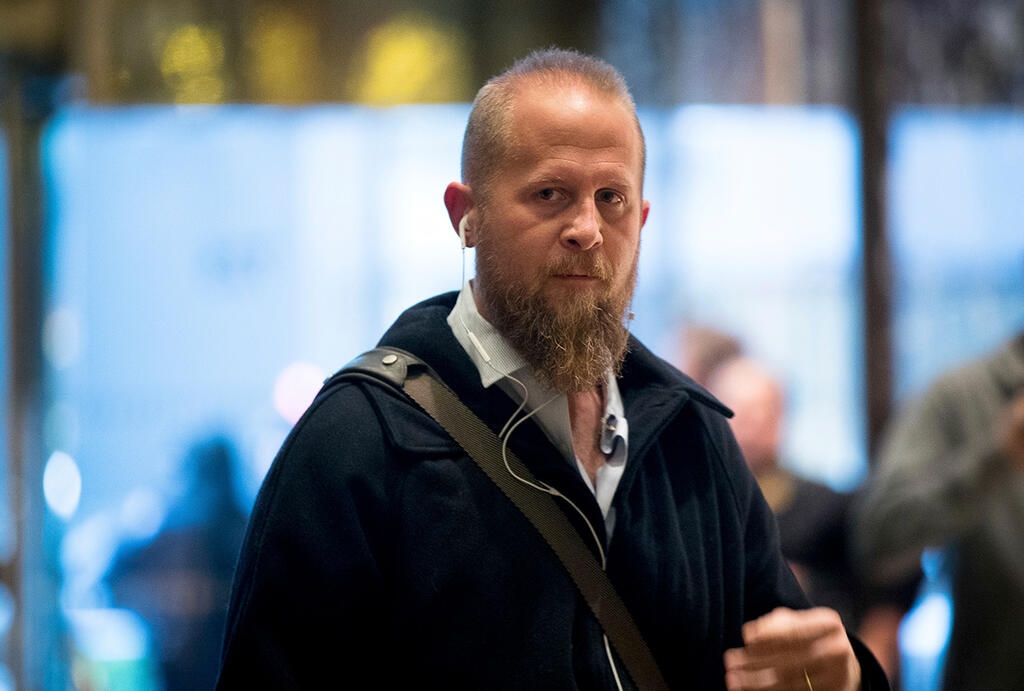
Brad Parscale is chief strategy officer at Salem Media, a company that hosts popular conservative podcasters and broadcasters
(Photo: AP)
Parscale’s work has drawn scrutiny because of his role as chief strategy officer at Salem Media, a company that hosts popular conservative podcasters and broadcasters, including Hugh Hewitt, Scott Jennings and Lara Trump. According to the Journal investigation, his initial contract with Israel included “integrating narrative messages into Salem Media assets and aligned distribution channels.”
Steve Bannon, Trump’s former chief strategist and a prominent podcaster himself, asked: “How is the second-largest conservative talk network being run by a registered foreign agent?”
Salem Media and Parscale said they do not pay their hosts to say anything specific about Israel, and that the money was spent on more than $500,000 worth of online advertising.
“Our hosts built their careers by saying exactly what they think, not by reading someone else’s script,” said Salem CEO David Santrella. Many Salem hosts are longtime supporters of Israel who at times echo one another’s messages.
Chatbots and the pitch to Israel: 'The biggest thing outside Fox News'
Parscale’s contract with Israel is significantly larger than those of other Trump advisers who have worked for foreign governments, including Saudi Arabia, India and Qatar, which the Journal said typically paid lobbyists tens of thousands of dollars a month, according to filings.
Parscale worked on Trump’s 2016 and 2020 campaigns, gaining public attention for his use of the data firm Cambridge Analytica to collect Facebook data. He is no longer in regular contact with the president but has ties to Trump’s family.
In late 2024, he flew to Israel to present his proposal to the government, telling officials that companies he built and invested in were “probably the biggest thing outside Fox News helping fight misinformation and Jewish hate.” He returned regularly to brief Israeli officials.
The effort includes creating websites, posts and links with pro-Israel content designed, among other things, to produce more favorable results about Israel in AI chatbots such as Claude or ChatGPT. At times, AI bots shared links to websites such as Allyvia.org about the U.S.-Israel alliance, which was built by Parscale’s team.
One goal is “to understand the biggest concerns people have about Israel and fight them, while reporting the responses to the Israeli government,” he said.
Parscale is also an investor in a company called Influentable, which pays social media influencers for posts. He said he did not hire influencers for Israel.
Recipients of Israel’s messaging sometimes felt they might be part of a broader campaign. Jewish artist Beth Surdut received one of the “Friends for Peace” text messages in June, asking for her opinion on Israel. She noticed that the conversation felt circular: Everything she said was rephrased and sent back to her in another text message.
“I said to him, ‘I don’t think you’re a real person’ — and he tried to persuade me to think that he was,” she said in an interview.
Example of a conversation published in the investigation (translated from Hebrew):
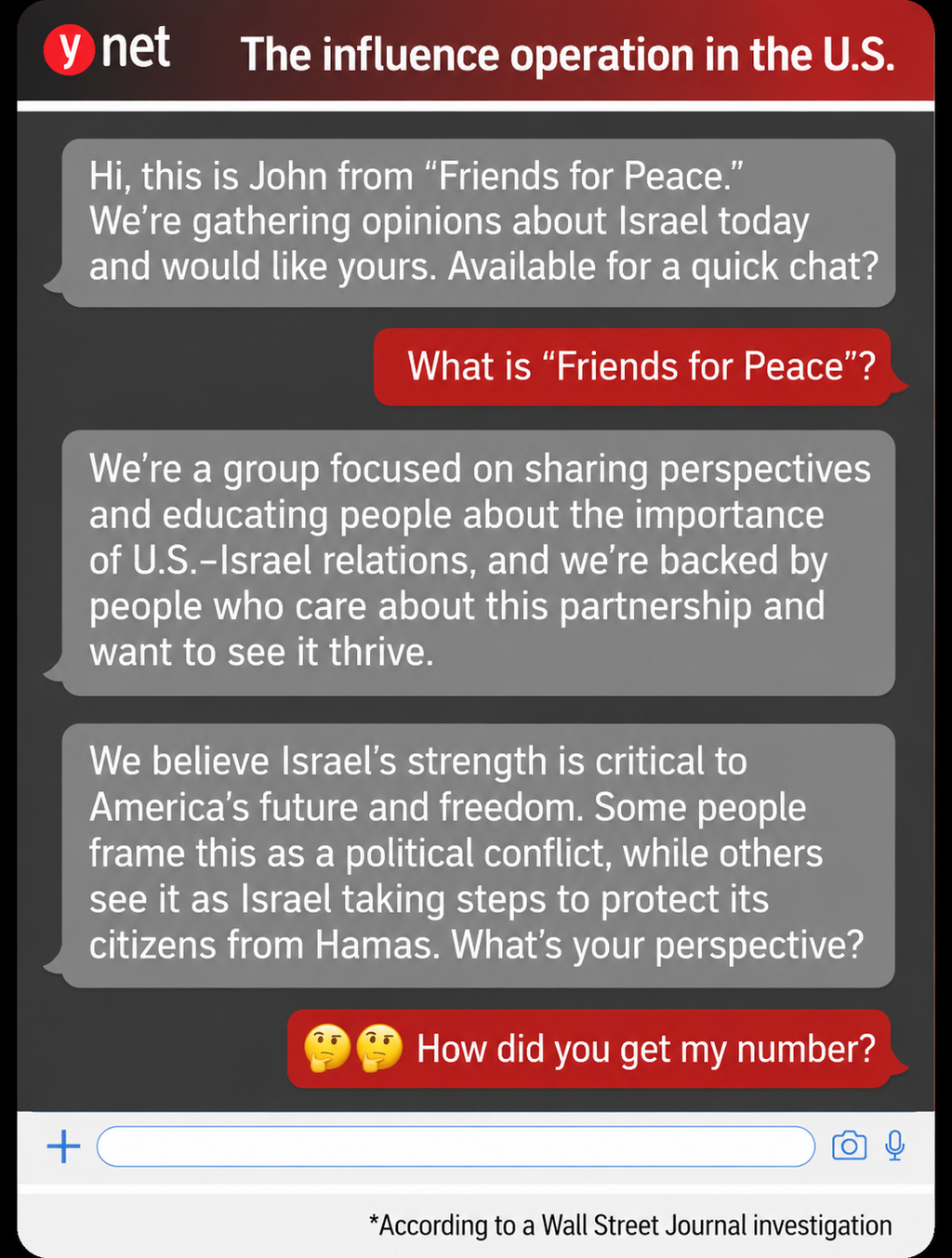
The messages are managed by Sparkfire, a company that says its AI-based text messages can conduct more productive conversations than traditional text campaigns. As of mid-May, the company had received $6.5 million to carry out the work.
A Sparkfire spokesperson said in a statement that “human team members are involved throughout the conversation process and interact directly with recipients.”
But “Friends for Peace” does not appear to exist as a nonprofit organization or limited liability company. Asked whether it is a real organization, Parscale replied: “What do you define as a real organization?”
Surdut also could not find a website for the group, and grew suspicious.
“Even if it is a cause I believe in, I don’t want to have a conversation with artificial intelligence,” she said.
The influencers — and the Steph Curry connection
Israel’s efforts extend beyond Parscale. A group called Show Faith by Works filed documents laying out plans to send pro-Israel messages, especially to megachurch attendees and Christian students. The group claimed it could reach about 4 million people in the southwestern United States through a “geofencing” campaign, which sends messages based on location.
The group, founded last July, said the work would include creating “positive connections with the nation of Israel while linking the Palestinian population to extremist factions,” at a cost of more than $3 million. It said it planned to approach influential people as part of the effort, naming actor Chris Pratt and basketball star Steph Curry as two examples of ideal spokespeople.
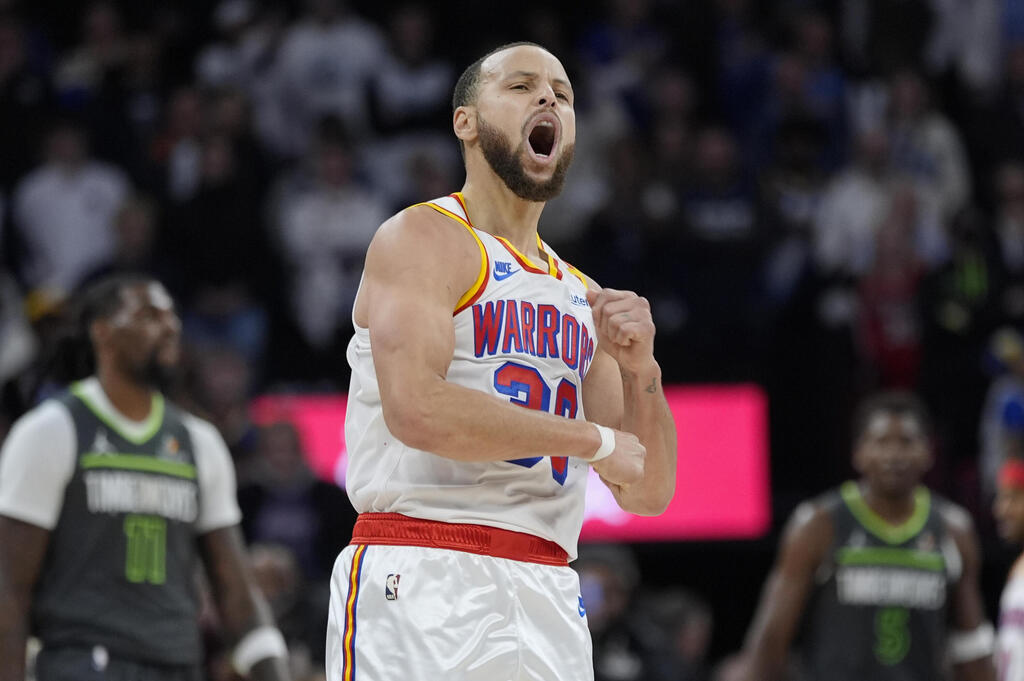
Steph Curry was identified as an ideal spokesperson
(Photo: Abbie Parr/AP)
The Journal noted that a representative for Pratt said he had never been contacted, while a representative for Curry did not respond.
In an email, Show Faith by Works founder Chad Schnittger said the group has “since gone in a different direction,” and that the budget was redirected mainly “to building a mobile museum with custom video displays.”
Other Israeli efforts focus on the American left, the Journal noted. The war in Gaza has sparked deep disputes among Democrats over whether support for Israel still has a place in the party.
Yoav Davis, who founded the popular Instagram page @Jews_of_NY, which has 193,000 followers, runs a marketing company that has a contract with Israel. The work includes taking part in calls with an “influencer management team” and “contract talent management.”
Davis frequently participates in online discussions about Israel and the war, including during a June visit to the Jerusalem Pride Parade.
“Israel is undoubtedly the safest place in the Middle East for LGBTQ people,” he said cheerfully to the camera.
However, he does not disclose whether Israel paid for posts or travel, and did not respond to the newspaper’s requests for comment.
Prime Minister Benjamin Netanyahu has made a point of courting conservative influencers, meeting with them during at least two recent visits to the United States. The deterioration in American support for Israel “correlates almost 100% with the geometric rise of social media,” he said in a May interview with “60 Minutes.”
Documents indicate that Israel and registered agents working for the country made payments to companies owned by other online influencers as part of their work, though they do not specify payment for posts.
Evangelical influencers Stefanie and Caleb Rouse, who post glowing content on topics such as “10 things to pray over your marriage,” own a company that received $4,500 from an Israeli contractor last year for “strategic marketing promotion.” The Rouses did not respond to requests for comment.
U.S. Vice President JD Vance last week accused Israel’s influence campaign of trying “to undermine U.S. negotiations to end the conflict in Iran.” He told Joe Rogan’s podcast that some Israeli officials are working “to keep the war going on indefinitely. Again, not towards any objective, but just indefinitely."
Israel set a 2026 budget of more than $700 million to expand the country’s efforts “to shape consciousness” and improve its image around the world, according to Foreign Minister Gideon Sa’ar late last year. The Foreign Ministry did not respond to the Wall Street Journal’s requests for an interview.
The report noted that Israel’s allies argue its influence campaign is necessary to counter those run by Iran and the pro-Palestinian movement.