


From a strategic observation point in the Sheikh Zayed neighborhood of northern Gaza, the view stretches clearly to the buildings of Sderot, the chimneys of the Rotenberg power station in Ashkelon, the large Israeli flag erected in Netiv HaAsara after the October 7 massacre, and additional Israeli communities just a few kilometers away.
Col. Omri Mashiach, commander of the IDF’s Northern Brigade in the Gaza Division, who led the tour, said: “At this stage, there is no significant threat and the enemy is weak.”
The observation point in northern Gaza Strip
(Video: Roni Green Shaulov)


The purpose of the tour in areas of the Gaza Strip under Israeli control east of the ‘yellow line’ was to explain how the IDF’s presence affects the security of border communities. In the background, Prime Minister Benjamin Netanyahu is expected to discuss next week, during his meeting with US President Donald Trump at Mar-a-Lago in Florida, the second phase of the ceasefire agreement. According to the American plan, it includes an Israeli withdrawal from the ‘yellow line.’
Earlier this month, IDF Chief of Staff Lt. Gen. Eyal Zamir said that “the ‘yellow line’ is a new border line, a forward defensive line for communities and an offensive line.” In the same spirit, soldiers on the ground told reporters: “We are here until further notice.”
From the observation point on ‘Ridge 70,’ which became a central anchor in IDF holding plans during the war, extensive destruction across Gaza is visible, along with IDF outposts rapidly rising one after another. In practice, no buildings remain standing except those serving military purposes.
Gallery
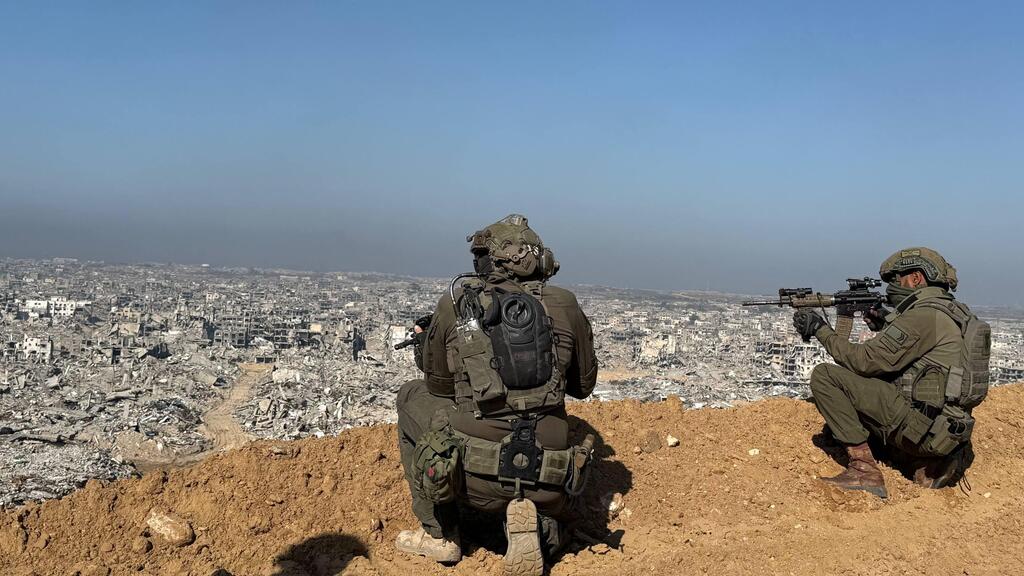
'We are here until further notice,' IDF soldiers in northern Gaza Strip
(Photo: Roni Green Shaulov)
Control of the kurkar ridge, named for its height of 70 meters above sea level, underscores its strategic importance, allowing dominance both west and east of the ‘yellow line.’ Engineering forces are working intensively to establish outposts along the ridge. Asphalt is being laid to provide access roads for vehicles and helicopter landing zones, while observation masts and additional systems are being installed to entrench the IDF in what the chief of staff has described as “the new border line.”
Mashiach outlined the brigade’s defensive framework. “You can divide it into four main components,” he said. “The forward outpost line along the ‘yellow line,’ the outposts near the fence, the barrier that failed catastrophically on October 7, and the community defense units.”
‘Our duty is to prepare for the worst-case scenario’
Asked by ynet about possible changes, Mashiach said: “It is very possible that the barrier will move to the ‘yellow line.’ The chief of staff defined the ‘yellow line’ as the new border line, and that is how we treat it. Our duty is to prepare for the worst possible scenario, and we are still destroying terrorist infrastructure.”
“We are entrenching ourselves here until the political echelon decides otherwise,” he added. “We are flexible. If we are told to withdraw within a month, we will know how to do it.”
Statements by Defense Minister Israel Katz suggest there is no intention to withdraw. Earlier Tuesday, Katz said: “Israel will never leave Gaza.” He added that his vision includes a significant security zone inside Gaza to protect Israeli communities, and that in the northern sector, Nahal pioneer groups could eventually be established.
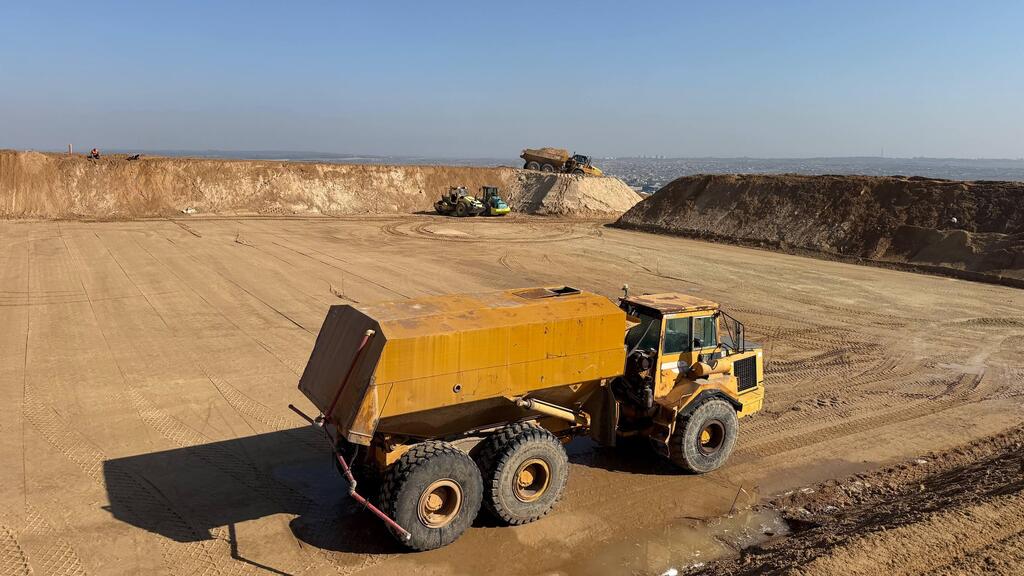
Engineering forces are working intensively to establish outposts along the ridge
(Photo: Roni Green Shaulov)
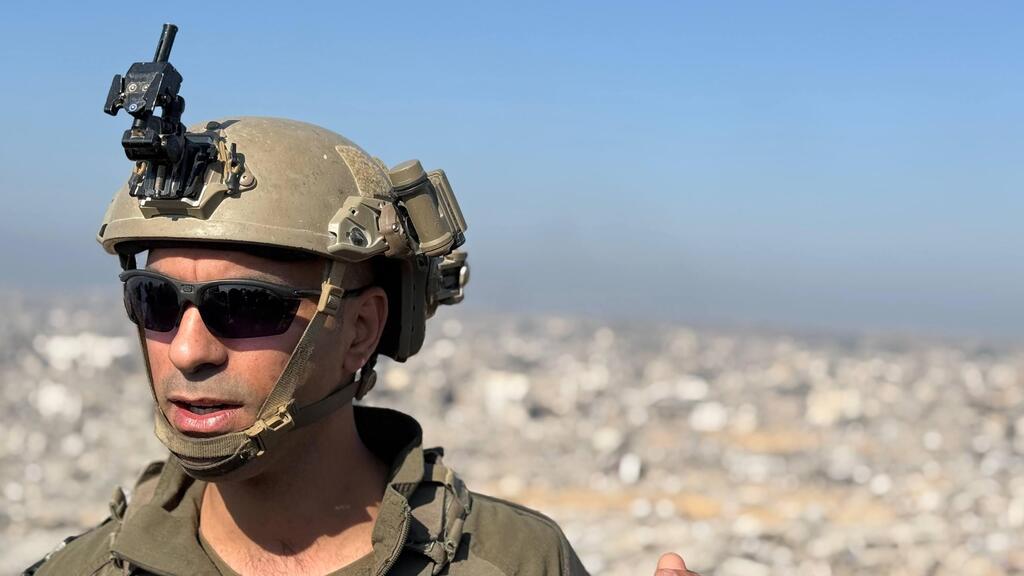
'At this stage, there is no significant threat,' Col. Mashiach
(Photo: Roni Green Shaulov)
Asked whether he was aware of any plans for future Israeli settlement in Gaza, Mashiach responded: “I have received no such instruction. As a military officer, I deal only with military operations and do not engage in matters belonging to the political echelon.”
While projecting calm, Mashiach also warned against complacency. “The enemy is weak,” he said, “but it has not abandoned its ambitions.” He noted daily attempts to approach the ‘yellow line’ that the IDF believes are intended to gather intelligence and test troop readiness.
“There are still attempts to create friction, such as sniper fire, explosive charges and anti-tank missiles,” he said. “But instead of this happening along the border with the communities, it happens at the ‘yellow line.’”
One method used to clear the area, Mashiach explained, is pumping concrete into tunnel shafts that extend deep into Jabaliya, pouring from an opening on the Israeli side to the exit on the Gazan side.
Addressing the loud explosions still heard in border communities and beyond, Mashiach said the IDF is conducting continuous operations near the ‘yellow line’ while maintaining force protection. “To protect our troops, we also use a great deal of firepower so that risks do not materialize.”
Footage from the destruction of underground routes in northern Gaza Strip
(Video: IDF)
“We are destroying extensive infrastructure, whether blowing up remaining underground routes or eliminating enemy infrastructure above ground,” he said. “That is ultimately the reason for the noise.”
Mashiach stressed the importance of linking frontline security with the sense of security at home. “We work constantly with the communities and their leadership to improve how we explain and convey what is happening at the front, so unnecessary pressure does not develop.”
Asked whether border residents can sleep soundly, Mashiach replied unequivocally: “Yes.”
“We do not sleep soundly, because that is our mission,” he added. “If I were a resident of the border communities, I would understand that the situation has fundamentally changed. The efforts visible here can truly provide a strong sense of security. Our role is not to sleep, so residents can.”
According to the IDF, since the ceasefire with Hamas in October and the withdrawal to the ‘yellow line,’ Northern Brigade forces have struck about 60 terrorist targets from the air and another 220 using artillery fire. The strikes targeted terrorist infrastructure, operatives approaching the ‘yellow line,’ weapons depots and sites used by the terrorist organization, including preventive strikes aimed at blocking renewed entrenchment.
‘There are still many terrorists’
As a result of the brigade’s activity and entrenchment in dominant areas such as ‘Ridge 70,’ several security-related changes have been implemented in the western Negev, including reopening Zikim Beach, resuming rail service between Sderot and Ashkelon, and removing the concrete barrier along the access road to Kibbutz Nahal Oz.
Today, the IDF says the military effort is intended to give the political echelon freedom to decide on the future of operations in Gaza and the ‘day after.’
“Whatever framework is chosen, the IDF will adapt and act accordingly,” Mashiach said. “There are still many operatives, many terrorists. I cannot say how many exactly, but what I can say is that if in the past every Hamas terrorist had a personal weapon, that is no longer the case. We are here to protect residents of the western Negev.”
The IDF said Northern Brigade forces under Division 252 have been operating for months along the ‘yellow line’ in northern Gaza, destroying terrorist infrastructure above and below ground in Jabaliya, Beit Hanoun and Beit Lahia, and eliminating any immediate threat to Israeli forces and the state of Israel.
During operations, the IDF said, dozens of terrorists who crossed the ‘yellow line’ and posed an immediate threat were killed. In cooperation with Yahalom combat engineers, forces destroyed more than four kilometers of underground tunnel routes used by Hamas. In Beit Hanoun, about 10 mortar shells hidden inside a children’s blanket were discovered in a residential home.
The ‘Future for the Border’ movement, which represents residents advocating for rehabilitation and rebuilding, responded sharply to Mashiach’s remarks.
“The northern brigade commander and senior defense officials must understand that border residents are not sleeping soundly,” the group said. “Not when there is an enemy beyond the fence, an enemy that is rebuilding and planning the next attack. Not when false alarms wake children at night. Living in a prolonged combat zone is not normal.”
The movement added: “We demand an end to normalizing a dangerous reality. You cannot speak of sleeping soundly when there is a living threat beyond the fence. We were already lulled once. On October 6 we slept soundly, and on October 7 we woke up to disaster. Security is not built on calming statements or temporary quiet. We support the IDF, but we also demand restored trust and a clear understanding: communities remain, commanders rotate. We are not asking for quiet. We demand the removal of the threat, the only real long-term solution.”