


Aryeh Deri has yet to speak publicly about Israel’s looming election campaign, but his party’s newspaper made the message clear: Shas will not join any future government unless the status of Torah students is resolved
Shas chairman Aryeh Deri has yet to address in his own voice the election campaign Israel now appears headed toward, after the government failed to pass legislation that would exempt tens of thousands of ultra-Orthodox men from military service. But in his party’s official newspaper, Haderech, Deri was already quoted with a warning to anyone counting on Shas after the election: “We will not enter a coalition or government without regulating the status of Torah students.”
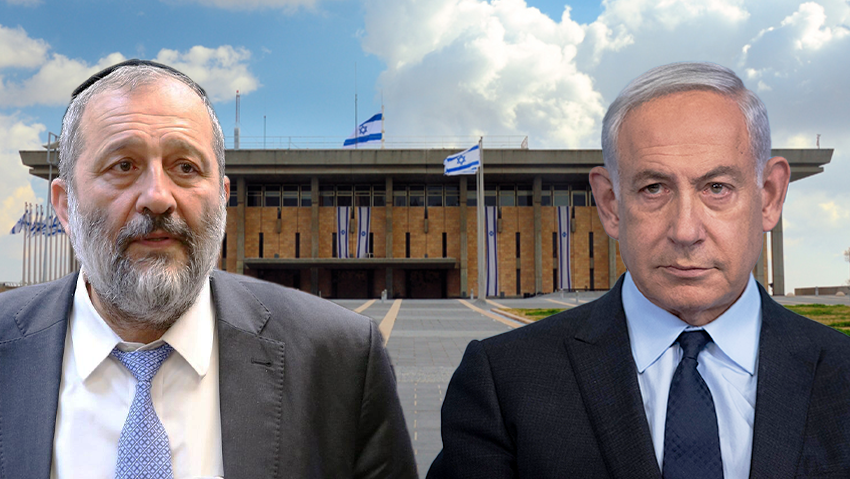
The newspaper, which is widely seen as reflecting Deri’s approved messaging, also took aim at Prime Minister Benjamin Netanyahu. “The ultra-Orthodox public received with great shock Prime Minister Netanyahu’s announcement that he does not intend to advance, during the current summer session, the law regulating the status of yeshiva students,” the paper said in the sub-headline of its front-page article announcing the move toward elections. “This is a violation of all the promises and agreements signed with the consent of all coalition components.”
Shas spokesman Asher Medina also published a column warning against the idea that an alternative government would be more favorable to the ultra-Orthodox parties. “Anyone who thinks a left-wing government will give us everything is living in a fantasy,” he wrote. “The only common denominator among that collection of figures is hatred of the ultra-Orthodox.”
According to Medina, once such a government consolidates power, “they will launch an unprecedented campaign of revenge and cleansing” aimed at regaining control of key institutions. He warned that the ultra-Orthodox public would then face harsh measures, including a sweeping draft policy. “The draft law in question will be thrown in the trash and replaced with a clear determination: conscription for everyone. The complete dismantling of the Torah world.”
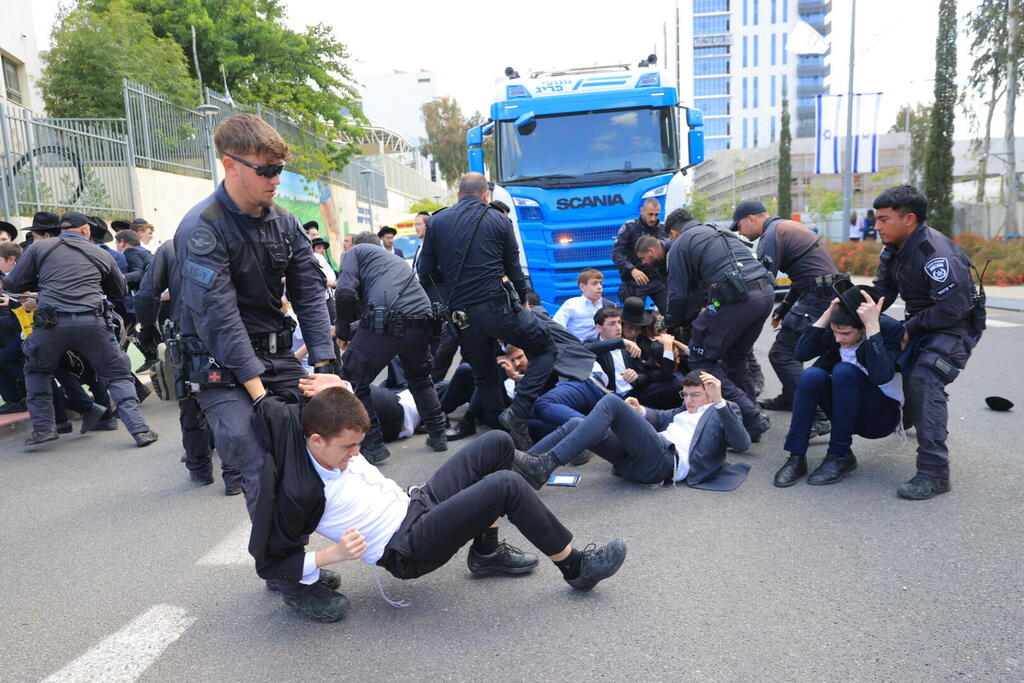
Medina went further, writing that yeshiva students and married Torah scholars would be turned into “enemies of the people,” with military police sent into yeshivas to drag students into detention vehicles. He also predicted the use of excessive force against mass protests, comparing such a scenario to the evacuation of Gush Katif and Amona.
(Photo: Yaron Brenner)
The political backdrop became clearer when coalition chairman Ofir Katz submitted a bill to dissolve the 25th Knesset, together with the heads of all coalition factions. The move is aimed at giving the coalition control over the election date and is expected to come up for a preliminary vote next week. AP reported that Netanyahu’s coalition has taken an initial step toward new elections by submitting a dissolution bill, with a formal parliamentary vote possible next week and elections later in 2026. Israel’s next election must be held by the end of October, though some ultra-Orthodox coalition members are pushing for an earlier date.
Netanyahu’s circle is trying to delay the campaign as much as possible, hoping to accumulate additional military and diplomatic achievements before voters go to the polls. Netanyahu has repeatedly told his partners that he wants to complete the government’s full term, but the ultra-Orthodox draft exemption bill has repeatedly shaken the coalition and revived questions over its survival.
Several possible election dates have already been raised in informal discussions. In addition to the original date of October 27, two September dates — September 1 and September 15 — have been discussed. Shas is interested in the September options, with Deri reportedly believing that the Hebrew month of Elul and the Selichot period could boost turnout among the party’s voters.
Likud and Religious Zionism, however, are urging restraint. Finance Minister Bezalel Smotrich, who recently passed the final state budget of the current Knesset term, is still contending with the threat that his party could fall below the electoral threshold. He is therefore trying to pull the election date back toward the original October 27 timetable. Another date under discussion is October 20.