


Iranian state television denied reports Thursday of multiple explosions across the country, even as state-affiliated media reported blasts in several locations during a day of heightened tensions following two nights of U.S. airstrikes.
The semi-official Mehr news agency reported that nearly 10 explosions were heard across Iran. But state television dismissed the reports, while the official IRNA news agency said explosions in the southern province of Bushehr were caused by the activation of Iranian air defenses.
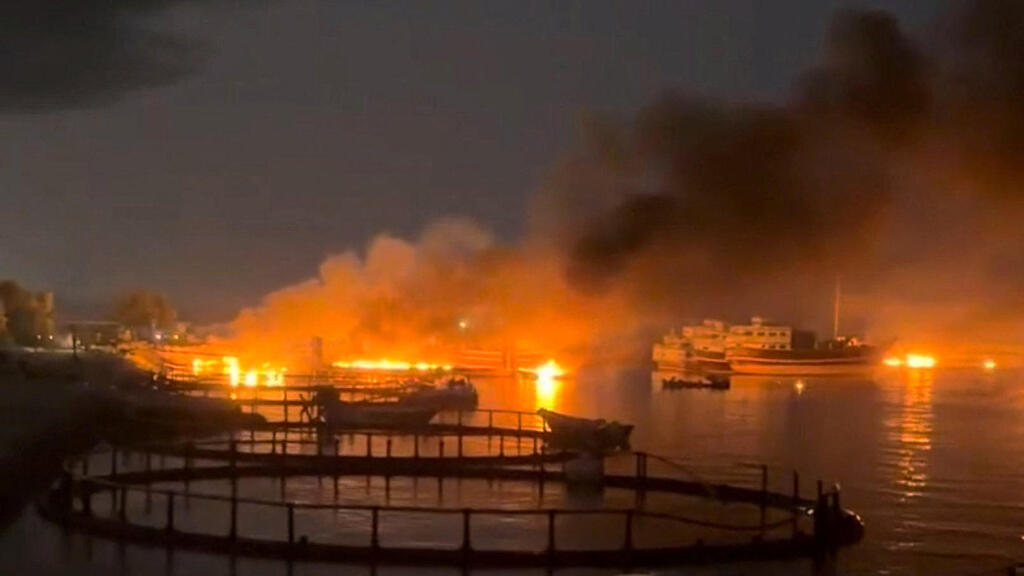
Fire near the Strait of Hormuz following US strikes on Iran
(Photo: Social Media/via REUTERS)
Against the backdrop of rising tensions in the Gulf, Israeli Prime Minister Benjamin Netanyahu spoke Thursday evening with U.S. President Donald Trump. According to the Prime Minister's Office, the conversation took place "as part of the ongoing contact" between the two leaders, and Trump updated Netanyahu on "the American operations in the Gulf."
The wording of the Israeli statement underscored Jerusalem's effort to distance itself from the current exchange of attacks between Iran and the United States. Notably, the Prime Minister's Office referred to the strikes as "American operations." Even so, Defense Minister Israel Katz and IDF Chief of Staff Lt. Gen. Eyal Zamir said during an Israeli Air Force graduation ceremony that Israel is prepared to resume military operations if necessary and is closely monitoring developments.
Iranian media also reported that a military headquarters in the Bushehr area had been struck by what they described as a missile fired by the "American-Zionist enemy." A U.S. official told Al Jazeera, however, that American forces had not carried out any strikes in Iran in recent hours.
U.S. President Donald Trump has not commented publicly since returning to Washington from the NATO summit in Turkey earlier Thursday. His last post on his Truth Social platform came more than 12 hours earlier, and his public schedule showed only an intelligence briefing and closed-door meetings.
The United States has not responded militarily to Iran's latest wave of attacks, which included 10 missiles fired toward Jordan and dozens of drones and missiles launched toward Kuwait and Bahrain.
Iran said it had targeted military sites in Jordan, Kuwait, Bahrain and Qatar.
Jordan's military said it intercepted eight of the 10 missiles launched toward the country and reported no damage. Iranian officials said the intended target was Muwaffaq Salti Air Base, which is used by both the Jordanian and U.S. militaries.
Kuwait said it intercepted three ballistic missiles, one cruise missile and 10 drones. Authorities said debris injured one person and caused damage.
Bahrain's military said it intercepted several drones and missiles. The Gulf kingdom hosts the headquarters of the U.S. Navy's Fifth Fleet.
Iran also claimed to have attacked Qatar, which has been mediating talks between Tehran and Washington. Qatari authorities issued and later lifted an early warning but did not report any attack. Qatar hosts one of the largest U.S. military installations in the Middle East.
Meanwhile, uncertainty remains over the implementation of the U.S.-Iran memorandum of understanding intended to ease tensions and reopen commercial shipping through the Strait of Hormuz.
At the center of the dispute is Article 5, which requires Iran to make its best efforts to ensure the safe passage of commercial vessels free of charge for 60 days while working to clear mines and other military obstacles before coordinating the future administration of the strategic waterway with neighboring Oman and other Gulf states, in accordance with international law and the sovereign rights of the coastal states.
According to The Wall Street Journal, Trump administration officials viewed the provision as the key to reopening one of the world's busiest energy shipping routes. Hard-line factions in Iran, however, have argued that the language effectively grants Tehran primary control over the strait.
The disagreement has left the two sides at odds over implementation. Iran continues to insist that vessels transiting the Strait of Hormuz require approval from the Islamic Revolutionary Guard Corps, a position rejected by the United States and its Gulf allies.
Shipping data from analytics firm Kpler showed that only 25 vessels transited the strait Wednesday, down from 49 the previous day and well below the more than 100 ships that crossed daily before the conflict.
A U.S. official familiar with the negotiations said Article 5 had emerged as one of the agreement's most contentious provisions, describing Washington and Tehran as being "on different planets" in their interpretations. The official noted that the agreement does not explicitly assign the United States responsibility for arranging safe passage for commercial shipping, a point Iran has seized on to justify attacks on vessels using routes coordinated with the United States.
First published: 23:07, 07.09.26