

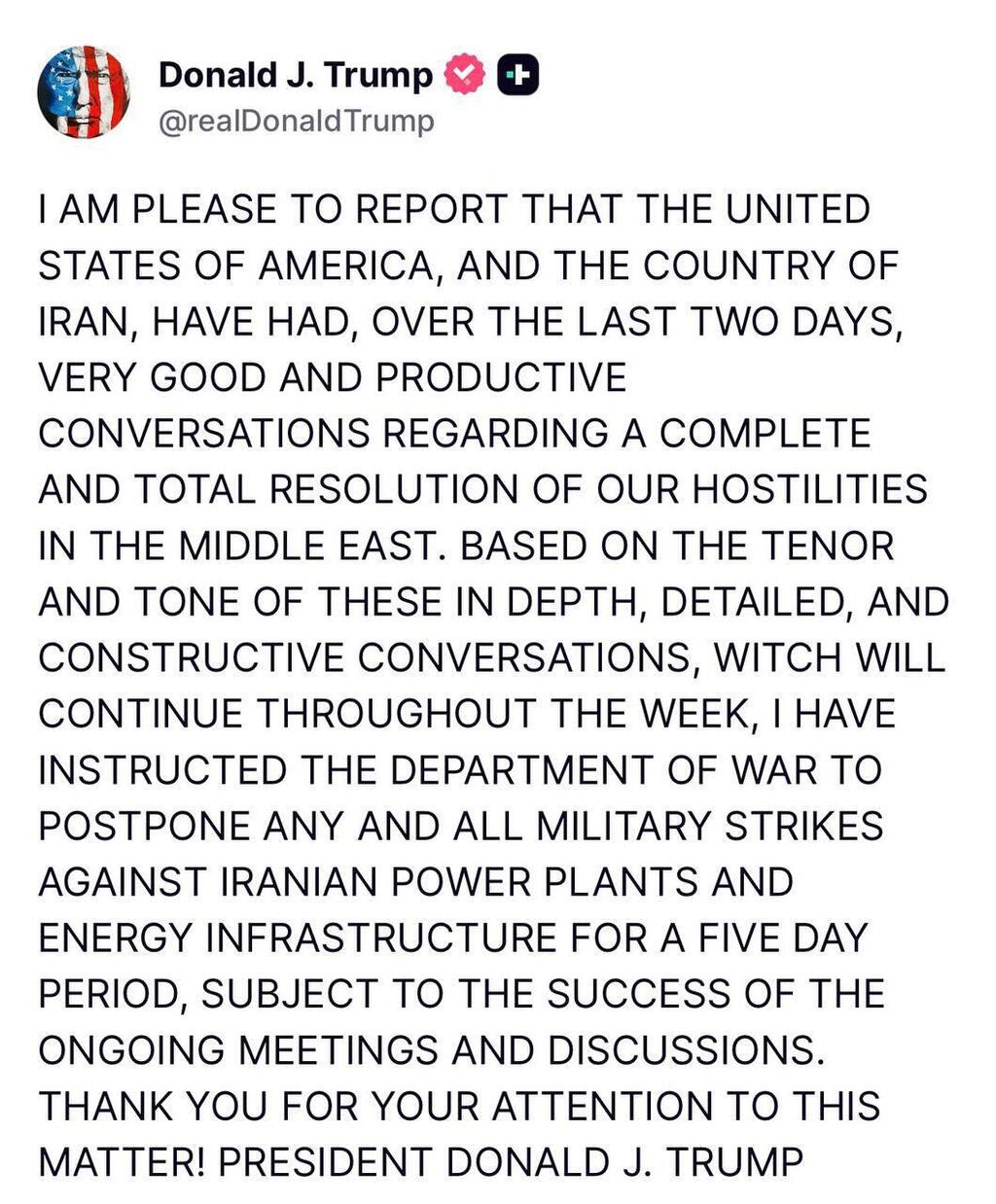
U.S. President Donald Trump said Monday he had ordered a five-day pause in any U.S. military strikes on Iranian power plants and energy infrastructure after what he described as two days of “very good and productive conversations” with Tehran on a “complete and total resolution” of hostilities in the Middle East.
In a post on Truth Social, Trump said the talks had been “in depth, detailed, and constructive” and would continue throughout the week. He said he had instructed the Department of War to postpone “any and all military strikes against Iranian power plants and energy infrastructure” for five days, with the delay dependent on the success of the ongoing discussions. Oil prices fell 12% after Trump’s announcement.
The statement appeared to mark a shift from Trump’s threat a day earlier to strike Iran’s electricity grid if Tehran did not reopen the Strait of Hormuz within 48 hours. That warning had sharply escalated tensions after earlier signs of possible de-escalation.
Shortly afterward, however, Iran appeared to reject Trump’s account of the talks. The Sabereen news agency quoted Iran’s Foreign Ministry as saying Tehran denied Trump’s claim about negotiations and remained opposed to any talks before achieving its war objectives. “Trump’s statement is a retreat from his earlier threats, but the Islamic Republic remains committed to its declared positions. Its position on the Strait of Hormuz has not changed and the passage will remain closed to the aggressors attacking Iran.”
Spokesman for the National Security and Foreign Policy Committee in the Iranian Parliament, Ibrahim Rezaei, claimed: "The battle continues. Another defeat for Satan. Trump and the U.S. have failed again."
The parties have reportedly been holding backchannel talks mediated by Qatar and Turkey and involving Trump envoy Steve Witkoff and Iranian Foreign Minister Abbas Araghchi.
Iran had responded Sunday with threats of regional retaliation, warning that any attack on its energy systems would trigger strikes on critical infrastructure used by the United States, Israel and their allies. Iranian Vice President Mohammad Reza Aref said an attack on Iran’s infrastructure would lead to “a complete blackout of the region,” while Parliament Speaker Mohammad Bagher Ghalibaf said energy and critical infrastructure across the Middle East would become “legitimate targets.”
Iran’s military also warned that the Strait of Hormuz, a vital global shipping lane through which roughly one-fifth of the world’s oil supply passes, could be fully closed. At the same time, Iranian President Masoud Pezeshkian suggested a more selective policy, saying the strait would remain open to all except those who “violate our soil.” According to the report, ships from countries seen as friendly to Tehran, including China, India and Pakistan, have continued to pass, while many others have remained stalled because of security concerns.
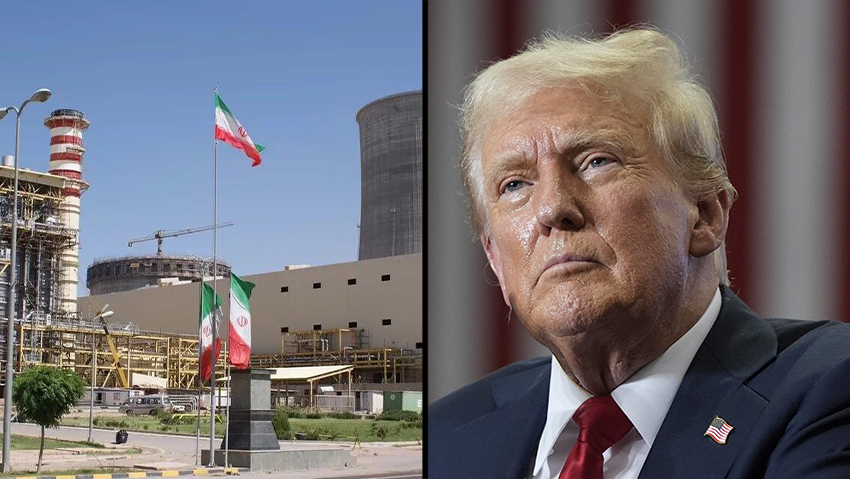
US President Donald Trump
(Photo: AP Photo/Alex Brandon)
Iran has threatened to attack and set ablaze any ship passing through Hormuz while the war continues. More than 20 commercial ships have been attacked since the fighting began, and nearly 2,000 vessels carrying about 20,000 crew members are stuck in the region because of fears over transit through the strait.
Minutes after Trump’s post, Omani Foreign Minister Badr Albusaidi, one of the main mediators between Washington and Tehran, also weighed in, saying the war was already causing broad economic harm and warning the damage would worsen if it continued. He said Oman was working intensively to ensure safe passage through the Strait of Hormuz.
An Israeli official told ynet that Jerusalem was not surprised by Trump’s statement, describing a behind-the-scenes effort by Qatar, Turkey and Egypt to broker a deal between Washington and Tehran to end the war. “Israel has no choice but to go along with Trump,” the official said. “We would prefer to continue the strikes, but we will do what he decides.”
The official said Trump was unlikely to want the war to end under the impression that Iran had forced him to back down over Hormuz. One possibility, the official said, was a phased arrangement under which Iran would reopen the strait and Trump would scale back attacks, though it remained unclear whether Tehran would accept such a move.
Meanwhile, in Israel, a meeting of the Security Cabinet that had been scheduled for Monday night was postponed until 9 p.m. Wednesday.
The prospect of tit-for-tat strikes on civilian infrastructure has raised fears of a broader regional crisis, including possible disruption to energy supplies, desalination systems and communications networks. The standoff around Hormuz has become a major flashpoint for regional stability and global energy markets.
Iran has also reportedly stepped up efforts to shape public opinion online, with Iranian-linked networks shifting toward messaging aimed at exploiting opposition to the war in the United States, particularly among Trump supporters. The campaign reportedly included AI-generated videos, memes mocking Trump and Prime Minister Benjamin Netanyahu, and fabricated footage showing attacks on U.S. and Israeli assets.