

The number of people missing in Nepal following the massive flood that struck the country and neighboring Tibet on Wednesday has climbed to nearly 2,000, Nepal’s National Disaster Risk Reduction and Management Authority said Friday. The agency said the death toll had reached 579 and that 517 foreign nationals were among those still missing, including a 60-year-old Israeli.
More than 550 people are also reported missing in Tibet, according to Chinese reports, although it remains unclear whether those figures overlap with Nepal’s count. Some estimates have put the combined number of missing people at around 2,500, while others have questioned whether the two sets of figures can be added together.
Drone at 7,200 meters captures glacier collapse that triggered deadly Nepal flood


Footage shared on Chinese social media over the past day appears to show the moment part of the glacier that triggered the disaster collapsed. The video, filmed by drone at an altitude of more than 7,200 meters, shows a huge cloud of dust suddenly rising among snow-covered peaks as the glacier crashes into the valley floor roughly one kilometer below. An analysis by the BBC found that the location corresponds with the direction in which the floodwaters later traveled down the Trishuli River.
China and Nepal resumed rescue operations Friday after they were briefly suspended. Authorities on both sides of the border are closely monitoring newly formed lakes created by the flooding, amid fears they could overflow and unleash another surge of water into rivers downstream.
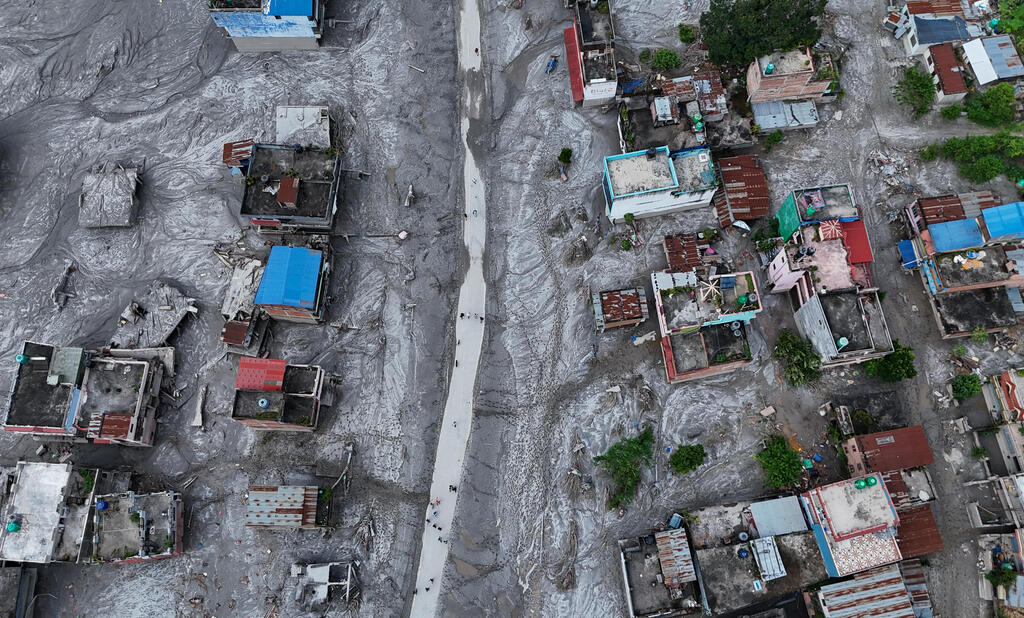
One of the lakes began spilling slightly over its banks Friday, prompting alarm and leading Nepalese authorities to issue warnings and suspend rescue operations for three hours. The immediate threat later eased, but Nepal continues to monitor two newly formed lakes. Chinese authorities said one is shrinking, while the other is continuing to grow.
Another dramatic video from Nepal was filmed in Bidur, a town downstream along the Trishuli River, and was verified by international media outlets. The footage shows several people sheltering on a balcony of a building that remained standing as enormous waves of water and mud crashed around it.
People sheltering on a balcony in Bidur
Later, some of the same people were seen standing on the balcony after the water level had dropped, surrounded by mud and debris. One woman was filmed waving a red cloth from the roof, apparently signaling for help.
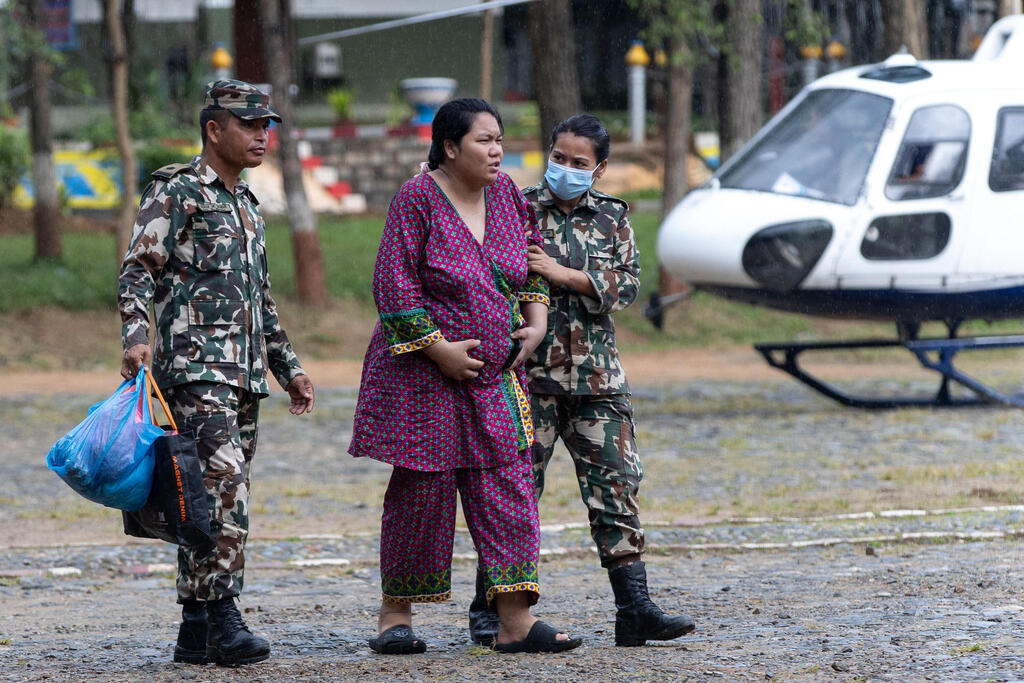
Most rescue operations in Nepal are being carried out by helicopter because the flood devastated an already difficult mountainous region near the Tibetan border, sweeping away dozens of bridges and blocking more than 40 kilometers of roads. In some cases, rescuers have been lowered from helicopters to reach stranded survivors before hoisting them to safety.
One of those rescued was Dibga Tamang, who was evacuated from Rasuwa District on Thursday. “All our people are gone. They are dead,” he said. “There is nobody waiting for me. Everything and everyone disappeared. This is the end.”
(Photo: PRABIN RANABHAT / AFP)
Nepal’s disaster management authority said more than 3,200 people have so far been evacuated by helicopter from the disaster zone, most of them to the capital, Kathmandu.
Customs officer Karbir Gaira was among the survivors in Timure, a Nepalese village close to the Chinese border. He said he arrived at work at 8 a.m. Wednesday and later felt the ground shaking.
“I saw a black storm coming toward us,” he said. “We all immediately started running outside, and within seconds we climbed the hill on the other side of the office building. Those roughly 10 seconds saved some of us.”
Fifteen of Gaira’s colleagues remain missing. “It was like a scene from a Hollywood movie,” he told The Associated Press. “I don’t call it a flood. It was a tsunami.”
How the disaster unfolded
The collapse
At an altitude of about 5,200 meters, part of the glacier broke away and fell roughly one kilometer into the valley below. The impact was initially suspected to have been caused by an earthquake, but it was later determined that seismic energy equivalent to a magnitude-5.2 earthquake had been generated by the collapse of ice and rock itself.
The surge
The enormous mass of ice, rock and mud crashed into the Lende Khola River, a tributary of the Bhote Koshi along the Himalayan border between Nepal and Tibet. According to a Chinese government geologist, the avalanche traveled at around 50 meters per second, about 180 kilometers per hour, for more than 20 kilometers, leaving people with almost no time to react.
A wall of mud
The water and debris did not move like an ordinary flood. Witnesses described a towering wave of mud that grew as it moved downstream, with one account comparing it to “liquid concrete.” The level of the Trishuli River rose by about nine meters in just half an hour.
Rescuers crawl into Nepal cave, emerge covered in mud
(Video: Reuters)
Tibet hit first
The floodwaters moved downstream into Gyirong County in Tibet, where the border crossing with Nepal was badly damaged and almost entirely buried in mud. Buildings, roads and bridges were swept away as the flood moved toward Nepal.
The flood enters Nepal
The surge continued through the river system into Nepal, traveling roughly 100 kilometers downstream while descending around 4,500 meters in elevation. Entire sections of infrastructure were swept away, villages were destroyed and communities were cut off.
Fear of another flood
The disaster created two new lakes on opposite sides of the Nepal-Tibet border. Authorities in both countries have warned that either lake could overflow or breach its natural barrier, potentially sending another devastating flood downstream.
Rescue crews are continuing their search while officials monitor the lakes for signs that the disaster may not yet be over.