

Attorney General Gali Baharav-Miara submitted an “urgent request” to the High Court of Justice on Thursday morning, asking to provide new information concerning Prime Minister Benjamin Netanyahu’s military secretary, Maj. Gen. Roman Gofman, his nominee to become the next head of the Mossad.
“Information has been provided to the deputy attorney general that must be brought to the honorable court’s attention,” the request said. According to the filing, the development came after Deputy Attorney General Dr. Gil Limon contacted the legal adviser of the body where Brig. Gen. G. serves, in order to coordinate the collection of an affidavit the court had ordered be obtained.
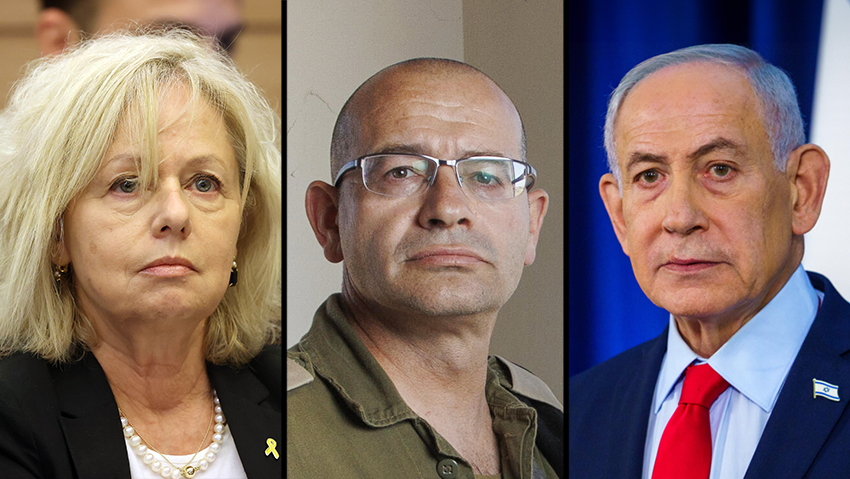
(Photo: Shalev Shalom, Gil Nechushtan, Amit Shabi)
According to reports, the attorney general’s request concerns Gofman’s alleged involvement in the continued employment of Brig. Gen. G. at the Mossad. Authorities are examining whether Gofman improperly spoke with the officer who questioned him, and failed to disclose that contact.
Baharav-Miara wrote that the information, “on its face,” was also something Gofman himself was obligated to bring before the court during the hearing. She therefore asked the justices to allow her to submit a brief update notice. Because of the classified nature of the information, she asked that the notice be filed under seal.
The attorney general stressed that she has no claim against Brig. Gen. G., and that the update she seeks to submit concerns only information that she says Gofman should have presented to the court during the hearing.
The High Court had ordered that an affidavit be obtained from Brig. Gen. G., formerly the head of the IDF Military Intelligence Directorate’s operations division, as part of its review of petitions against Gofman’s appointment. During the hearing earlier this week, the justices indicated that there was not enough evidence to establish that Gofman had lied about the use, under his command, of Uri Almakaies as an influence operative. The main possible indication cited was a conversation Gofman held with Brig. Gen. G. shortly before Almakaies was arrested over alleged leaks of information to Telegram.
Brig. Gen. G. told the commander of the Information Security Department, Col. G., about that conversation. Col. G. later relayed the matter to the Senior Appointments Advisory Committee, known as the Grunis Committee, in testimony revealed this week by ynet. According to that account, Gofman denied the matter, but it remains unclear what exact question he was asked and what precisely he denied.
On Tuesday, Gofman met Brig. Gen. G. at the Mossad compound as part of the transition process he has been conducting in recent weeks with senior officials in the organization. Gofman’s appointment now depends in part on Brig. Gen. G.’s affidavit, though the meeting is understood to have taken place before the High Court ordered the affidavit at the end of the hearing on petitions seeking to block the appointment.
The fact that Brig. Gen. G. did not testify before the Grunis Committee, which approved Gofman’s appointment on integrity grounds, has drawn criticism.
On Wednesday, Netanyahu asked the High Court to prevent the attorney general from submitting the affidavit that could affect Gofman’s appointment, arguing that the testimony should be collected by an objective official who had not expressed opposition to the appointment. The court rejected the request.
“The submission of the affidavit on behalf of Brig. Gen. G. is intended to bring before the court his factual version of events — and nothing more,” the court wrote in its response to Netanyahu. “The submission of the affidavit therefore contains no elements of representation or legal opinion, and it will include no legal arguments. Accordingly, the proper course is for the affidavit to be submitted through the attorney general’s office, as is customary.”
The status of Brig. Gen. G. makes the affidavit especially sensitive. After completing his role in Military Intelligence, he was seconded to the Mossad and now serves in a senior position under current Mossad chief David Barnea, who opposes Gofman’s appointment as his successor.
Last November, IDF Chief of Staff Lt. Gen. Eyal Zamir decided to hold Brig. Gen. G. responsible for failures linked to the intelligence breakdown before the October 7 massacre. As a result, Barnea decided that Brig. Gen. G. would end his role at the Mossad at the end of the year. However, the arrangement allows him to continue serving as a reservist — leaving open the possibility that the next Mossad chief could reverse the decision and keep him in the defense establishment.
That has raised concerns about a possible conflict of interest: Brig. Gen. G. may have an interest in giving testimony favorable to Gofman, because if Gofman becomes Mossad chief, he could eventually decide to keep him in the organization.
Brig. Gen. G. headed the Military Intelligence operations division during the Hamas-led October 7 attack. The division is responsible for intelligence collection systems, including Unit 8200, target-bank development and coordination between intelligence bodies and operational commanders. IDF probes found that the division did not act sufficiently on information collected about Hamas’ “Jericho Wall” attack plan, and that intelligence failures contributed to the absence of warning and preparedness before the assault.
The probes also found that in August 2023, Brig. Gen. G. led a discussion on the situation assessment in Gaza, but the findings did not lead to significant preventive steps. Unlike other senior Military Intelligence officials who publicly accepted responsibility after the failure, Brig. Gen. G. has not so far issued a public admission of responsibility.
The request is the latest development in the legal battle over Gofman’s appointment. Earlier this week, Baharav-Miara told the High Court that Netanyahu’s decision to appoint Gofman as Mossad chief “cannot stand,” arguing that the senior appointments process relied on an incomplete picture when it approved the choice. English-language coverage has reported that the attorney general asked the court to cancel the appointment over what she described as serious flaws in the process.