


The Dubai Airshow 2025 was held last week at the Dubai World Central. This was the 19th edition of an event that brings together leading international bodies in space, aviation and defense, serving as a key platform for building relationships and collaborations. More than 200 aircraft were showcased, according to the show's website.
Among the highlights was a model of the F-35 fighter jet by U.S. defense giant Lockheed Martin, currently at the center of discussions surrounding Saudi Crown Prince Mohammed bin Salman’s recent visit to Washington.
Ya Allah: The Dubai Airshow 2025
(Video: Liron Sharon)


The F-35 was showcased and participated in the show’s opening aerial demonstration. Lockheed Martin released a promotional video inviting visitors to view the aircraft, take photos and speak with pilots. Although both the UAE and Qatar had previously expressed interest in acquiring the F-35, negotiations have stalled in recent years.
UAE President Mohammed bin Zayed Al Nahyan toured the exhibition, visiting national and international companies specializing in aircraft and air defense systems. He was briefed on the latest technological innovations in civil and military aviation, UAVs and radar systems. Iranian Defense Minister Aziz Nasirzadeh also attended with a high-level delegation, and representatives from Syria were present as well.
Reflecting the UAE’s growing ambitions in space, the airshow featured its largest-ever Space Pavilion, organized with the UAE Space Agency. It served as a hub for space agencies, tech firms, startups and investors, focused on discussing modern challenges, fostering cooperation, and driving commercial activity.
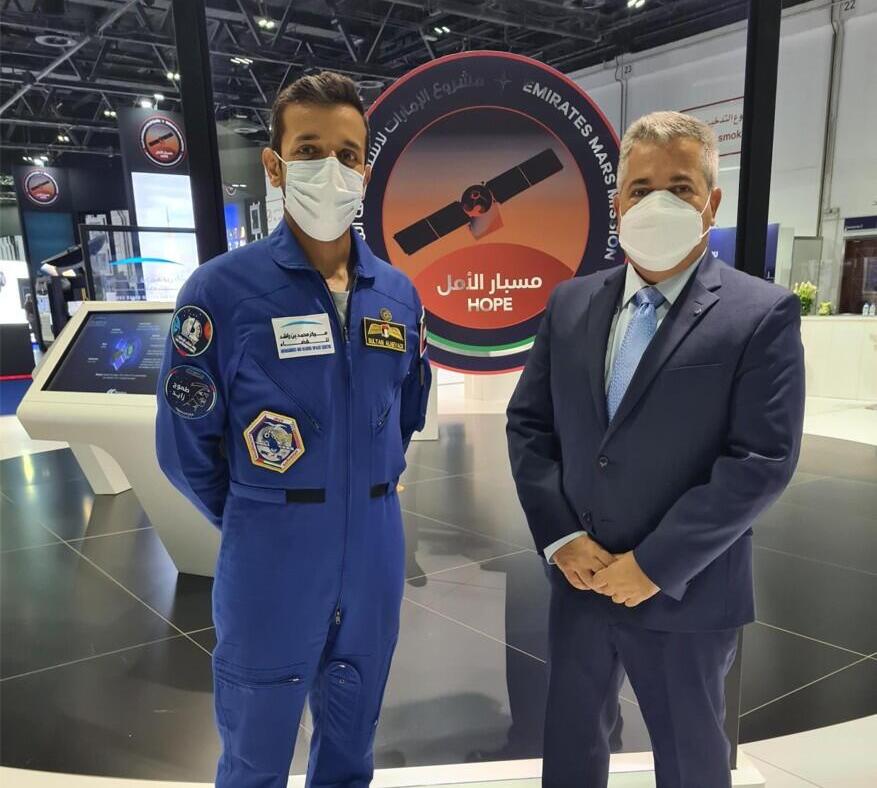
“The Dubai Airshow showcases the UAE’s impressive strides in space, the result of sustained efforts to turn our national space strategy into reality — helping build a comprehensive and stable space economy,” said Dr. Ahmad Belhoul Al Falasi, minister of Sports and Chairman of the UAE Space Agency.
He added that the UAE takes pride in hosting partners from around the world, reflecting the country’s growing role as a global center of space innovation and collaboration.
“Around 200 companies in the Emirates are involved in space — both public and private — with about 60 of them being international firms," according to Tal Inbar, a leading expert on Arab space programs. "The UAE has satellite development capabilities, although its cameras are still mostly sourced from South Korea. It has an astronaut program; two of its astronauts have been to space, one of them for six months, serving as chief engineer aboard the International Space Station. The country is also developing at least three types of radar satellites, some already active in orbit. Through the company SPACE 42, it aims to make radar satellite production a viable export product.”
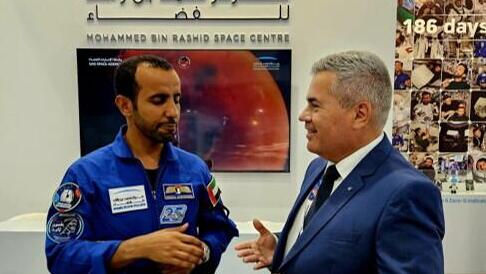
Emirati robot on the far side of the moon. At an exhibition in Dubai
Inbar emphasized that the UAE is deeply involved in high-level in-house development.
“Contrary to popular belief, they’re not just buying foreign systems and rebranding them. While they do purchase knowledge, which is standard globally, they also engage in sophisticated development,” Inbar said.
Under the UAE’s defense conglomerate EDGE, a dedicated space division has emerged, currently working on a series of radar observation satellites for security purposes. Inbar also highlighted MBZ-SAT, an advanced optical satellite named after the UAE president, which launched in January. He noted that its capabilities rival those of some Israeli-made systems. A UAE-built robot is also expected to land on the moon’s far side in 2026, aboard an American spacecraft.
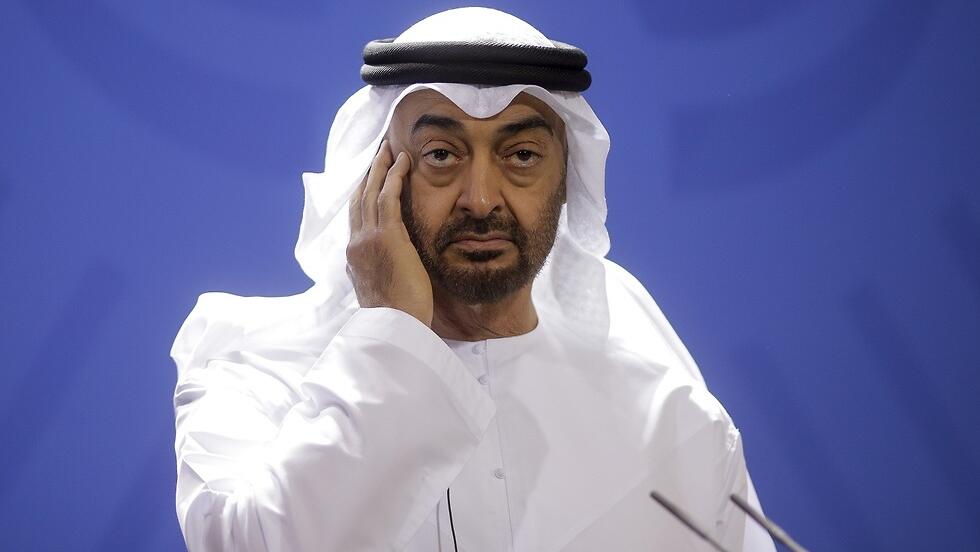
There is already a sattelite named for Mohammed bin Zayed
(Photo: AP)
Israel, for its part, signed a historic space cooperation agreement with the UAE in 2021, including MOUs on several joint projects.
Quiet space race in the Arab world
The UAE is not alone in its space ambitions. Neighboring Saudi Arabia has ramped up its space efforts in recent years.
“There’s a quiet space race in the Arab world between the Saudis and the Emiratis, and right now the Emiratis are clearly in the lead,” said Inbar.
Saudi Arabia’s space journey began in 1985 when Prince Sultan bin Salman Al Saud, an air force pilot, flew aboard NASA’s Space Shuttle Discovery — becoming the first Arab and Muslim in space. Recently, the kingdom established the Saudi Space Agency, evolving from its former Space Commission. It trained four astronauts — two women from scientific fields and two male air force pilots. In 2023, Rayyanah Barnawi and Ali Al-Qarni launched aboard a SpaceX mission for scientific research. The other two are expected to fly on a future mission.
Indian fighter jet crashes at Dubai air show
Saudi Arabia’s King Abdulaziz City for Science and Technology also houses a longstanding space center, which collaborated with NASA over two decades ago. Several new Saudi space startups have also emerged, focusing on satellite development and related technologies.
In Oman, the company Oman Lens is developing AI-powered observation satellites, with hardware supplied by China’s Star Vision. Oman has launched a project called “Itlaq” (“Launch” in Arabic), aimed at building a commercial spaceport open to global clients.
Egypt, meanwhile, is expanding its space infrastructure, largely built with Chinese support. It was the driving force behind the creation of the African Space Agency, now headquartered in Cairo. Egypt also established a “Space City,” housing its national space agency, the African agency, a space academy, and more.
Other Arab countries like Morocco and Jordan are also developing space programs, adding momentum to a growing Arab presence in the global space race.