

Hezbollah continued to violate the ceasefire Friday, attacking Israeli forces operating in southern Lebanon as well as northern Israeli communities. Around midday, an Israeli Air Force drone operating over Lebanon was shot down, while the military said a drone launched toward Israeli territory was intercepted before crossing the border. At about 3:15 p.m., alerts warning of a drone infiltration were activated in Kibbutz Yiftah in the Upper Galilee, but the military later said they were false alarms.
Overnight, U.S. President Donald Trump announced a three-week extension of the ceasefire, though Israeli authorities had yet to formally update the public. In practice, however, Hezbollah has not complied with the ceasefire and has rejected its terms. The Israeli Air Force carried out strikes in southern Lebanon at noon but refrained from expanding the scope of operations. Lebanese media reported three strikes in Deir Aames, which the Israeli military had previously ordered evacuated, as well as another strike in the Bint Jbeil area.
Footage: Israeli Air Force drone shot down over Lebanon


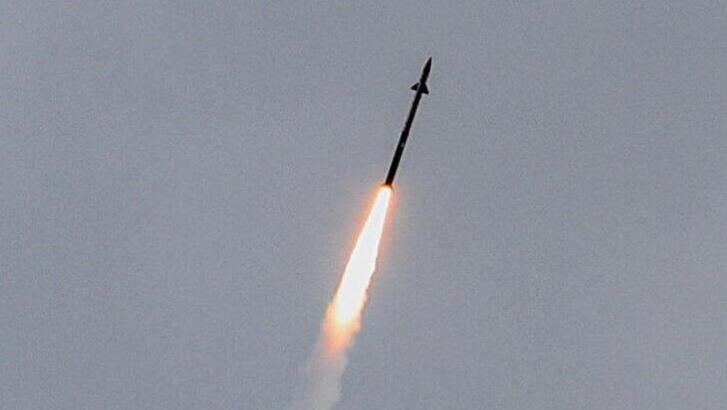
Iron Dome intercepts rocket fire in northern Israel following Hezbollah launches from Lebanon
(Photo: REUTERS/Tyrone Siu)
A review by ynet of Israeli military statements on its Telegram channel since Monday indicates at least 15 instances of ceasefire violations by Hezbollah operatives:
Monday
Armed operatives crossed the forward defense line twice.
Tuesday
Operatives crossed the forward defense line and approached Israeli forces in the al-Qusayr area before being killed.
Rockets were fired at Israeli forces in the Rab al-Thalathin area of southern Lebanon.
A drone launched from Lebanon was intercepted before entering Israeli territory; the military initially described it as a false identification before retracting that statement.
Wednesday
A drone was launched at Israeli forces in southern Lebanon.
A Radwan Force operative planning an attack was arrested south of the “Yellow Line.”
Thursday
An anti-tank missile was fired at Israeli forces in southern Lebanon.
A surface-to-air missile was fired at an Israeli Air Force aircraft.
An explosive drone was launched at Israeli forces in southern Lebanon.
A barrage of rockets was fired from Lebanon toward Shtula.
Today - Friday
Explosive drones were launched at Israeli forces in the Qantara area of southern Lebanon.
A surface-to-air missile was fired at an Israeli drone, bringing it down.
A drone launched toward Israeli territory was intercepted before crossing the border.
A “suspicious aerial target” was launched toward Israeli forces in southern Lebanon, and contact with it was lost.
The “Yellow Line,” it should be noted, was originally used to describe the line in Gaza to which Israeli forces withdrew in October 2025. The Israeli military has since adopted the term for its defensive line in Lebanon following Trump’s ceasefire announcement, in which he said Israel should not strike in Lebanon. Under the agreement, Israeli forces are permitted to remove immediate threats and operate along the Yellow Line. Hezbollah, for its part, is demanding that Israel withdraw from southern Lebanon and halt the demolition of structures, a demand that has not been met.
Promises and actions diverge
Since Lebanon joined the war alongside Iran, Defense Minister Israel Katz and Prime Minister Benjamin Netanyahu have pledged a decisive outcome in Lebanon and the disarmament of Hezbollah. Cabinet ministers, like the broader Israeli public, first learned of the ceasefire from Trump’s social media post, prompting anger. By the time of the extension announcement overnight, however, no public criticism was voiced over Israelis again hearing the news from Trump.
White House announcement: ceasefire in Lebanon extended
(Video: News Nation)
On March 2, after Hezbollah joined Iran in firing toward Israel, Katz said Hezbollah would pay a heavy price and declared that its secretary-general, Naim Qassem, who he said ordered the attack under Iranian pressure, was now a target for elimination. A day later, he said Netanyahu and he had authorized the military to advance and seize additional strategic positions in Lebanon to prevent attacks on Israeli border communities, adding that the group would continue to pay a heavy price.
On March 29, during a visit to the north, Netanyahu said thousands of Hezbollah operatives had been killed and the “massive threat of 150,000 rockets” had been destroyed, while acknowledging that work remained. He said Hezbollah still retained residual capabilities to launch rockets and that he had discussed with commanders ways to eliminate that threat. “I cannot share these discussions,” he said, “but we are determined to fundamentally change the situation in the north.”
Reducing the cost
Israel is awaiting developments in negotiations and talks between Israel and Lebanon led by Trump. Officials hope these efforts will achieve their objectives, including disarming Hezbollah, at a lower cost than a full-scale invasion of Lebanon and a prolonged war. Hezbollah, for its part, exploited the talks at the White House, while Israel refrained from a strong response to ceasefire violations during the discussions.
Trump said Thursday that Iran would have to stop funding Hezbollah in order to reach an agreement with the United States. Israeli officials believe it is prudent to allow time for the process to unfold as long as Trump remains supportive, viewing Iran as the central driver of events in Lebanon. “The alternative is not a picnic but the occupation of Lebanon, with all the costs that entails,” a senior Israeli official said. “For residents of the north as well, this is not a move that takes a week or even a month, and if a similar outcome can be achieved with less, it is certainly worthwhile.”