


Israel and Hamas have begun negotiations on the second phase of the 20-point peace plan proposed by U.S. President Donald Trump to end the war in Gaza, The Wall Street Journal reported Wednesday afternoon. The talks come as pressure mounts on Hamas to return the bodies of additional hostages.
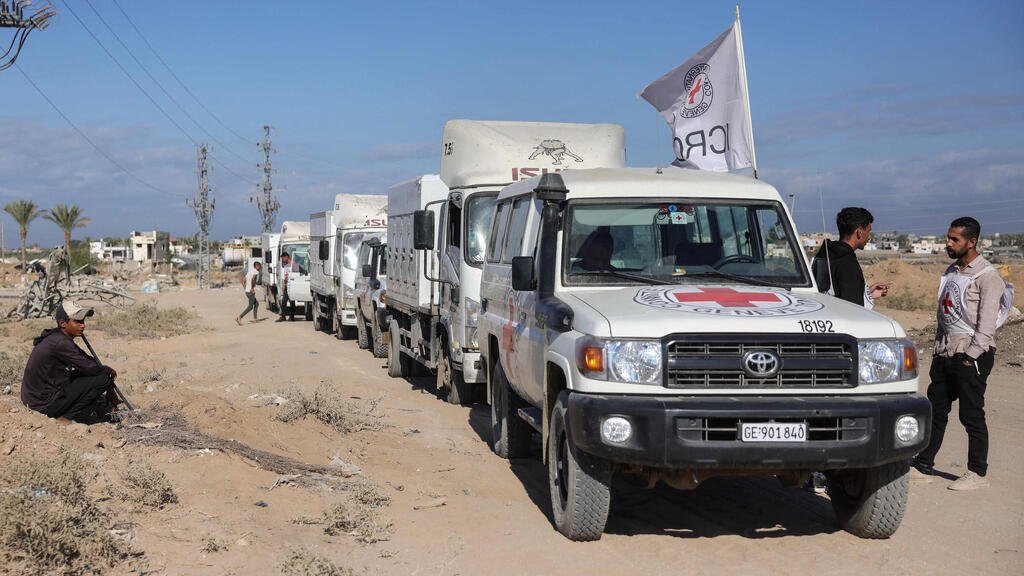
Near Deir al-Balah Gaza Red Cross vehicles wait to travel to Kissufim to receive Palestinian bodies being returned in the ceasefire deal
(Photo: Bashar Taleb / AFP)
According to the report, the first phase of Trump’s plan required Hamas to release all hostages, both living and deceased. The second phase addresses more sensitive issues, including postwar governance of Gaza, new security arrangements under Arab supervision, and the disarmament of Hamas.
Mediators are now discussing the deployment of an initial force of around 1,000 Palestinian police officers trained in Egypt and Jordan, who would help enforce security in Gaza. The Strip has recently seen fierce clashes between Hamas and local clans, including reports of massacres of Hamas opponents. Egyptian officials hope the force will eventually grow to 10,000, though Israel is expected to oppose any role for the Palestinian Authority in Gaza.
Implementation of plan remains complex and likely to take time
The Trump proposal also calls for the establishment of an international “stabilization force” under Arab leadership to oversee Hamas’ disarmament — by force if necessary — and to serve as a buffer between Israel and the terrorist group. However, many Arab governments are reportedly reluctant to be seen as occupiers in Gaza, making the formation of such a force politically sensitive.
Unresolved issues also remain around the Rafah crossing between Gaza and Egypt. According to the agreement, the crossing was to be reopened after phase one — but it remains shut on both sides. Israeli officials see the closure as leverage to pressure Hamas into returning the bodies of hostages believed to still be recoverable. At the same time, humanitarian aid continues to flow through the Kerem Shalom crossing, with up to 600 trucks permitted daily as stipulated in the agreement.
Despite Israel’s efforts to pressure Hamas, officials acknowledge the recovery of bodies is logistically difficult. So far, Hamas has returned seven deceased hostages; an eighth body turned out to be that of a Palestinian, likely due to an identification error. “Better they send bodies that turn out to be misidentified than wait for their confirmation, which could take much longer,” an Israeli official said.
In exchange for three deceased hostages, Israel has returned 45 Palestinian bodies. For now, it has refrained from sanctioning Hamas further, beyond delaying the reopening of Rafah.
Another transfer of deceased hostages is expected Wednesday, in line with the past two days. Israeli officials are awaiting confirmation from Hamas and hope the process continues without disruption. Meanwhile, a Turkish team has arrived in Gaza to assist in locating bodies, joining Egyptian teams already operating in the field based on coordinates provided by Israel.