

“The return of the hostages was our top mission at headquarters in Israel and at all Israeli missions around the world,” said Shuli Davidovich, coordinator for hostages and missing persons at the Foreign Ministry, on Wednesday. She led the diplomatic, public relations and awareness efforts on the issue.
The Foreign Ministry has for many years worked to elevate the issue of the return of hostages and missing persons on the international agenda and has supported all the families of the hostages taken on Oct. 7, she said.

“We worked on this day and night,” Davidovich said. “If one window closed, we looked for another. If one door closed, we looked for another initiative. We left no arena in the world where we did not bring the voices of the hostages and the diplomatic, moral and ethical demand for the return of all 255 hostages (including those taken during Operation Protective Edge in 2014 and the following year) home.
“Everyone was mobilized beyond measure. Every Israeli diplomat felt as if a hostage family was his own, and we are proud to say today that there are no more hostages in Gaza. The Foreign Ministry played an important and meaningful role both diplomatically and in terms of public awareness.”
Davidovich, who also serves as head of the Foreign Ministry’s Diaspora Division, noted the extensive activity of her office over the past two years and four months. “Everything we have done in the last two years and four months has been on a scale many times greater than in the past for obvious reasons. The work was carried out differently. The Foreign Ministry always had one of our coordinators as a second job. The Foreign Ministry had been invested in the mission of bringing all hostages and missing persons home since forever.”
“I was asked to take on this role in addition to my other duties more than three and a half years ago, also in light of accompanying the families,” she said. “The major public effort was in December 2022, when the Goldin, Shaul, Mengistu and Al‑Sayed families met with Pope Francis.”
'We acted on every continent'
On the dramatic shift after Oct. 7, Davidovich said: “There was a very broad range of activities in all our missions around the world, at the Foreign Ministry headquarters and with the foreign minister. There was ongoing, daily public, diplomatic and awareness‑raising activity. The Foreign Ministry led the diplomatic and awareness effort. Since Oct. 7 we truly operated on every continent. Together with the Defense Ministry, the hostages directorate and the IDF, we coordinated hundreds of family trips and dozens of delegations initiated by the Foreign Ministry.
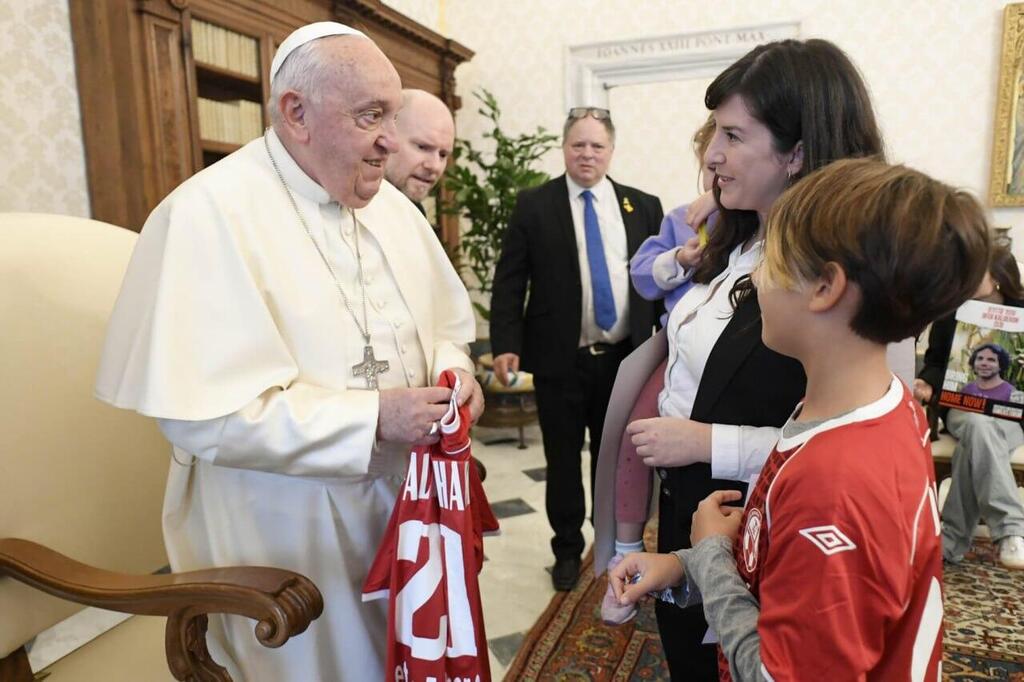
Families of hostages meet with Pope Francis in the Vatican
(Photo: Foreign Ministry)
“We brought families and their firsthand accounts to the most significant arenas in the world. We convened special meetings at the Security Council, brought family representatives as speakers to the Human Rights Council, the Munich Security Conference and meetings at the opening of the UN General Assembly. In November 2023, we brought a second delegation of hostage families to meet the Pope. There was almost no place in the world that the families didn’t reach and where they were not supported and accompanied by our missions.”
Nearly 30 countries were in direct contact with the Foreign Ministry in Jerusalem, given that their citizens were among the 255 hostages. The Foreign Ministry served as the coordinator for all foreign embassies in Israel. “We worked together as a coalition of countries, and that shared message was super important,” Davidovich said.
The ministry also established a dedicated media operations center for relatives of hostages called “Gesher” (Bridge), through which special press conferences were organized for the families and countless interviews with foreign media were arranged. The Foreign Ministry also organized a special exhibition for foreign diplomatic staff showcasing the shirts of all the hostages. Additionally, two gatherings of the Women in Diplomacy Network were held with hostage families, attended by all foreign women diplomats serving in Israel alongside local diplomats.
“We made sure that in every international statement, such as European Union conclusions or UN decisions, there was a clear linkage between a ceasefire and the release of all hostages — the living and the fallen,” Davidovich said. “The mission of bringing home the fallen hostages was a special and important task, an ethical mission carrying the message that it is a religious obligation, and in that regard, we worked to engage religious leadership, both Christian and Muslim, around the world.”
She added: “The previous Pope was a dominant figure in doing this. He met twice with hostage families since Oct. 7. We always made sure in all delegations to tell the full story of all the hostages, speaking about the living and the fallen, the young fathers, the elderly, the women, the children. Of course, we also highlighted in the Foreign Ministry and our missions in ‘orange’ to raise awareness for the return of Shiri, Kfir and Ariel Bibas, who unfortunately did not return alive. Our missions worked with Jewish and Christian communities that support Israel to hold mass rallies around the world, and we reached Japan, China, Hong Kong and South America.”
'Around-the-clock digital work'
The Foreign Ministry also arranged a special flight bringing all hostage families to a special session of the UN Security Council chaired by the UN undersecretary‑general on sexual violence in conflict zones.
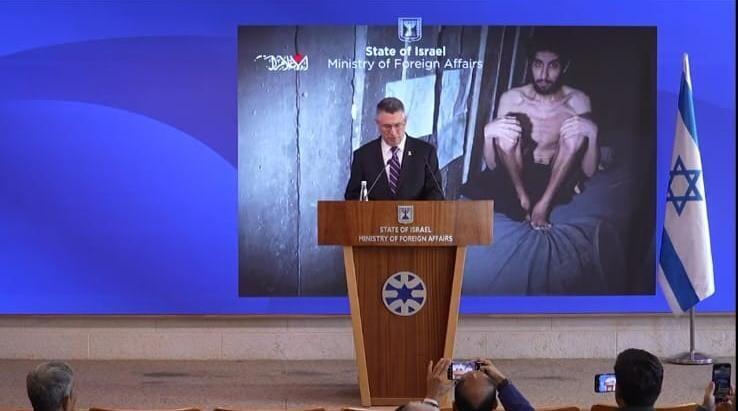
Foreign Minister Gideon Sa'ar speaking with an image of an emaciated Evyatar David in Hamas captivity behind him
(Photo: Foreign Ministry)
“We brought testimony to the Security Council," according to the coordinator. "Foreign Minister [Gideon] Sa'ar, in a special Security Council session, presented the harrowing story of the torture and starvation of Evyatar David and Rom Braslavski. We brought Eli Sharabi and Ilana Gritzewsky to the Security Council. We projected images of the hostages in Times Square in New York. There was round‑the‑clock digital work.”
Most of the foreign nationals among the hostages came from Thailand, the Philippines and Tanzania. “The consular division worked closely with ambassadors and consuls in those countries to provide close support to the families of the foreign hostages,” Davidovich said.
“Our ambassadors and consuls received those who returned to their countries, took part in state ceremonies and continue to stay in contact. For us, they are all flesh of our flesh — brothers in tragedy, in life and in the painful ending — and we worked closely with all foreign ministries and all other relevant authorities in the countries involved.”
In addition, the Foreign Ministry initiated and organized meetings for the families with senior officials from a range of international organizations. “We held side events, mainly in Geneva, home to the Human Rights Council,” Davidovich said. “It was important to make present all the torture, the injustices, the suffering and the gravest human rights violations committed against the hostages. Every senior official who came to Israel as a guest of the Foreign Ministry met with hostage families as a matter of protocol.
“There was almost no guest who did not meet them — it was an obligation and a mission. We brought the families, the stories and the testimony to all the major forums in the world. At our initiative, families came to give testimony at the Security Council, the General Assembly, the Human Rights Council, the European Union, the European Parliament, Davos and more. There was no arena, no discussion, in which the issue of the hostages and the demand on all countries for their return did not come up. Our message was that while it began in Israel, it could reach other places in the world as well.”
Davidovich noted that while there was strong international attention to the hostage families at first, as the war dragged on, the international community moved on to other issues. “Not everyone wanted to hear,” she said. “Very quickly, the world moved on, and the task of all Foreign Ministry employees in Israel and abroad was not simple. We did not relent, and we made sure there was no decision, statement or speech by foreign ministers or other senior officials in which the issue of the hostages was not mentioned, and that there was an unconditional demand for the release of all the hostages as a condition for moving to the next stage.”
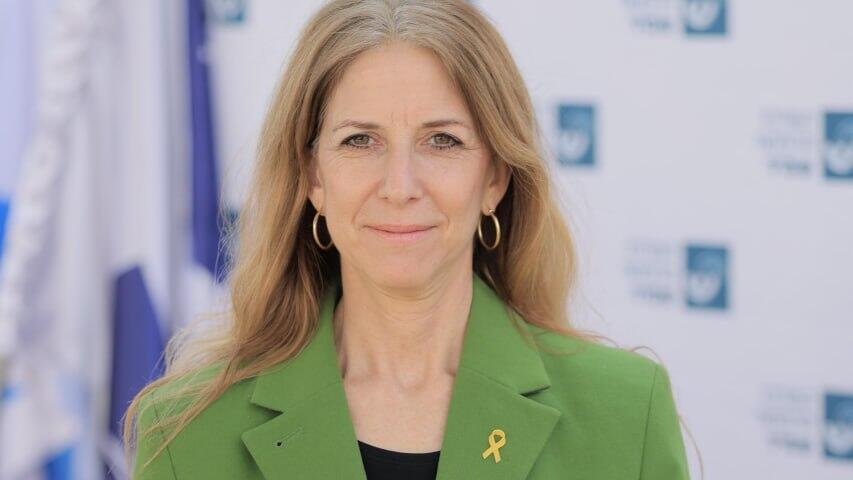
Shuli Davidovich
(Photo: Foreign Ministry)
She added that pressure was also applied to the mediators “through diplomatic tools and other means.” “We reached all kinds of actors, and it was part of the broader effort. Our uniqueness was identifying diplomatic and other figures through whom messages and requests could be conveyed, both via humanitarian organizations and on the political level. At a certain point, foreign media outlets said, ‘You’ve already approached us,’ and international actors said, ‘We’ve already heard, we know and we’re acting,’ but negative answers were not an option for us. Again and again, we brought delegations even to those same central countries, not only once.”
Davidovich recalled how one Western foreign minister who visited the ministry in Jerusalem said after meeting hostage families: “The issue of the hostages is always on my agenda, but when I meet a family and know that I’m traveling to one of the mediator countries, it sharpens my request even more. I planned to raise it anyway, but it adds another layer of commitment.”
In conclusion, the Foreign Ministry’s coordinator for hostages and missing persons said: “Our goal was to keep the hostage issue on the international agenda and to create diplomatic and awareness‑based leverage for their return. The foreign minister worked with his counterparts to preserve the linkage between a cease‑fire and the release of the hostages.”