


About 900 meters off the coast of Nahariya and roughly 10 meters beneath the Mediterranean, the first official memorial ceremony was held Thursday for seven crew members who died 115 years ago in the sinking of a British merchant ship.
Thomas Phipps, Britain’s deputy ambassador to Israel, took part in the ceremony representing the sailors’ home country, alongside members of the Putsker diving club in Gesher Haziv and underwater photographer Amir Weizman of AQUAZOOM.
Thomas Phipps, Britain’s deputy ambassador to Israel
(Video: Yair Kraus)


For decades, Israeli divers and fishermen believed the striking underwater site, where the remains of an iron steamship lie off Nahariya, belonged to an old Turkish vessel that had gone out of service sometime in the last century.
A chance archival discovery, first reported by ynet last year, changed that story entirely.
Marine archaeologist Prof. Ehud “Udi” Galili and Weizman had been researching another vessel that sank off Haifa when they came across documents relating to the trial of the captain of an English ship carrying coal from Britain to the Land of Israel.
The records showed that the wreck off Nahariya was not Turkish at all. It was the Ardo, a British coal ship that ran aground on a kurkar reef during a storm in December 1911.
Seven sailors died in the disaster.
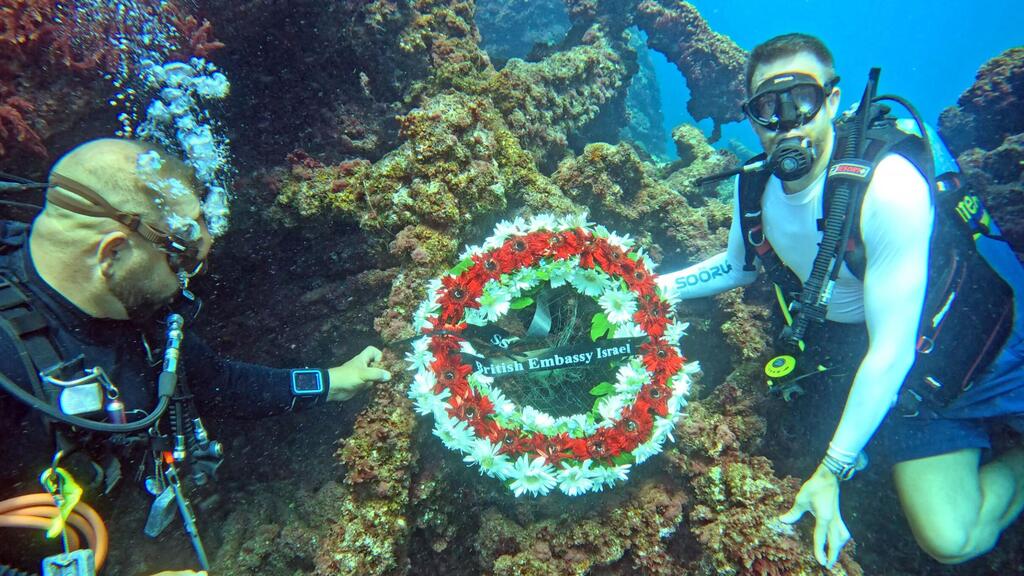
“We are here today not only to remember the ship, but also to remember the people who sailed on it,” Phipps told ynet.
“I think one of the amazing things is that memories which had been forgotten are now resurfacing, and we have the opportunity to pay tribute to our heritage,” he said.
Phipps added that he was proud, on behalf of the British Embassy, to honor men who had been forgotten for so long.
“Thanks to the hard work of local divers, historians and researchers, they are now remembered,” he said, thanking AQUAZOOM for making the memorial possible.
The Ardo was built in Glasgow in 1894 and departed Newport, England, bound for Haifa with about 10,000 tons of coal and a crew of 22.
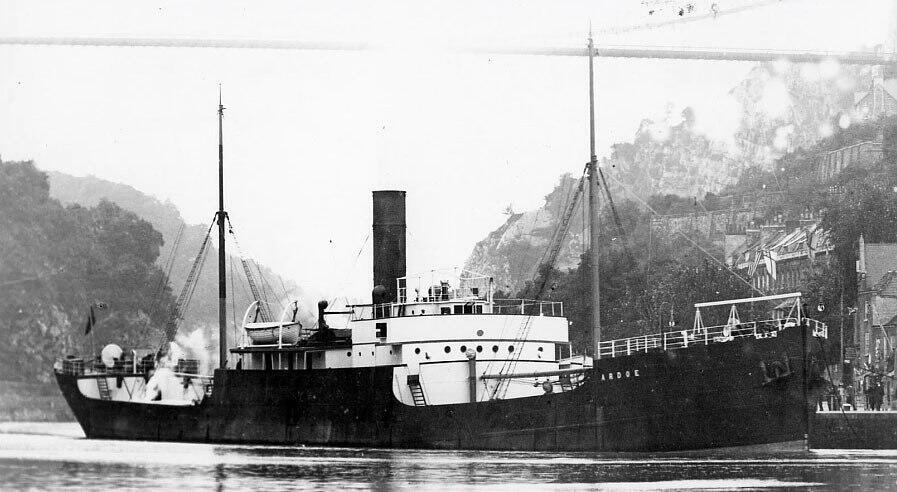
The Ardo
(Photo: Citizen ProMaster)
On the night of December 27, 1911, the captain made a navigational error and mistook the lights of the village of al-Zib, today Achziv, for those of Haifa Port. The steamship struck the offshore reef.
During efforts to abandon the vessel, one of the lifeboats overturned in heavy surf, and seven sailors drowned.
For decades, parts of the metal hull remained visible above the waterline. In the 1960s, the Israeli Navy blew up sections of the wreck to prevent it from interfering with maritime traffic.
Weizman said the renewed interest in the wreck followed ynet’s report last year.
“After the publication, we contacted the British Embassy in Israel and invited them to hold a memorial ceremony for the seven sailors who died about a century ago,” he said.
“The deputy ambassador took up the invitation and came to dive with us today, together with the Putsker club at Kibbutz Gesher Haziv.”
Weizman said he had been diving at the site, commonly known as “the Turkish ship,” for more than eight years.
“I’m glad we managed to shed light on its true story,” he said. “It will take some time before divers in Israel adopt the new name, but I assume that over time it will take root in the diving community.”
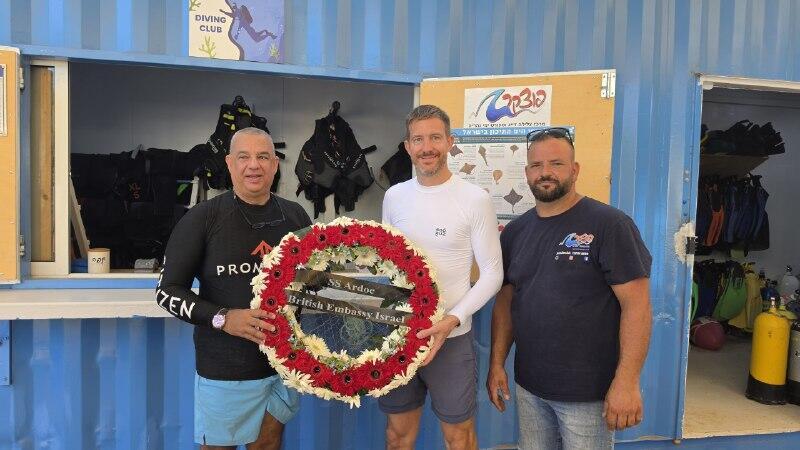
Amir Weizman, Deputy Ambassador Thomas Phipps and Putsker Diving Club member Yosef Khamaisi with the wreath before the dive
Phipps, Weizman and members of the diving club descended to the wreck carrying a floral memorial wreath, which they placed on the rusting boilers of the steamship.
After returning to the boat, Phipps described the dive as “a fantastic experience.”
“It was amazing to see the remains of the ship lying there on the seabed for more than a century,” he said. “I’m very glad I had the opportunity to commemorate the lives of the seven British merchant seamen who lost their lives there so long ago.”
“We laid a beautiful wreath on the remains of the ship, and I hope their memory will continue to be honored.”
For divers in the Western Galilee, Thursday’s ceremony may not be the final chapter.
“We are trying to make contact with and locate the families of the sailors who died here,” Weizman said. “Perhaps in the future we can bring them here for another, larger and more impressive ceremony together with their relatives.”