


Roughly 12 hours after the launch of Operation Roaring Lion, officials said the central story was how Israel managed to surprise Iran for the second time in less than a year — despite months of public discussion about the possibility of war.
Officials described the achievement as a tactical surprise rather than a strategic one, but said it fundamentally shaped the opening phase of the campaign.
IDF strikes in Iran
(Photo: IDF)


According to security officials, the surprise was the result of months of intensive intelligence work aimed at mapping patterns of activity among Iran’s senior leadership, identifying routine gatherings and determining when key officials would be least prepared for an attack.
Military intelligence and the Mossad assessed that Iran was expecting a strike overnight. Instead, the operation began in the morning, a decision officials said created an unexpected window of vulnerability.
The effort required real-time intelligence to pinpoint locations and senior figures, with the goal of eliminating as many high-value targets as possible in the opening blow. Officials said the window for such action narrows significantly after the first strike, as leadership disperses and security tightens.
The political leadership was closely involved in what officials described as a broader deception campaign. The security Cabinet approved Operation Roaring Lion early Saturday morning, after ministers had received updates in recent days about the possibility of a preemptive strike.
Senior Cabinet members were summoned to the military command bunker Saturday morning, where they managed the operation as it unfolded.
A security official said the decision to strike in the morning was driven by operational considerations and by the goal of confusing Iranian decision-makers. “All the conduct in recent weeks was designed to mislead them. Everything was planned in advance,” the official said.
As part of the deception effort, ministers and senior government officials who were briefed under strict secrecy agreements were instructed not to make concrete preparations that could signal an imminent operation — including avoiding unusual logistical steps such as purchasing food for emergency command centers ahead of the weekend.
Some officials reportedly made routine purchases only after the operation had already begun. In the days leading up to the strike, officials who were asked about the timing said it would not happen Friday — which proved accurate, as the operation began Saturday morning.
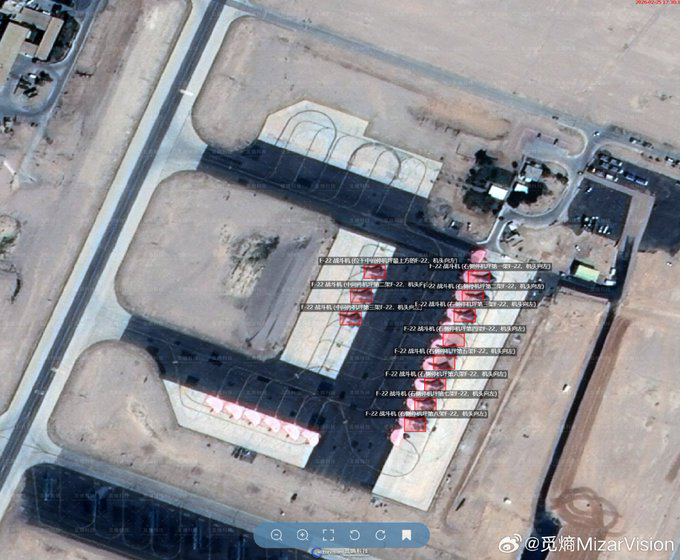
US F-22s in Israel
(Photo: MizarVision, מתוך X)
Shortly before the attack, the Chinese satellite company MizarVision, which has published imagery of U.S. force buildups in the Middle East, reported that American fighter jets in the region were “all in position” and that there were no signs of large-scale activity. The company also suggested that any Israeli preemptive strike would likely be carried out independently.
Both assessments appeared to be incorrect after it became clear the campaign was a coordinated Israeli-U.S. operation.
Prime Minister Benjamin Netanyahu, like U.S. President Donald Trump, released a prerecorded video message shortly after the operation began, including a call to the Iranian people to rise up. After the campaign was underway, Netanyahu spoke with Trump. The Prime Minister’s Office released a photograph of the conversation showing Netanyahu in the command bunker, seated beside a large map of the Middle East.
In the opening hours of the war, about 200 fighter jets struck roughly 500 targets. Officials said that since the start of the campaign, Israel and the United States have used more than 2,000 munitions.
The primary mission, officials said, is to hunt missile launchers in order to degrade Iran’s ability to fire ballistic missiles, cruise missiles and drones toward Israel.
Despite the intensity of the opening strike, officials cautioned that it is too early to speak of a collapse in Iran’s command structure. They described the Iranian leadership as experienced and warned that the coming days would reveal how it adapts after the initial shock.
Initial retaliatory responses were already visible shortly after the opening blow, with air raid sirens sounding repeatedly across Israel.