


U.S. President Donald Trump has escalated his threats toward Iran over the past day while at the same time inviting Tehran back to the negotiating table, but Prime Minister Benjamin Netanyahu remains uncertain about what Trump will ultimately decide and has so far remained in a holding pattern, issuing his own clear warnings toward the clerical regime. Some observers even suggest Trump may be deliberately drawing Iran into a trap similar to last June’s 12-day war.
It appears Trump himself has not yet made a final decision on how to handle Iran. Meanwhile, several countries — including Turkey, Qatar, Saudi Arabia, Oman and Egypt — are working behind the scenes to mediate between Washington and Tehran.
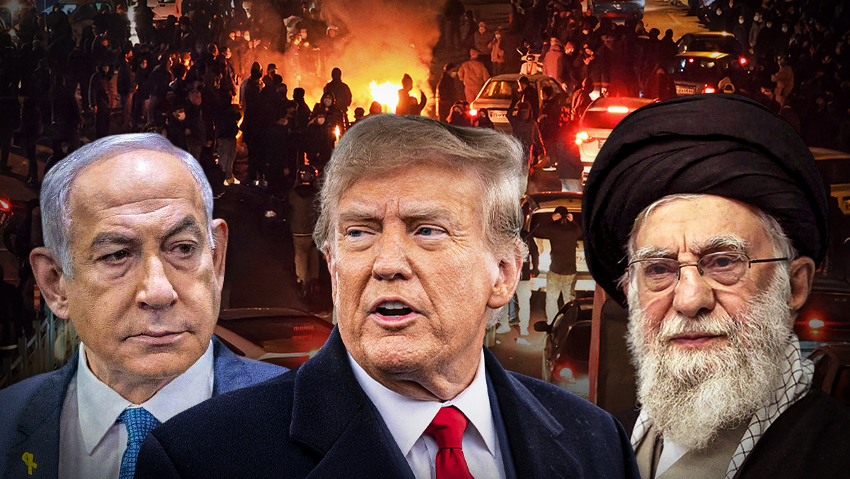
(Photo: Chaim Goldberg/Flash90, Lev Radin/Shutterstock, AP, Anonymous/Getty Images)
Washington is offering Tehran a deal that would include abandoning its nuclear program, including giving up uranium enrichment and transferring its stockpile to a third country, scaling back its ballistic missile program, possibly limiting missile ranges so they cannot reach Israel, and ending its campaign of terror and support for proxy groups such as Hezbollah, the Houthis, Hamas and Shiite militias in Iraq.
Senior Israeli officials and Iran experts say there is a chance Supreme Leader Ayatollah Ali Khamenei could agree to compromise and flexibility on the nuclear issue, but they regard the likelihood that he would accept demands on ballistic missiles and the terror campaign as negligible. Iran has previously opposed entering negotiations on ballistic missiles and support for terrorist groups — issues the Islamic Republic considers non-negotiable.
That raises the question of how determined Trump really is to insist on those demands, and whether this is merely a negotiation tactic that could ultimately see the U.S. president focus solely on the nuclear issue and abandon other contentious points. In any case, it appears the region may be entering a prolonged period of uncertainty, during which Trump and Iran will trade mutual threats while continuing direct and indirect negotiations — both covert and public.
It also seems that Trump himself has no clear sense of direction, other than the need for a quick and decisive achievement to defuse the situation he has created. That outcome does not necessarily have to be within Iran itself, since few believe his rhetoric is truly driven by concern for the Iranian people. His promises to protesters that “help is on its way” have so far failed to materialize.
Even in the case of Venezuela, it took U.S. forces months to build up military capabilities while simultaneously negotiating with Nicolás Maduro until he was arrested. In the current case, it’s unclear whether the Americans could carry out a similar strategy with Khamenei. Most experts say that eliminating the supreme leader would not bring down the clerical regime — at most it would cause change, but not necessarily for the better. Perhaps behind the scenes the Americans are looking for a senior figure within the Tehran leadership who might act in line with their objectives.
Recently, U.S. intelligence reportedly told Trump that the Iranian regime is far more unstable than commonly perceived. That could tempt Trump toward a strike or even an attempt to eliminate Khamenei. On the other hand, Trump is expected to be wary of deeper entanglement, especially as his domestic political standing ahead of the midterms is weak. All of this could easily lead to a prolonging of negotiations.
Attempt to avoid miscalculation
While Netanyahu has no clear information on what Trump will do next regarding Iran, he remains in a waiting position and has issued his own clear warnings to the clerical regime, saying that if Iran dares to attack Israel, the response from the IDF would be far stronger than the regime imagines. Netanyahu’s remarks may also be intended to signal to Tehran that Israel does not intend to initiate an attack, in an effort to avoid miscalculation.
Some believe Trump is deliberately trying to lure Tehran into a trap similar to the short war last year that began with an Israeli surprise attack. In this view, Trump is setting a threshold the Iranian regime cannot meet, and then ordering a military strike. It is entirely possible there will be a “replay” and that Trump will ultimately act militarily. As Netanyahu has said, Israel is preparing for all scenarios.
Trump: 'A massive Armada is heading to Iran'


“A massive Armada is heading to Iran,” the U.S. president wrote in a threatening post aimed at Tehran, while reiterating his demand that Iran quickly come to the table to negotiate a new agreement on its nuclear program. Trump added of the naval fleet deployment: “It is moving quickly, with great power, enthusiasm, and purpos.”
Trump also wrote: “Hopefully Iran will quickly 'Come to the Table' and negotiate a fair and equitable deal - NO NUCLEAR WEAPONS - one that is good for all parties. Time is running out, it is truly of the essence! As I told Iran once before, MAKE A DEAL! They didn’t, and there was 'Operation Midnight Hammer,' a major destruction of Iran. The next attack will be far worse! Don’t make that happen again.”
Tehran has responded with its own threats. Iran’s mission to the United Nations said that “the last time the U.S. became entangled in wars in Afghanistan and Iraq, it spent more than $7 trillion and lost more than 7,000 Americans. Iran is ready for dialogue based on respect and mutual interests — but if pushed into a corner, it will defend itself and respond in an unprecedented way!”
Iranian Foreign Minister Abbas Araghchi, who has been in contact with his counterparts in Saudi Arabia, Turkey, Egypt and Qatar, said there has been “no contact between me and special envoy Steve Witkoff in recent days. No request for substantive negotiations has been presented to us. Various mediators are in touch and different countries are trying to work on the issue, especially those with whom we are in contact, but so far no decision has been made, and no request has been submitted from our side.”