

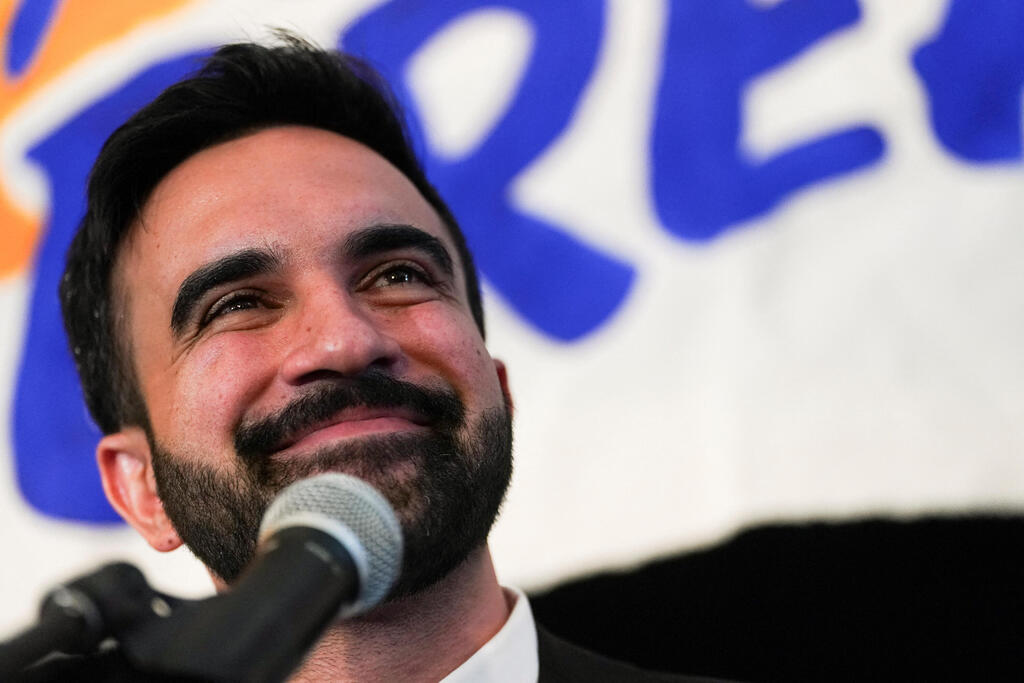
It was past midnight when Zohran Mamdani stood smiling and excited on the victory stage in Long Island City, alongside the woman who may become the first openly pro-Palestinian First Lady in New York City’s history. Unlike her 33-year-old Ugandan-born husband—an articulate speaker with a hip-hop background—27-year-old Rama Dawaji is less accustomed to the spotlight, but no less an activist.
The Syrian-American artist, born in Texas, is known for her provocative imagery: women in burqas buried under rubble, pro-Palestinian protesters in keffiyehs trampled by police, animated videos in support of Palestinian activist Mahmoud Khalil, and Palestinian children depicted in scenes of “ethnic cleansing.” Her work has been showcased at Tate Modern in London, featured in The Washington Post, The New Yorker, and broadcast on the BBC.
Even when Mamdani, as a state assemblyman, promoted the “Not On Our Dime” bill—intended to block U.S. charities from funding Israeli settlements or IDF units accused of human rights violations—he posted one of his wife’s animated videos to Instagram. According to Dawaji, New York-based charities send over $60 million annually to fund “Israeli war crimes,” and by granting them nonprofit status, the city effectively legitimizes “illegal settlement expansion” and “state violence against Palestinians.” It was the first of many public collaborations between the couple.
Mamdani and Dawaji met on the dating app Hinge, bonding over socialism, human rights, and their mutual love for fringe theater. Before entering politics, Mamdani led a political theater troupe in Washington Heights, taking part in productions focused on the experiences of immigrants, refugees, and marginalized groups. The couple held their wedding this past winter in Dubai in a private but lavish ceremony overlooking the Burj Khalifa.
Many are stunned that in 2025, in New York—the city that hosts AIPAC headquarters, delegations from Jewish institutions around the world, the largest Israeli consulate, and the biggest Jewish population outside Israel—this couple is likely to become the next mayor and First Lady. If Mamdani, who just won the Democratic primary, triumphs in the general election this November, he’ll not only become the city’s first Muslim mayor, but also the first declared anti-Zionist, a proud BDS supporter, a vocal critic of the tradition of New York mayors visiting Israel, and someone who has stated—twice—that he would order the arrest of Benjamin Netanyahu should he enter the city while an ICC warrant is in effect. He also supported calls to “globalize the Intifada.”
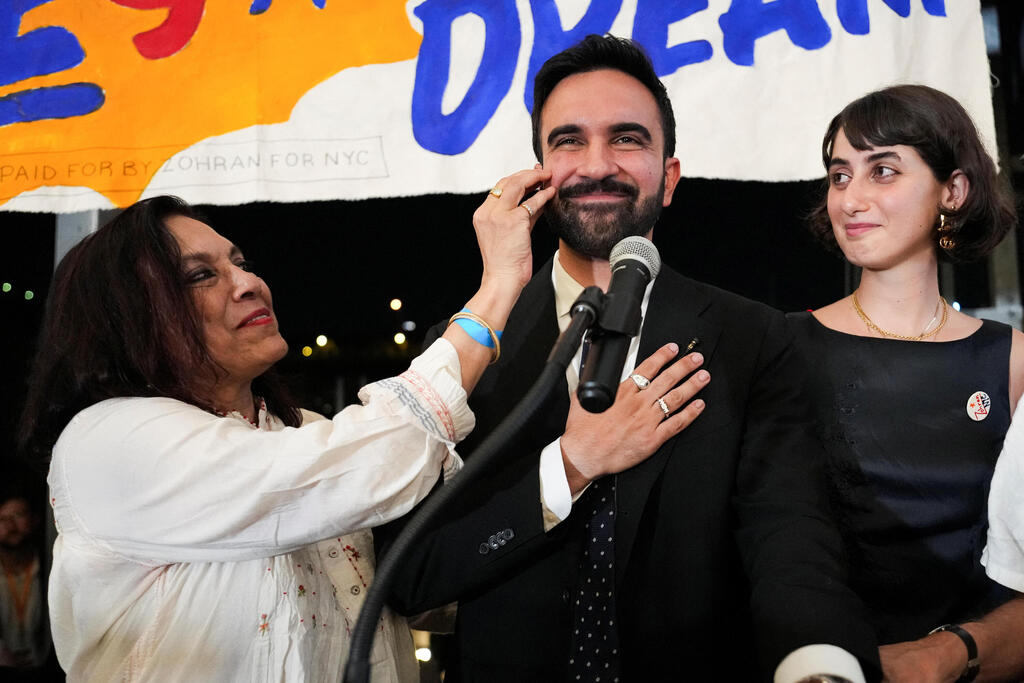
After winning the primaries
(Photo: REUTERS/David 'Dee' Delgado)
Yet despite this, Mamdani is estimated to have secured about 20% of the Jewish vote, received endorsements from leading Jewish legislators Chuck Schumer and Jerry Nadler, and benefited from the support of Jewish candidate Brad Lander, who campaigned jointly with him and urged voters to back either of them instead of Mamdani’s main rival, former Governor Andrew Cuomo.
Mamdani made efforts to counter the antisemitic image projected in negative campaigns against him, offering a detailed plan to combat antisemitism—including an 800% funding increase for anti-hate programs and the creation of a new department for community safety. He met with Hasidic groups in Williamsburg, gave interviews to Yiddish-language newspapers, spoke about Holocaust remembrance, and largely focused his campaign on housing, free public transit, and expanding daycare access, rather than on Middle East policy.
“A lot of wealthy interest groups tried to paint him as a Muslim man who hates Jews,” said Sophie Ellman-Golan, spokeswoman for the group Jews for Racial and Economic Justice (JFREJ), which supports Mamdani. “But that image doesn’t reflect who Zohran really is.”
Two days after the Democratic primary, it’s clear the massive attack campaign—costing tens of millions of dollars—failed. And although some tried to frame the election as a referendum on Israel and the Jews, that wasn’t the case. The election was about a city struggling with identity in a post-pandemic era: the cost of living, rent, the erosion of the middle and working classes, disillusionment with establishment politics, and, most of all, a desire for change. To many young people across the city—even Jews—Mamdani represented that hunger for something different.
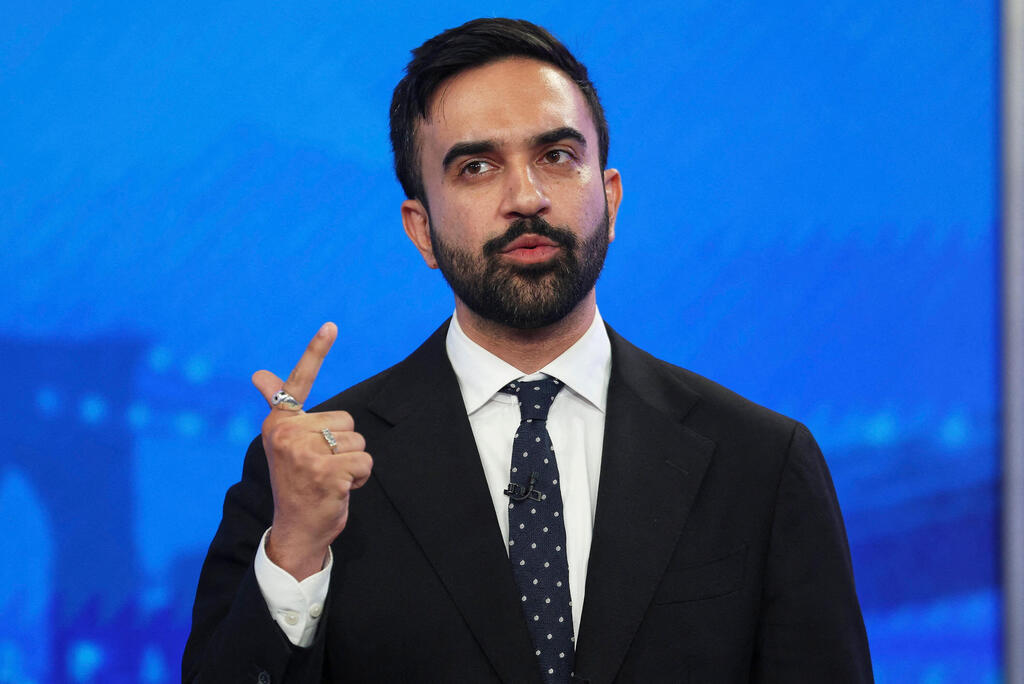
Zohran Mamdani
(Photo: Yuki Iwamura / POOL / AFP)
“You don’t have to agree with him to feel like he’s telling the truth,” said Jeremy, a Reform Jew from Harlem who voted for Mamdani. “My problem with the establishment is that it only calls out antisemitism when it’s politically convenient. If you support Israel, you're okay. If you support human rights, you’re dangerous. Mamdani doesn’t hate me—he hates hypocrisy.”
Others noted the blatant bias against him due to his background. “It’s not that they feared him because he was inciting,” said Yael, an Israeli doctoral student from Brooklyn. “They feared him because he’s a Muslim with power. That’s the whole story. In reality, I’ll feel safer as a Jewish New Yorker under a Mamdani administration.”
Even former New York mayor Bill de Blasio defended Mamdani: “I reviewed what he said carefully—and found no sign of antisemitism. I never heard him express hatred toward Jews or any other group.” De Blasio, who served two terms and maintained close ties with the Orthodox community, added that Mamdani has the temperament and values needed for meaningful dialogue. “The community cares about affordable housing, public housing vouchers, childcare subsidies, good schools, and personal safety—that’s where a mayor can actually make a difference. We don’t set U.S. foreign policy here. The mayor’s job is to care for daily life—and I believe Mamdani understands that.”
The threat of a “municipal boycott” on Israel
Among parts of the Democratic Party and within segments of the Jewish—especially Israeli—community in New York, deep concern remains. What happens if Mamdani is asked to deploy police to secure an Israeli cultural event? When his proposed department must decide who is attacker and who is victim? When pro-Palestinian activists demand the cancellation of agreements with Israeli institutions or with U.S. charities that run exchange programs?
Mamdani campaign HQ celebrating primary results


Mamdani has stated that he won’t interfere with the free speech of city residents, but his support for BDS principles sets a precedent: this is the first time a candidate for mayor of the largest city in the U.S. has openly expressed an intent to cut ties with Israeli entities for ideological reasons. His support for a “municipal boycott” of Israel—though vaguely defined—has alarmed the city’s traditional Jewish establishment, which sees it as a slippery slope. It could potentially result not just in symbolic gestures but in the denial of city contracts, halting of funding to joint ventures with Israeli or Jewish institutions, restrictions on public facility use, and the cancellation of delegations to Israel.
Since 2016, New York State law has prohibited public funding or contracts with entities supporting boycotts of Israel, which limits what a mayor could legally do, even if inclined to push a local boycott.
Mamdani’s critics point out that he has already publicly opposed city-funded student delegations to Israel, calling them discriminatory against Muslim and Palestinian students. He consistently avoids using the word “terror” in reference to attacks against Israel, even when asked directly. He has also refused to back legislative initiatives recognizing Israel’s independence, commemorating Holocaust Remembrance Day, or adopting the IHRA definition of antisemitism, which classifies some forms of anti-Zionism as antisemitism.
The Jewish Community Relations Council of New York (JCRC-NY) has publicly opposed Mamdani, saying his views “deny the legitimacy of Jewish ties to Israel.” They and other critics cite his sponsorship of the “Not On Our Dime” bill, which, though shelved, he has pledged to reintroduce. As mayor, he could pursue similar actions on a city level—such as cutting budgets for groups that transfer funds to activities beyond the Green Line.
To illustrate the potential impact: each year, New York sends between $200 million and $500 million in philanthropic donations to Israel. That figure demonstrates how a legislative move, even symbolic at first, could evolve into genuine pressure. Mamdani has claimed the intent is to enforce human rights standards, not to target Jews. Throughout his campaign, he repeatedly condemned antisemitism and affirmed Israel’s right to exist—“provided it is a state with equal rights for all its citizens.”
When protests rise again at Columbia, or when Netanyahu lands at the UN
“He can say he’s only against the occupation, but when you start applying selective sanctions—you open the door to a campaign of delegitimization,” said a former senior official at the UJA Federation. The American Jewish Committee (AJC) released a formal statement warning: “Many New York Jews fear—with good reason—the dramatic rise in antisemitism and the real threats to their daily safety. The next mayor must take these concerns seriously and must not contribute to an environment that tolerates or fosters antisemitism. We will continue to confront any words or actions from candidates or officials that undermine that responsibility.”

What will a mayor Mamdani do about pro-Israeli demonstrations in NY?
(Photo: Liri Agami)
Still, assuming Mamdani is totally disconnected from the Jewish community ignores the complexity of the situation and the facts on the ground. His messages—focused on social justice, accessibility, and equality—have resonated even with Jewish voters. Statistically, his landslide win would not have been possible without the support of hundreds of thousands of white, secular, educated, and affluent voters from Manhattan and Brooklyn. He’s maintained steady relations with Hasidic communities in the city and promised to protect their educational institutions from regulations that have long accused yeshivas of neglecting core curriculum standards.
“I will work to defend your way of life from anyone who tries to interfere with it,” Mamdani told rabbis from the Satmar community. Unlike Christian communities, which often vote based on fixed ideological principles, Haredi politics in New York tends to be pragmatic and driven by local needs. In the past, they’ve backed candidates across the political spectrum—as long as their community interests are protected.
Mamdani may talk about intifada, but more often—and more urgently—he talks about rent. The American Jewish discourse is shifting. Polls show that among millennials and Gen Z Jews, Israel is no longer seen as a vulnerable state, but as a regional power—sometimes coercive, even occupying. The lines between anti-Zionism and antisemitism are blurring, and fears of being seen as pro-Palestinian are being replaced by fears of appearing racist. Mamdani’s campaign—perhaps more than any before it—managed to straddle all fronts: criticizing Israel without attacking Jews, promoting public safety without adopting the IHRA definition, and convincing voters that even if he’s not moderate, “at least he’s not a hypocrite.”
Get the Ynetnews app on your smartphone: Google Play: https://bit.ly/4eJ37pE | Apple App Store: https://bit.ly/3ZL7iNv
In the meantime, Mamdani is celebrating—kissing Dawaji’s hand before a cheering crowd, laughing with Brad Lander like high school buddies, and fielding calls from former presidents. One of them, Bill Clinton, even sent a warm congratulatory message, shared on Mamdani’s feed. Clinton, who had tried (unsuccessfully) to rally Jewish voters behind Mamdani’s opponent Andrew Cuomo, decided to embrace the new political tide. “It’s inspiring to see New York’s next generation setting the pace,” he wrote.
The question now is: what kind of pace will that be? “Imagine six months from now, when student tents go up again at Columbia, or when Netanyahu arrives for a UN debate,” says Rabbi Marc Schneier, one of Mamdani’s outspoken opponents. “What will the mayor of New York do? Where will he stand? With whom? This isn’t just about sentiment anymore—it’s about policy. If he wins, the whole world will be watching and taking notes.”